Some who Fought and Returned

In 1936 Freddie Midgley (left) joined the RAF. He trained as an aircraft engineer. He escaped from Dunkirk to England by lying flat on his back in the bottom of a small French boat.
See Books Freddie Midgley’s war experiences and life story
“When we arrived (at Dunkirk) we found the rest of our unit already there and were able to rejoin them. We burnt the lorry and managed to obtain some food.
The next day dense black smoke and clouds of sea mist covered the town. That didn’t stop the German planes from constantly dropping bombs and spraying machine gun bullets over the harbour. Fortunately, they couldn’t see us and, of course, we could not see them but we could hear them and the noise was deafening. All day long we hid under some trees. Later, in the night, the Wing Commander got us together to tell us that he had obtained a small boat and it was to take us home the following night. How he managed to arrange this we never knew. However, on the 30 May 1940, we got down to the harbour and what a sight! Bomb craters, bodies and burnt out vehicles everywhere! We found this very small boat in a small boathouse and our little party clambered aboard. I dropped to the floor and knew nothing more until the following morning when I heard Pop’s voice saying, “Come on son, wake up, we’re home.” (Courtesy Neil Midgley, son)
He was then posted to Africa. It was during his time in the forces that he met and later married Louie. At the end of the war, he returned to Pool with his new wife and soon came to live in the newly built and attractive pre-fabricated Swedish houses on Mill Lane, their home until their death. He spent the rest of his working days as a motor engineer at Whiteley’s mill.

Ronald lived on Manor Crescent with his wife Hetty. Joining the Yorkshire & Lancashire Regiment, his initial training was in Pontefract, using the Pontefract race course. He was sent to Ireland where he specialised in the use of 3” mortars. After Dunkirk, being the only person left in the whole country who could use this weapon, was sent back to the U.K. as an instructor. Back to Ireland, still in the Yorkshire Lancashire Regiment, was sent to Bombay to become part of the 14th Indian Army, then to Burma as part of the Chindits, Long Range Penetration Group, penetrating deep behind Japanese lines. Being a Sergeant, was often sent in an advanced “cut and run” party. Once being cut off from the main group and relying on air drops, he and several others survived the heat and nearby Japanese, being hidden in thick jungle for six months. This photograph was taken in January 1945 during his three weeks home leave before returning to continue fighting in Burma. (Grandson, Geoffrey Wiggins)

Billy Webster joined the RAF in 1942, aged 17. He eventually trained as a flight mechanic at Halton, Bucks. later being posted to Port Said, Egypt where he became a crew member of the Air Sea Rescue. His final posting was Malta. After leaving the RAF for a short time he became a policeman in Rotherham, returning to Pool to work at Whiteley’s mill. He was a keen cricketer playing for the successful mill team, captaining them to victory in the Wharfedale Cricket League Championship in 1955. He lived for many years in Park Buildings on Arthington Lane.

The 300 h.p. high speed launch used for air sea rescue. “When it set off it was so fast you didn’t stand at the back!”
One of the many who did not return, (see “Roll of Honour”)
David Pickard –139528 Flying Officer Bomb Aimer. On 27 July 1944, Albemarle aircraft serial number P1400, 297 Squadron RAF, took off from RAF Brize Norton at 2300hrs for a special secret operation ‘Harry 41’ over France. Whilst crossing the coast west of Montmartin-sur-Mer the aircraft was attacked by a night fighter, damaging the controls, and the pilot gave the order to bale out. The aircraft crashed in the vicinity of Muneville-sur-Mer at about 0030hrs on 28 July 1944. Three of the crew managed to bale out of the aircraft, but the remainder lost their lives. Their bodies were recovered and they were buried on 31 July 1944. Father was gardener at Pool Hall. Married to Hilda Davey. Was a joiner at Stephen Kaye woodyard, Pool – lived at Huby before marriage. (Full details and photo on www.raf38group.org/muneville)
Pool-in-Wharfedale Railway Station
There is no doubt that the proximity of Pool-in-Wharfedale railway station to the military camps of Riffa and Farnley made for a very busy village.
The station was a hive of activity during the Second World War. New tanks and stores arriving continuously from Leeds armament factories to be stored at the nearby military camps. For safety reasons, many of these movements were made during the night. A special ramp was built on the platform to ease transfer of heavy equipment.
In order to cross the River Wharfe, Pool Bridge was used as it was considered the route through the village from the station to Farnley mlitary camp was easier than through Otley. When a particularly heavy tank was moved to the Camps it was sometimes unloaded at Arthington Station and driven across the River Wharfe at Arthington’s ancient Castley Ford. On occasions soldiers would alight from the train and, headed by a band, would march through the village to Farnley Camp.
At one time a large movement of tanks rumbled through the village en-route for the Normandy Landing. About a week prior to all this activity the base camp at Farnely was at different times visited by King George, Viscount Montgomery and Winston Churchill who gave his famous salute when passing through the village.
Villagers had to contend with this heavy traffic but in March of 1942 police help was requested when military traffic had increased to such an extent that it had become a danger to school children crossing the road. Long queues of tanks and Army lorries could be seen waiting for petrol at the small village garage situated behind Fir Tree cottages. These cottages were demolished in the 1960’s to make way for the Shell station we see to-day.
A number of villagers recall that the King and Queen slept in two royal carriages which were parked overnight in Pool-in-Wharfedale station. The following day they inspected a Bailey bridge being erected by the military over the river, using the new Bailey bridge which had only been developed during 1940-41 for military use, as pontoon bridges were considered not strong enough to transport tanks and heavy machinery. The station had an even heavier military patrol all that night. The Pool and Arthington stations, the rail track, Arthington Viaduct and Bramhope tunnel were all continually guarded by the military during the war. More recent memories recall the train and Royal family were parked overnight in Bramhope Tunnel. (See “Pool-in-Wharfedale Railway”)
Home Front

“Pool Precautions. Even in country districts gateposts are being painted white to help those returning home in the dark” News cutting 1939
In 1939 as the country prepared for war, an invasion committee was formed with planning for many precautions. Emergency equipment e.g. shovels,coal (50 tons to be stored at the railway station). Food was in the care of several shopkeepers. Planning for sewerage; burials and mortuaries at the White Hart, St. Wilfrid’s church and the Methodist school room. Work was planned for digging slit trenches for bell ringers when bells would be rung should an invasion occur. Mr.Mills of Pool Crooks Farm was to take charge of milk and farming activities whilst keeping in contact with Otley butcher Hymas. Extra bleach for cleansing; lists of all available vehicles, tools and personnel. River water and sand was to be used to deal with fires. Arthington Hall be used as a convalescent home.
Pool Bridge and Arthington Viaduct were regarded as main targets for the enemy. The roads around Pool were of military importance. Defense would be provided by the Home Guard to assist the Civil Defense and the Police.
Although Pool escaped the horrors of some of the large cities, bombing did take place at nearby Arthington no doubt aiming for the railway viaduct. Fortunately the bomb landed in a nearby field, killing the odd cow. The area had been secretly photographed in 1936 during a visit by the German Hindenburg balloon which ostensibly was on a good-will mission. Whiteleys later discovered their paper mill had been photographed.
A flare was dropped on the village setting alight a garden shed owned by Horace Bland of Manor Crescent. This was soon extinguished by the stirrup pumps which had already been issued to villagers.

29th D of W (Otley) Bn. Home Guard –Nov 26th 1944

The Pool Platoon 26th Nov. 1944.
Home Guard
“The police installed an air raid warning siren on top of the watch tower and the telephone had to be continuously manned in order to switch it on when warning of an air raid was received. When the enemy was overrunning Continental countries and there was a real threat of invasion a unit was formed in Pool of Local Defense Volunteers – later changed to the Home Guard. A number of our men were enrolled in this, principally those who had fought in the Great War.” (David Whiteley)
The Home Guard held their meeting in a Nissan hut supplied by the War Office. This stood in the car park to the west of the White Hart Hotel. Drills were held here too.
One of the Home Guard duties was to protect the water pipe lines at Fewston, Swinsty and Lindley from possible sabotage. The Lindley reservoir was the responsibility of the Pool detachment, as was Pool bridge.
Billy Webster recalls the Home Guard practicing using guns on the field where Parklands Estate is now built. “An imitation cardboard tank was erected in the middle of the field and it was hilarious to watch, as no-one could ever hit it!” They also held camouflage practice here, when trees and the earth moved! “Great fun to watch for the young village boys” recalls Geoff Perkins. But boys would quickly scatter when they saw the army loading their guns when practicing on the field adjacent to Pool Bridge.
Many years ago, after seeing “Dad’s Army” and with memories still fresh in his mind, Kendal Newby wrote an account of his service in the Home Guard before receiving his call-up papers. Kendal lived at Pool Farm Cottage. He had duly reported at the White Hart yard. “The building at the Pool end of the White Hart was the Home Guard stores where I was kitted out with a khaki uniform, tin hat, boots and gaiters, a rifle and bayonet.” Here are extracts from his memoirs:-
“I remember vividly in 1940 me, my father and my mother, we had all the blackout curtains up, as nobody had to show a light. We had no electric anyway on the farm, just paraffin lamps, when there came a strident knock on the door.” He goes on to say that two men, who he later learned were Captain Coghilll (a WW1 veteran) and the Lieutenant Smith, came to ask him to join the Home Guard. “So my father said, “Well, what’s ta think about it lad? I said I think perhaps I should join if it would help the war effort.”
“We used to parade in the White Hard yard on Sunday mornings and during some evenings practising arms drill. On Sunday mornings we were out on exercises trying to come in contact with and defeat Home Guards from another town or village. These exercises were taken very seriously.
I remember Lieutenant Smith showing us how to use a weapon called a Blacker Bombard, which fired some kind of missile. Some week-ends we were taken in trucks to Fewston where some rifle ranges were set up and where we had a taste of shooting with a rifle – it was the first time I had fired a rifle. At weekends we took our turn being taken to Fewston where some tents were set up and we were taken there to guard the reservoirs in case German paratroops were dropped.
In the quarry at Old Pool Bank a barricade of tin sheets had been erected and with officers in charge, we stood behind the tin sheets. We were shown how to throw hand grenades. They were Mills hand grenades which were pear shaped with a lever held down by a pin which, when pulled out, released the pressure on the lever. When you threw the grenade the lever came off and you had just five or six seconds to duck before the grenade went off. I can’t remember how far mine went but shouts of “Duck” rang out as the grenade went off. It was all taken very seriously.”
“This used to go on every weekend with different Home Guards from other districts. We could hear the bangs in Pool all week-end.
When anybody in Pool Home Guard was called up they organized a little send off in the White Hart. I remember getting very drunk as I wasn’t used to a lot of drink as we never had much money. Anyway, I was told somebody brought me home, just across the road to the old farm and that my parents told some of them off for getting me like that. Anyway, I must have come round as I went off to report to Aberdeen next day as that was where I had to report to.”
William Kendal Newby joined the Royal Pioneer Corps as a Pte on 17th June 1943 and was discharged on 3rd July 1947.
Sunday 26th April 1942 “When we came out of chapel there was street fighting going on all over the village as the Home guard were defending us against attack by some other Home Guards. They were making it very realistic, with crackers to represent bombs which were thrown at the telephone Exchange, Police station and other such points. To add to the excitement a big Wellington bomber chose just that particular moment, to come over the village just clearing the rooftops. It was so low you could see where paint had been knocked off and where there appeared to be damage to the fuselage”……he was going to tell more but stopped because of careless talk”
“The quarry face was also used for abseiling by Canadian troops”- Mrs. Singleton, a resident of Old Pool Bank
The Nissan hut was at one time used for a display of photographs of prisoners who had been held in Belsen. Mrs. Mavis Whiteley can remember men crying as they emerged from the exhibition. After the war the hut was offered for sale by the War Office. At the time Old Pool Bank residents were in need of a new village hall but turned down the suggestion to buy it.
The Air Raid Precautions Unit
A.R.P. meetings were held at the rear of Wharfe View and at one time used the Pool Tennis Club room.

The Ladies section of the A.R.P learned the workings of their ambulance. Mrs. Gladstone, a member of the Pullein family, past Lords of the Manor of Pool, was for a time the ambulance driver. In 1941 she received an official letter of thanks from the Wharfedale District Council. This was for saving a boy’s life “by driving him swiftly to Harrogate Hospital”

Women’s Land Army
By April 1943 the land army had recruited 58,221 girls to work in farming, market gardening and timber production. Girls could often be seen working on the land around the village. A fire badly burned some of the girls who were housed in a wooden shed on one of the farms at Castley.
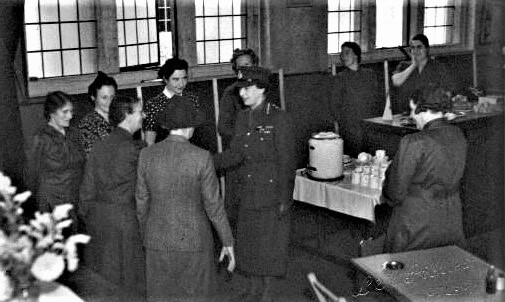
Women’s Royal Voluntary Service
In 1939 a communal feeding scheme was organized by the W.R.V.S. for 120 children and their teachers who were evacuated to Pool from Leeds. Electric cookers and other equipment was installed in the Methodist School Room. Dried food was obtained, whilst other food needs were contracted out to local businesses.
First Aid Unit

Pool’s mobile First Aid Unit Jan. 1944
L. Leeming; E M Harrison, F. Wildon, E.M Lamb, E Maud, E Wigglesworth, J.W Gregson, ?J.Rastander, J. S. Thackrah, Mary Washington, G. Smith S.R.N, M Clegg, M. Jackson, W H Smith, W.G.Desmond, S.E.Lee, A.R Leeming, M. E. Johnson, M. J. Tindall, M. M. Mullins, E M Shann, E. Brown.
Prisoners of War – there were many in the area. There was a Prisoner of War Camp at Otley
David Holmes, who until recently farmed from Hall Farm in the centre of the village, recalls his father’s story. During WW2 whilst working in one of their fields he heard a fire engine and commented that someone in Pool had a fire. Looking towards his farm he realized it was his barn on fire! Dashing back he found most of his corn had been saved. At that time German prisoners of war were camped at Otley and each morning were transported to work on farms in the area. It was one of these prisoners who had entered the barn and rescued most of the corn crop, for which they were very grateful.
According to Mrs. Chapman, Manor Farm, Castley, who had Russian prisoners of war working on the farm, they did not know how to use knives and forks.
Roland Tankard recalls that towards the end of the war a surveyor on the District Council decided a better water pressure would be obtained for Pool’s private village water supply by enlarging the reservoir at the bottom of Old Pool Bank. A party of Italian prisoners was employed to dig a much bigger reservoir. This of course was a waste of time as it made no difference to the pressure. Leathley Hall had alterations made by the Pool workshops of Kayes and Tankards. German P.O.W’s were employed at the Hall.
B. S. & W. Whiteley Ltd., paper mill – had a large part to play.
Before the death of David Whiteley, grandson of the founders of B.S. & W. Whiteley Ltd. he wrote his memoirs. Here are extracts of his section on the early part of the wartime activities at the paper mill, before he joined the R.A.F.
“Since Hitler’s rise to power there was increasing nervousness over the possibility of trouble due to German rearmament. This became very apparent in 1938. For this and general protection for the works a Dennis trailer pump was obtained with a tow bar fitted to the old Chrysler car. A works fire brigade was formed, and organised so that whichever shift was on duty there would be a crew to handle and operate the equipment. First aid training was also taking place and a works team was formed under David’s charge with Seth Longbottom as assistant. At a slightly later date a squad was formed as a gas decontamination unit with cleansing facilities in the remains of the old barn behind the reel mill. This was led by William Tankard, a veteran of the First War.

In 1938 Whiteley’s formed a works fire brigade for the protection of the works. First aid training was also given. Soon after a Squad was formed as a gas decontamination unit with cleansing facilities.At this time the firm was recognised as an approved suppplier, by the Air Ministry Inspection Department.
In response to government requirements for fire watching a reinforced tower was built on top of the reel mill beater house with slits so that observation could be kept in all directions over the factory roofs and beyond. For the fire watchers on the roof there were some very cold nights, 22 degrees of frost being recorded at 11.15 p.m. during one January night.
Practically all employees, who were not in one of the special units, were listed in rotas for fire watching duties in the tower. The whole works had to have all windows and openings blacked out, which was a very considerable task in view of the roof lights running the whole length of the single story buildings.

All employees from the directors downwards were numbered and issued with badges indicating their status. When they collected their wages at the weighbridge window of the mill office they had to quote their number.”
Also, in response to pressure from the Air Raid Precaution authorities, three reinforced concrete air raid shelters were constructed on the west side of Torracks Hill drive.(the road lead to Whiteley’s offices) The watercourse originating near the old railway line and passing down the side of the grounds was diverted under these shelters to provide a makeshift toilet system. Apart from a trial exercise these shelters were never used during the war and much later were used for storage of old files from the offices.”
(During recent alterations to the original old mill an underground room and tunnel were discovered running underneath Otley Road, used to connect steam and water pipes for the new mill and to make a safe crossing for staff, with a lift at either end )
To assist in the defense of the premises six double barrelled shot guns were purchased by Holmes, (father of David) who was used to handling these. He conducted practices at a moving target on a long wire set up on the island near the dry loft.

The Special Constables H.Q was behind Wharfe View which was manned day and night
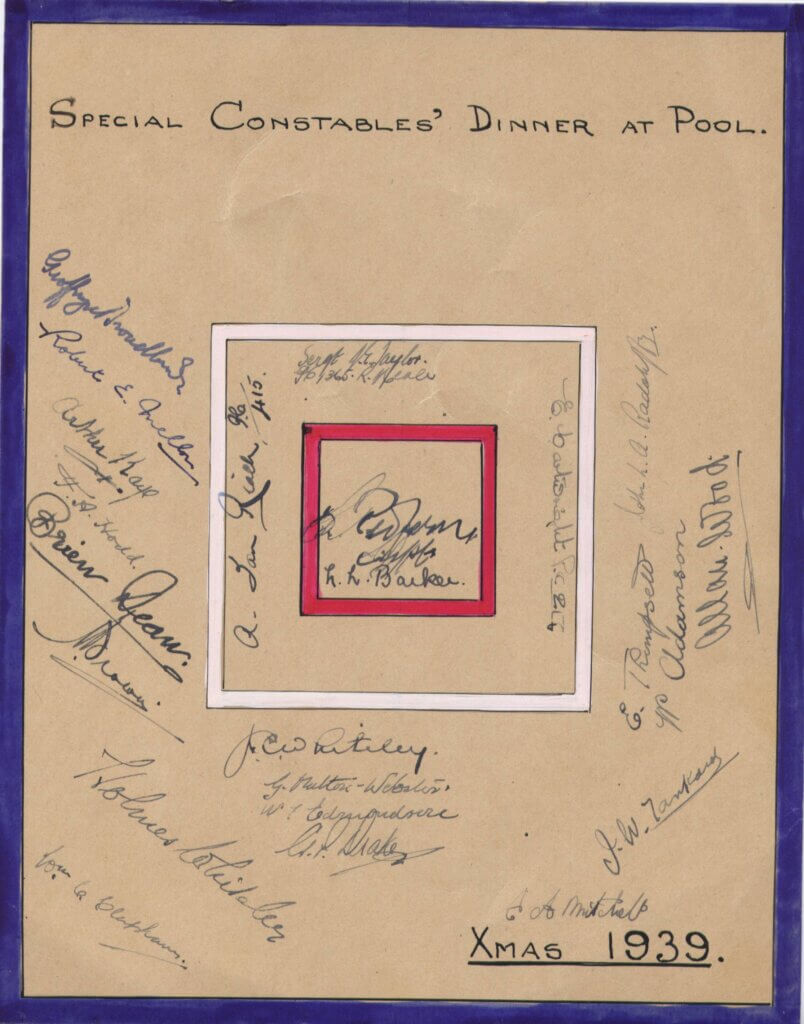
Special Constables dinner Christmas 1939.
Holmes Whiteley was the Section Commander of the Special Constables. He was on regular duty in charge of a unit which was housed in a wooden hut behind Wharfe View which served as the local police headquarters. In 1940 an extension to the Pool police station was made for the use of the Special Constables Regular Police as a rest room and for the treatment of road casualties and lectures.
The duties included guarding Bramhope tunnel and Arthington railway viaduct, as well as explosive stores at the local quarries and the public water supply reservoirs in the Washburn valley. Duties of enforcing blackout regulations were shared with the A.R.P. Arthington Viaduct and Pool Bridge were considered possible targets for German aircraft.
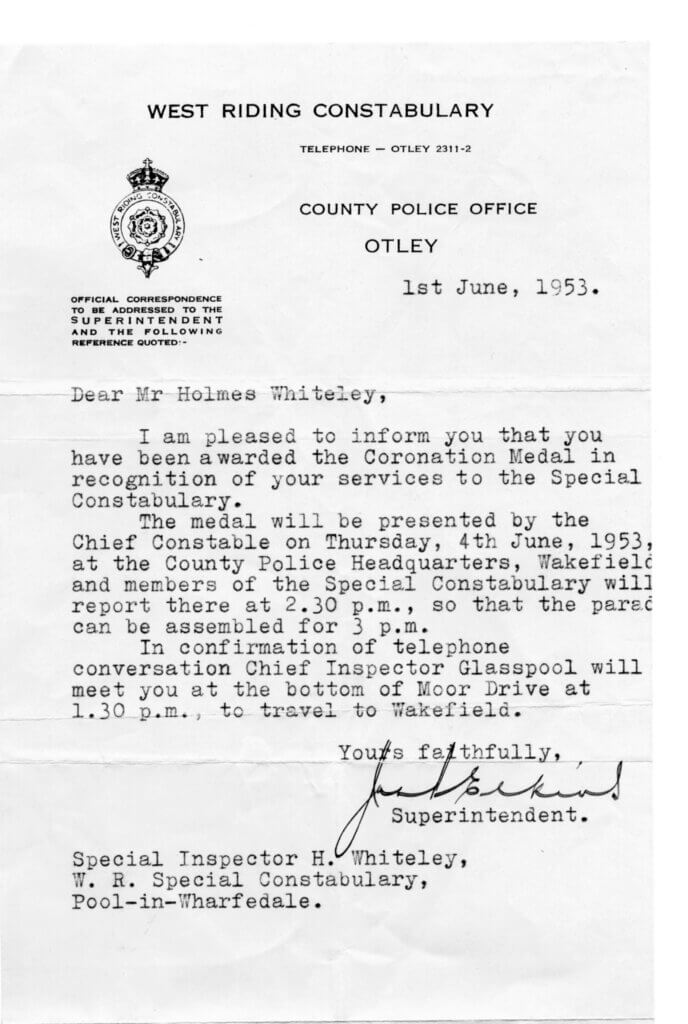
Coronation Award to Special Inspector H. Whiteley
There had always been a pigeon loft above the top drying loft. Much to everyone’s dismay the government ordered that all the birds should be destroyed in case they should be used for illegal message carrying.
An interesting sideline developed due to the blackout requirements. We were able to sell off many rolls of non-standard reel material and the news spread to other traders who flocked to the works for supplies. Our stocks of normally unsaleable rolls of black were soon exhausted but then it was suggested that the paper did not need to be black so long as it was thick enough to be lightproof. Many substandard rolls of all other colours of reel papers were accordingly cut into handy sizes for the traders to handle. Business was so brisk on the various local market days that we set up a retail selling arrangement next to the slitting and weighing machines. The youngest members of the family were installed with a cash box and receipt book on the spot.”
John Whiteley, then aged 12, was summoned to stand selling the paper supposedly just for one day – which lasted 2 weeks! The traders tried to barter him down but his father Holmes said “we don’t put our price up to take it off again”. This remained his catch phrase.
Gaps were having to be filled in the workforce by the periodic call-up of the younger men for the forces and later by those who were recruited into the new aircraft factory at Yeadon. More women and girls were being employed.
Fortunately, there were very few bombs dropped in the Wharfedale area, although during the winter of 1940-1 the district was regularly overflown by Luftwaffe bombers on their way to Manchester and Liverpool or up to Clydeside which caused regular air raid warnings. The nearest bomb to the mill was probably one which landed about 50 yards from the railway viaduct at Arthington. An incendiary bomb was dropped somewhere at the top of the Chevin.
One night I was walking back up to Overdale up the Old Bank when a very brilliant flare was dropped from an aircraft. The Germans then had an excellent photo of the Whiteley’s works which was seen by William Whiteley after the war.”

Many companies and private individuals had their own vehicles converted into ambulances, field vehicles, etc. for war use. B. S. & W. Whiteley Ltd. were no exception. They converted a Rolls Royce into this ambulance which was gifted to help the war effort.
During the War David Holmes Whiteley served in the RAF as Flying Officer, initially a training navigator in Canada, before being posted to India. He served from 1942 – 1945. Charles William served in the Rifle Brigade as Captain seeing action in Italy, served from 1942 – 1947. John Holmes served in the Royal Marines as a Marine 1945 – 1947 and Jean was an officer in the NAAFI.
Evacuees
Evacuees from various parts of the country were accommodated around the village. The large houses including Pool House, The Manor House,The Tower and Farfield were used. Soldiers recovering from war wounds were in Arthington Hall. Reckett & Colman evacuated their offices from Hull to Caley Hall.
Several small private houses were also used – 2 Italian girls from London lived in Manor Crescent.
Nos 3 and 4 Chevin View was the property of Miss Musgrave of Elm Bank which was requisitioned on 4th June 1940 to be used to house evacuee children together with their teachers who soon arrived, most from the Brighton area, some from Hull and Armley Leeds. They were considered 14 “difficult” children. Chairs could be seen being thrown out of the attic windows. A large refractory table was given but soon became covered in carvings; coke was stuffed down the local children’s backs then rubbed in. Some played truant, stole money and one girl was found wandering around the village dressed only in a Macintosh. They ate and were mostly taught in the Methodist Chapel School Room. The matron was paid £110 a year, other staff £80 with the cook £65 per year. The buildings were decommissioned in 1946.
Sports Clubs were affected.

Pool Cricket Club managed to keep going throughout the War. This was not without difficulties as many of the men of Pool had been enlisted and it was not a case of who played in a match but who was available. Many of the local clubs had had to close down and the cricket pitch at Arthington was now a cornfield. Often matches were cancelled due to other teams not being able to field a team. All jobs had to be done and everybody helped in some way, mowing, raking, rolling, marking out, sodding, chasing up players, collecting subs., care of tackle, arranging fixtures, painting the pavilion, mending seats and carrying water for the tea-tent. Even though tea was rationed and potted meat was scarce the ladies were magnificent in providing a cup of tea and sandwiches for 6d. and no “under the counter”.
In April 1940 Pool Tennis Club had their old club room commandeered by the Air Raid Precautions Unit. That same month their A.G.M. commenced early – 6.45p.m. The reason was that “black-out” restrictions would force the meeting to terminate before darkness fell. A committee meeting in December of that year was broken up rather abruptly when air-raid sirens sounded.
Various events were held to raise money. In 1943 a White Elephant Stall and Whist Drive for the “Wings for Victory” campaign. In 1944 a Whist drive to support “Salute the Soldier” week. In 1945 a Bring & Buy Sale in aid of the National Savings Thanksgiving week.
Allotments were formed in an effort to relieve the shortage of food.
In March 1941 Old Pool Bank Allotment Society was formed, Mr. Hartley (Pool School headmaster) was Honorary Secretary. The membership was 6d. with an annual rent of 5/- plus 5/- per year for expenses. Meetings were held in the “Cabin”, Old Pool Bank.
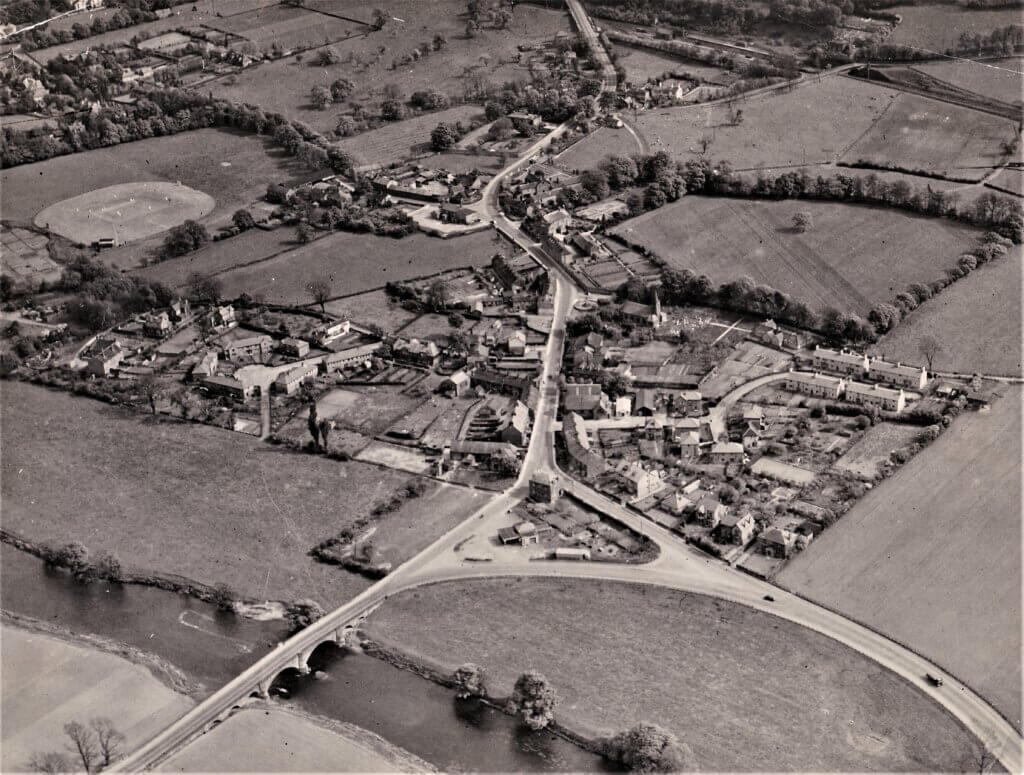
A little later in September 1942 Pool-in-Wharfedale Allotments and Gardens Society was formed, with William Peart and Frank Cooper in control. The allotments were sited on the land which is now the floodlit football pitch off Arthington Lane.
The Avro Factory at Yeadon

Many people from the village worked at the new “Avro” factory at Yeadon, one of whom was the mother of Mrs. Webster of Park Buildings, shown here. (A.V.Roe Ltd)
When building the factory, broken bricks were used as hardcore for the foundations. Bricks were used which had been disposed of in a pit by B. Whitaker & Sons whose brick works had operated from within the quarry on Pool Bank.
In an effort to foil enemy aircraft into believing the factory was a field, grass was placed on its roof. Cardboard cows, sheep, etc. were placed on top and moved around daily.
Pool Church of England School
The re-opening of the school for the Autumn term of 1939 was delayed for one week owing to the declaration of war. An air-raid shelter was soon erected in the school playground but could not be used by pupils living nearby – they had to go home when air-raid sirens sounded! The school held regular air-raid precaution practices and gas mask inspections. The local policeman, Sergeant Taylor, gave a talk warning children of the dangers of handling bombs, grenades and cartridges, since several scholars had taken cartridges to school. As in WW1, the children collected blackberries from Riffa Wood. This was made into jam for use in the school canteen.
The school was the hub of the village, being used for many activities. Gas masks were issued here, Whist and Beetle drives held, Youth Club, Home Guard parties, Nursing Association dances. This was to the annoyance of the headmaster, Ben Hartley, who states “another dance tonight – more upset”. Tables and chairs were often broken and the piano scratched. However, there was a good side too. When a teacher was absent then an evacuee teacher from Leeds would help out.
As mentioned earlier, there were over a hundred evacuee school children, together with their teachers, living in the village. Some were housed in what the headmaster referred to as “Chevin View Hostel for difficult children”. His frustration is summed up in January 1940.
“A very bad week for weather and for school work. Undoubtedly many people have become accustomed to thinking attendance in war time doesn’t matter. This is due to the Attendance Officer being switched to other work. Attendance Cards just come back as they were sent and it is a waste of time filling them in.”
Again fuel was short. In 1944 although permission had been refused by the caretaker, the Vicar “borrowed coke from a pile in the school yard”.


These cards were distributed to school children throughout the Country
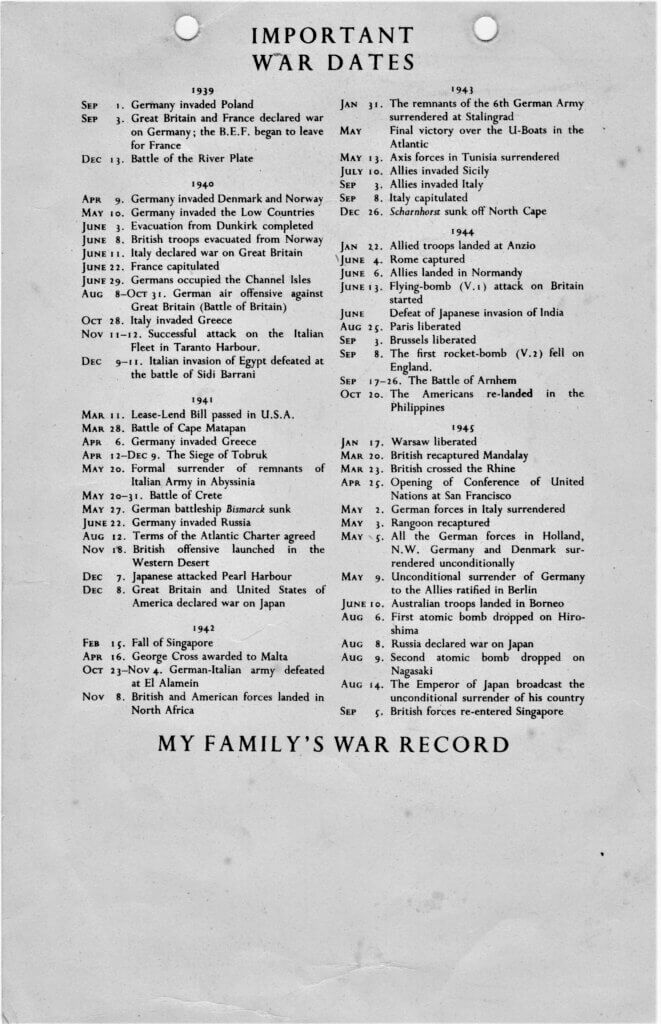
As can be seen the village was involved in many money raising activities. In 1943 the school, under the direction of the headmaster, spent six months preparing for an “artistic show with really high class entertainment” to raise money during the “Salute the Soldier” week. The backroom boys, made up of Mums and the more elderly members of the village, provided lighting and made spectacular costumes out of whatever was available at the time. The curtain finally went down with a “Salute the Soldier” item. £26 was presented to the Institute Treasurer for investment in War Savings. On another occasion £2.6s.7d. was handed to the Red Cross from plays given by each class. A play was also produced during Wings for Victory week.
A “Victory” holiday was declared on May 8/9th 1945 to celebrate the signing of the end of the war in Europe and by June of that year all the evacuees had left.
The official surrender of Japan was made on 2nd September 1945. Celebrations followed throughout the village.
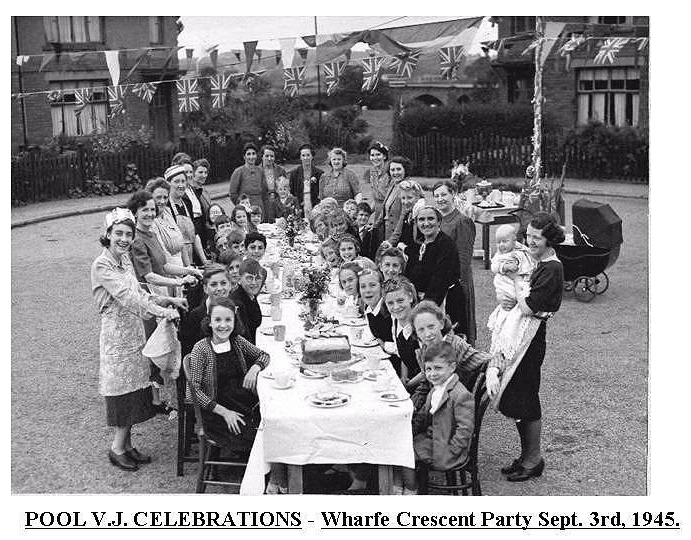
Starting from the left standing behind the children are Mrs. Cheetham, Grace Rawlinson, Grace Dennison, Nancy Dodds, (?) Alice Parker, Serwie Whitely, Mrs. Bland, Doreen Paley, Alice Wood, Hilda Mitchell, Minnie Cryer, Olive Pickard, (?) Mrs. Foster & Mrs. Throp holding baby Donald.
Children round the from the left — Ann Rawlinson, Harold Whiteley, Michael Cryer, Donald Newbould, Tony Whiteley, David Armitage, Malcolm Throp, Geoffrey Throp, Joan Bert, Jean Throp, I think the youngest Cheetham girl, (?) Stanley Paley, Ann Paley, Michael Wood, David Mitchell, Shirley Dennison, Margaret Cryer, Marjory Mitchell, leaning back is Joan Pickard, Audrey Bland, Doreen Cheetham, Audrey Dennison,
Pat Rawlinson and Trevor Page
Snippets
Prisoners of the war were housed on Weston Lane, Otley on land owned by Weston Hall. Many were to work on farms in and around Pool.
Pat Rawlinson was a young girl during the war. She often wrote to her father who was serving in the RAF. “My father was called up at the age of 36. His first visit to the RAF dentist resulted in him having all his teeth extracted and replaced by a false set. As a curious ten year old my letters often asked how his teeth were!
Here are extracts from some of her letters and her memories.
“School children collected books for soldiers. When you got 250 you became a Field Marshal!
Local dances were a great attraction. Over 200 tickets sold, half of them to soldiers at a camp in Otley. The soldiers made a model tank and raffled it, and they all gave 3d. each to buy a bottle of whisky to raffle (1 ½ p. to-day).
Fancy dress events for children were held. Whist & Beetle Drives for adults.
The Manor House was occupied by refugees from the London bombing.
The schoolmaster, Mr. Ben Hartley, and a team of mothers organised school concerts to entertain villagers. The concerts raised £26 and £29 respectively. Mrs. Rawlinson played the piano and produced both concerts and also helped with the costumes. Much ingenuity was needed to produce the costumes from black-out cloth and old sheets and blankets dyed to make the costumes. A team of “mothers” all helped.
The King and Queen, and the two princesses stopped at Pool Bridge to watch soldiers practicing crossing the river in case the bridge was blown up. I remember the Queen wearing pale blue and the two Princesses being dressed alike and worrying that they would get their shoes dirty as it was very muddy! The visit was secret but the excited school children were allowed to line the road-side to see the Royal Family.
(Brian Clapham (his father Vincent, a Special Constable at the time) recalls ” the Royal party had spent the night in the train in Arthington tunnel before coming to Pool”)
Winston Churchill also passed through the village on his way to the Army Camp at Farnley Hall, Otley. I remember that he stood up in the jeep and gave his famous “V” sign in salute.
During the war a German plane *crash-landed just over the bridge. A member of the crew was arrested by the local bobby, Sgt. Taylor, and members of the Home Guard. He had parachuted down and was caught in the trees by the river. The material from the parachute was retrieved and made into underwear by the local ladies! The prisoner was locked in Sgt. Taylor’s greenhouse (he didn’t know what else to do with them) and then taken to Otley on the back of his motor bike. Professor Challenger, who lived on Arthington Lane, acted as interpreter when being questioned.” He had spent three years studying chemistry in Germany.
(*It was later said that the plane was in trouble but carried on to land at Idle after one of the crew had bailed out)
“The Home Guard kept watch from the roof of the Paper Mill and I remember my mother having a tin hat, a large bucket and a stirrup pump and a whistle.
During the war, some Italian prisoners of war worked on the local farms. Also some prisoners who had been stationed in Jersey were sent to work at Otley Hospital. I remember meeting one called Fritz Anderman, who was a barber by trade and had worked in the hospital in Jersey. I still have the leather writing case he made for me one Christmas. One day a German plane fired at us whilst playing in the school playground. The teacher told us to keep up against the wall. It was very frightening.
Travelling was difficult in war time but I remember going to the pictures in Otley buying fish and chips and walking the three miles home – all for 1/-d. (5p now!)


Occasional film shows were given in the School and I remember seeing a film about Rembrandt with Charles Laughton and Elsa Lanchester.
At the beginning of the war Arthington Hall was handed over to the British Red Cross by the Sheepshanks family where it remained a convalescent home until 1961.
Part of my mother’s (Mrs. Grace Rawlinson) war effort was to wash socks for the soldiers at Arthington Hall using a copper boiler which stood in our old wash house. She washed and sorted some 100 pairs a week and was given a large tablet of carbolic soap and a bottle of ammonia. She always said that the ammonia was to help her recover from the smell of the socks! My grandfather was very envious of some of the wool socks and mother had to watch carefully to make sure that the correct number were returned!
The shop which is now a hairdressers (now a house on St. Wilfrid’s Terrace 2000) was an old-fashioned grocers run by Misses Littlewood and Baker, two stern characters resembling Laurel and Hardy. I remember having to take our own paper bags when buying sweets or provisions and the smell of the shop – cheese, ham and particularly the paraffin. The sweets in glass bottles on high shelves and the time taken on how to spend one’s sweet coupons to get the best value for them. Mrs. Gladstone, who lived at No. 1 Mill Lane, was an ambulance driver during the war.”
Mavis Whiteley recalls walking along Arthington Lane to school when she was stopped by a man who asked the way to the docks. When told there weren’t any here he said his instructions were to enlist at Pool(e) Docks!
The records of Pool Parish Council reveal:- in April 1940 a request was made to the Council to find “common land” for sports, to be used by troops stationed at Riffa Camp. The request was refused as no land was considered available!
In 1940 authority was given for the removal of all iron gates and fences for war salvage. It was reported over half a ton had been collected within two weeks.
March 1944. The residents of Old Pool Bank requested that, in view of residents need to travel to Pool Village, facilities be made for the repair or exchange of gas masks in the “Cabin” on Old Pool Bank. Later in 1945 a request was made for them to issue ration books.
The Pool Bank Quarry railway bridge which spanned the A660 was dismantled in May 1941. The scrap metal was removed and taken to help in the war effort.
David Whiteley in his memoirs recalls, “The name of the telephone exchange was always Arthington, although it had always been in Pool since the beginning of telephoney.* During my RAF service I often had trouble trying to make the name clear to operators in the south of England. Various alternatives were offered such as Hartington, Arlington etc. My uncle as M.D. at the mill, made repeated efforts to get the exchange name altered to the same as the postal address, without any success, even after the new exchange was built below Avenue des Hirondelles. The name only went out of use when we became 84 on the Leeds exchange.” *(Roland Tankard says the exchange was originally at Arthington, at the bottom of Creskeld Lane, in the first house on the left going up.)
A sense of humor was maintained…

Wherever possible, the villagers kept livestock usually poultry or pigs. It was a great day when a pig was killed. “Every little bit was eaten.”
A Pig Tale. Food was short during the war. This story is about Clifford Midgley whose family ran Pool’s coal and haulage business for almost a hundred years.
“Lup” Lupton had a smallholding on Castley Lane. Clifford decided he would buy a pig and pay Lup to look after it alongside Lup’s own pigs, so that when it was fattened up it could be killed and eaten by Clifford’s family.
Later Clifford delivered sand for Lup’s pigsty and whilst there asked if he could he see the pigs. “Aye” said Lup “but yours’s deead.” When Midgley’s bill arrived for the sand, Lup considered he had been overcharged so delayed paying. Eventually when Lup did pay he showed Clifford their Midgley calendar hanging on the wall. Underneath the words “Sand and Gravel Delivered” Lup had written “AT A PRICE“
The Churches were mindful of the feelings of the village.
Mr. Thomas Walsh of Pool House agreed to part of his servants’ cottages, which had lately been used as a billiard room, be used to take Catholic Church services for the duration of the war.
The Church and Chapel and White Hart were on standby to act as temporary mortuaries if required
During WW2 invasion preparations were being made for the digging of slit trenches for bell ringers.
Damage had occurred to Pool Bridge and in 1946 a bill for repair of £26.12.7d.was sent to the MOT Centre REME, Farnley Park, Otley, claiming it had been damaged by a R.E.M.E vehicle. This was paid in full.

still serving after the ending of the war.
Memorial Halls
In February 1946 a decision was made to build two Memorial Halls one at Old Pool Bank and one at Pool-in-Wharfedale, to commemorate those who fought in both WW1 and WW2.The Memorial Hall at Pool-in-Wharfedale also built in memory of William L. Whiteley J.P.
On the 12th Sept. 1946, land owned by Squadron Leader Boddington, was eventually found on Quarry Farm Road for the building of the Old Pool Bank Memorial Hall. Holmes Whiteley “made a generous offer to pay for the land” which was £250 plus costs required by the owner. Holmes then gave the land to Old Pool Bank residents for 10/-d.
The prospect was tackled with enthusiasm by both villages with a tremendous number of events being held to raise sufficient money before building could begin. Eventually Old Pool Bank Memorial Hall, the majority of which had also been built by the villagers, was opened on 17th May 1952 by Her Royal Highness the Princess Royal.


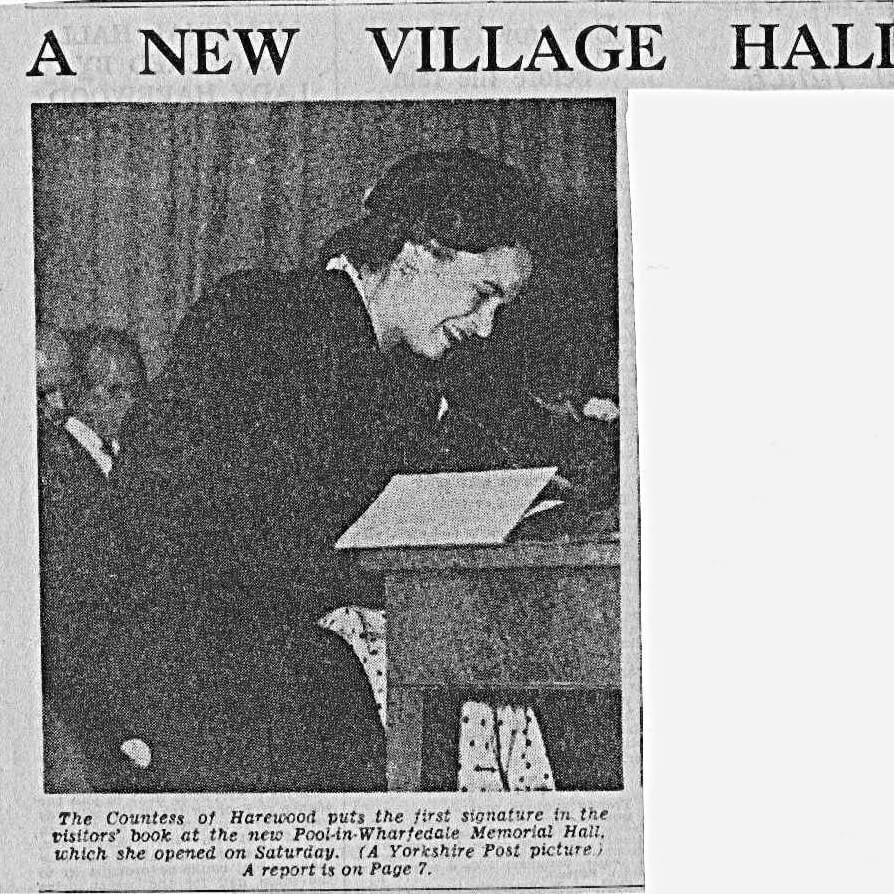


Pool-in-Wharfedale Memorial Hall opening.
Quote from the time when Pool-in-Wharfedale Memorial Hall was soon to be opened in 1958, “The general feeling in the village is that this building should, not only be a social center, but also a memorial to those who had fallen in the Wars. This idea was approved and now the Hall stands as a permanent reminder of their sacrifice.”
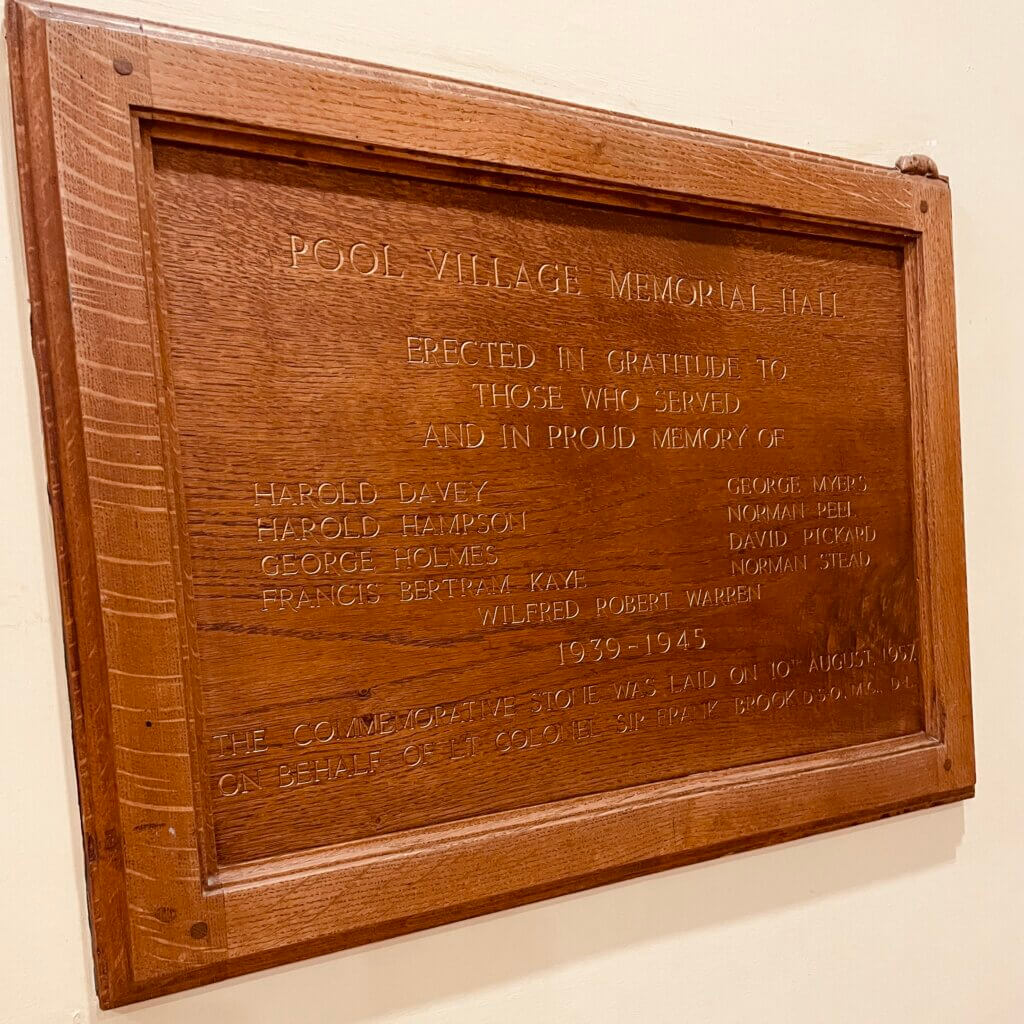
Memorial Plaque in Pool Village Memorial Hall – made by “Mouseman of Kilburn”
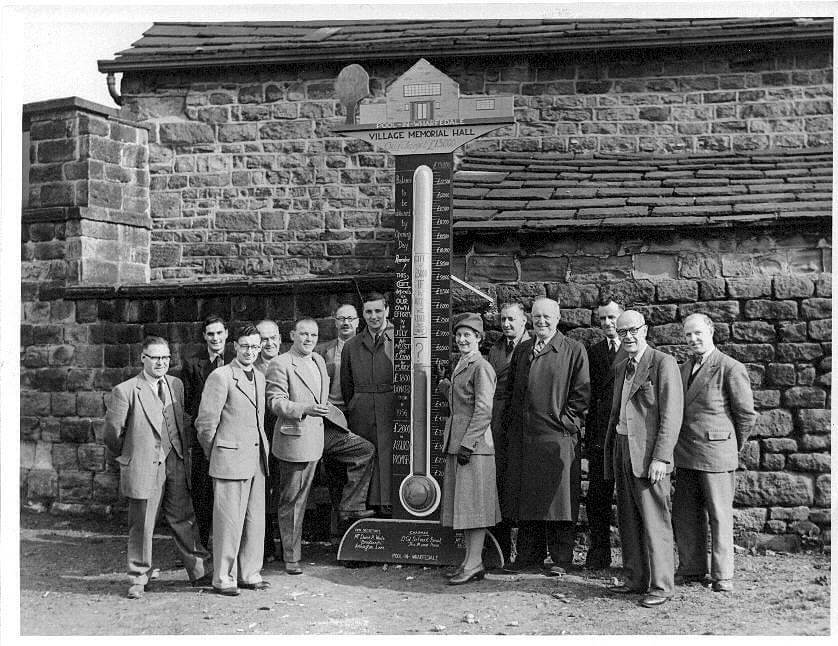
“Thermometer”on Stocks Hill, recording the money raised to date.
Many money raising events by the villagers included whist drives, garden parties, dances, stage presentations, raffles, sales of work, coffee mornings, “Men only smoking evenings”, etc. etc., On 2nd August 1958 the Pool-in-Wharfedale Memorial Hall was opened by the Countess of Harewood. This also commemorated William L. Whiteley, who before his death in 1937, had given much to the village. He and his brothers, Ben and Samuel, had in 1886 founded B. S. & W. Whiteley, Pool’s paper mill, after purchasing from the executors of Nicholson & Co.
Royal British Legion
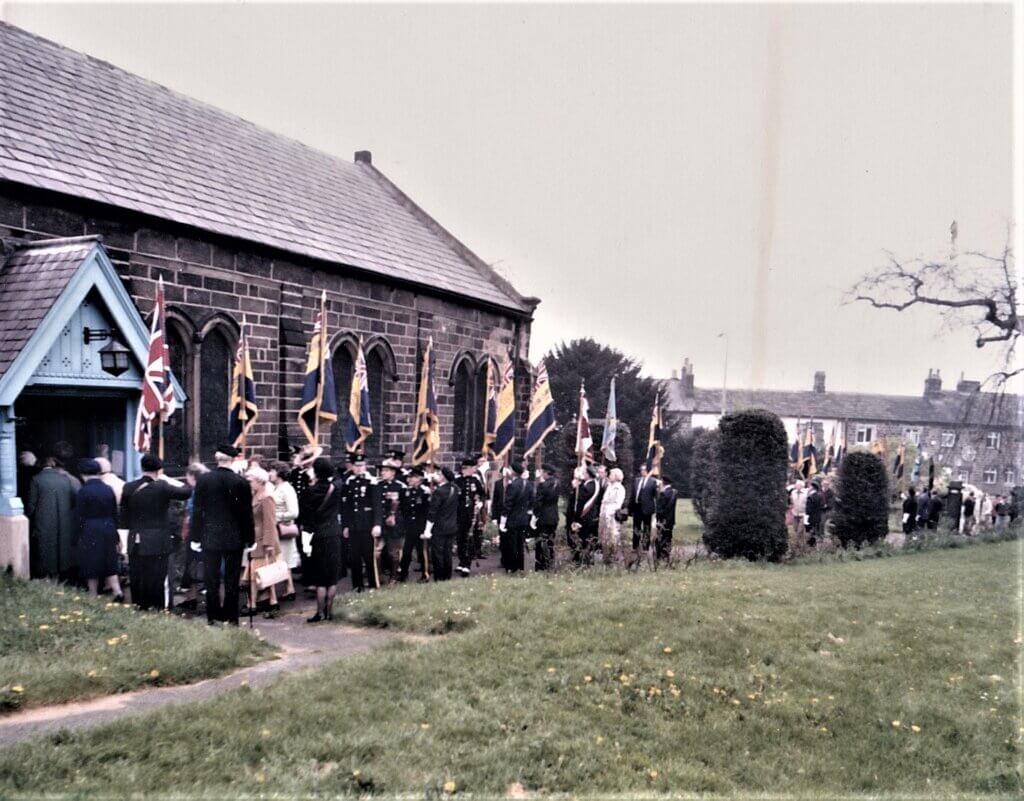
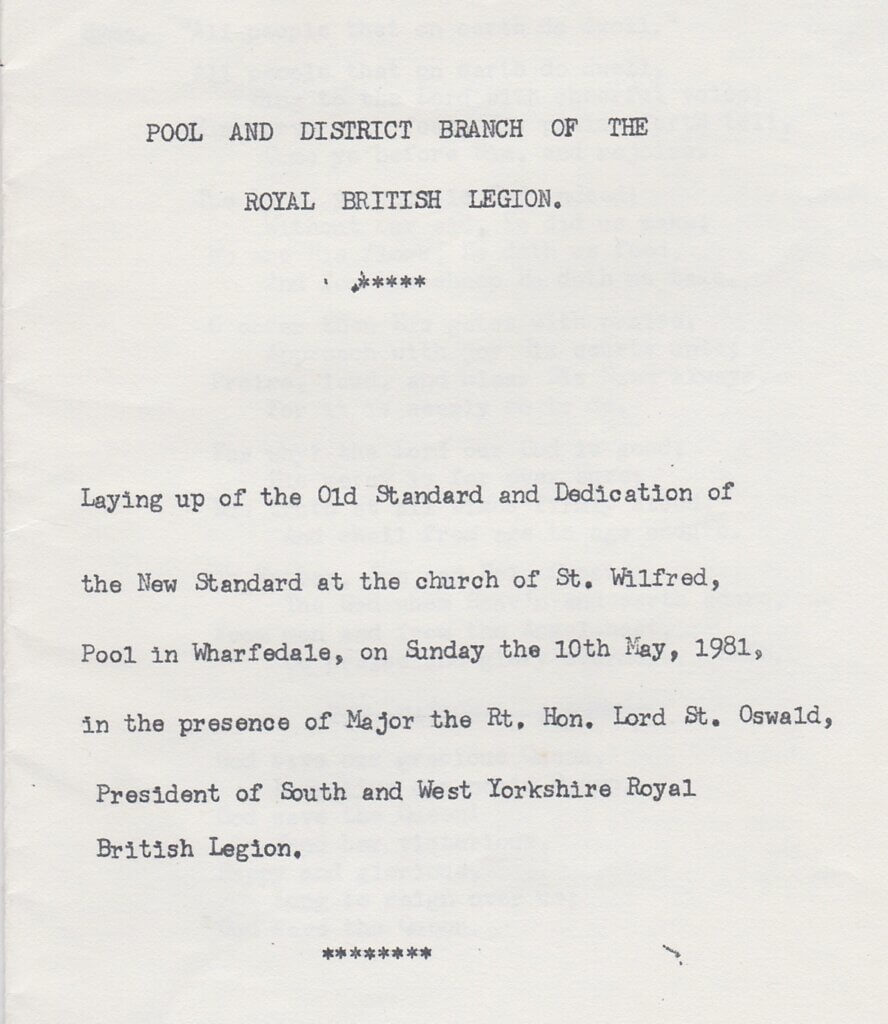
The Huby, Weeton and North Rigton Branch of the British Legion was formed in 1946. By June 1947 it was suggested that Pool-in-Wharfedale should be a part. October 1947 saw the first meeting being held at the White Hart, Pool, where it continued to be held for several years, moving to the Church Room on Mill Lane then to the Pool-in-Wharfedale Memorial Hall, shortly after its opening. By 1953, Arthington had been included and became the Weeton, Huby, North Rigton, Pool & Arthington Branch (Later known as Pool and District British Legion). The Branch Standard and Union Jack to be housed in St. Wilfrid’s church. Each year the British Legion Branch Standard was taken to the service in the Royal Albert Hall by the President (C.W.Whiteley) and a member of the Branch. There was a very active ladies section who assisted in the many fund raising activities, whist drives, dances, Poppy Appeal, Benevolent Fund, etc. Annual dances were held in the Pool-in-Wharfedale Memorial Hall when Miss Legion was elected. Visits were regularly made to Menston Hospital when cigarettes and chocolates would be given to the patients. During 1948, War Memorial plaques to those who fell during WW2, were ordered and unveiled towards the end of that year at Pool, Arthington, North Rigton, Huby, and Weeton. On the 13th September 1981 the Branch hosted a large contingent of members from other local Branches for the laying up of the old and to celebrate the dedication of the new Branch Standard, which was held at St. Wilfrid’s Church. Once recorded to have 147 members, these slowly dwindled with the Branch finally closing about 1995.
The Holocaust
For around 30 years before his death in 2016, Eugene Black came to live in Pool with his wife Annie and his four adult children. In 2005 he gave to Pool History Group an account of his experiences as a German Nazi prisoner. This is his story which is abridged: –
“At school you had to wear the Star of David. When the Germans came we were rounded up very quickly and the Jewish quarter became the ghetto.” Eugene was classified as a Hungarian Jew and came from a town called Munkács, now part of Ukraine.
Within a matter of weeks most of the surrounding town’s 30,000 Jews were deported to Auschwitz-Birkenau in Poland. Eugene, his parents and two older sisters arrived there after a gruelling three day train journey. “We had no idea where we were going although I think my parents knew what was happening.
We got separated the moment we got off the train. My mother and sisters went to the left and me and my father went to the right. I saw them being taken away but I didn’t have the opportunity to say goodbye. A few minutes later I was separated from my father. I was marched to the sauna, ordered to strip, had all my hair removed, showered and given a striped uniform and sent to barracks with those deemed fit enough to work.

I was born in 1928 (records in the camp show 1926). The father of a friend of mine had told me to lie about my age” Eugene also told the History of Pool group that he was told say he was an engineer so he would be useful to the Nazis and therefore would not be sent to the gas chamber. “All I could see that night were these flames coming out of the chimney and there was a horrible smell. The next day a friend of my father’s Mr Kornreich, came over and said he was sorry but the smell was the bodies of our families burning. My family perished within two hours of arriving. They were sent to the gas chambers and that’s what I watched that night – that was my first experience of Ausvhwitz-Birkenau.” Eugene later found out his two sisters had survived the gas chamber and were sent to a munitions factory but unfortunately, had been killed by an allied bombing raid because the SS would not allow the Jewish prisoners into the bunkers.
After three weeks he was loaded on to another train with as many as a hundred to a single wagon. “In the middle there were two barrels, one with water in and the other to relieve yourself. The smell was terrible”
He was being taken to a concentration camp at Buchenwald, from there he was taken to a labour camp called Mittelbau-Dora.
At Dora there were underground factories producing Hitler’s V1 and V2 rockets. Eugene spent six months in the tunnels, which were up to a mile long, loading huge rocks onto small wagons ready for transportation. “We worked a 16-hour shift, lots of the time with no lights. To describe that, what can I say? I can’t find the words. The Nazis knew they were losing the war but the conditions were unbelievable, it was one of the worst camps. If you survived three months you were lucky”. He recounted that If any of the prisoners made the slightest error or disobeyed, they were rounded up into a group, all the rest of the prisoners made to assemble to watch them being shot or hanged. (Dora was one of the most notorious labour camps because of the harrowing conditions workers were forced to endure. Originally, prisoners were made to work and sleep underground in one of the many tunnels, sleeping on shelves cut from the rock.) Eugene worked in these tunnels. After a bout of pneumonia his weight dropped to six stones.
Early in 1945 he was sent to Bergen-Belsen (where Ann Frank died.)
Conditions inside the Bergen Belsen were horrific, and prisoners did anything to stay alive, pockets of the dead were searched to see if there were any crumbs, “you were so desperate. It’s difficult to come to terms with what happened, it’s difficult to put into words and hard to explain to people how you suffered – the hunger was unbearable.”
Belsen was liberated on 15th April 1945, on Sunday afternoon at 3 o’clock, the only concentration camp taken by the British – a day Eugene will never forget referring to the moment the Nazi commandant handed over control of the camp. The level of degradation that greeted the British soldiers was unimaginable with piles of rotting corpses, some of which were half eaten.
“After the war ended I suddenly realised I was free, but I had lost everything.”
Eugene finished his account by saying, “It was not only Jews but everyone who suffered in the war. It’s a tragedy which must never be forgotten and must never reoccur”
Eugene became an interpreter for the British army where he met and married his English wife Annie and came to live in England, moving to Pool-in-Wharfedale around 1995. Eugene worked for Marks and Spencer all his life, retiring as a manager. In his retirement he spoke to thousands of young people about the Holocaust in his mission to promote peace amongst all. His story is one of 16 now featured at the Holocaust Exhibition and Learning Centre in the University of Huddersfield. http://holocastelearning.org.uk/ where he wrote “It’s so important to always remember, live and let live, because we are only here for a short while and enjoy while you’re here.” *
- Eugene’s daughter Lilian Clara Alexandra Black was awarded the O.B.E. in the Queen’s Honours List, 2020. For services to Holocaust Education. Chair of the Holocaust Survivors’ Friendship Association in Leeds, founder of the Holocaust Exhibition and Learning Centre based at University of Huddersfield opened September 2018. She had received notification of her O.B.E a few days before her death from Covid 19 on 29.10.2020,
AWARDS received by some of the people from Pool-in-Wharfedale
Sergeant Harold Ellis Denton D.C.M. killed during W.W.1.1914-1918.
Actg Captain Harry Reginald Ridealgh M.C. bravery during W.W.1
Lance Corporal Thomas Ralph Kitson M.M. bravery during W.W.1
Corporal J. M. Tankard, M.M. bravery during W.W.1
William Lumb Whiteley 1937 sworn in as Justice of the Peace
Holmes Whiteley. Award for “services to the Country in the capacity of Special Constables” during the General Strike, dated “Downing Street, May, 1926 “
Harold Ellison, B.E.M. for keeping Whiteley’s Paper Mill going during W.W.2.
Seth Longbottom. 1960’s for working at Whiteley’s (First Aid)
Walter Woodhead B.E.M. for services during the war. This B.E.M. was the last to be presented actually at the Palace.
Frank Rackham, B.E.M. The Bungalow, Old Pool Bank for development of the Iron Lung.
Holmes Whiteley At the end of WWII received a Certificate as President of the Otley Branch of Special Constables for many years of devoted service signed by George VI and the Queen.
Holmes Whiteley Coronation Medal on 2nd June, 1953 as “an inspector of the special constabulary of the Otley Division in the W.R. of Yorkshire”.
William Whiteley O.B.E. New Year honours list of 1965
Chas. Wm. Whiteley. O.B.E 1978. He had been president of Leeds Chamber of Commerce and a long serving member of BEAMA (British Electrical and Allied electrical Manufacturers Association.) Son of above William Whiteley O.B.E.
Eric Cryer received Maundy Money from the Queen in 1985 in Ripon Cathedral for services to St Wilfrid’s Church, Pool for being organist for 50 years also choir master.
Kendal Newby the Queen Mother’s Honorary Birthday Awards 1988 for keeping the two villages of Pool-in-Wharfedale and Old Pool Bank tidy.
Jeannie Barber M.B.E. for services to the Insurance Industry. 1992.
Hazel Lee Chair of the Pool Parish Council for her “Women of Achievement” award. In the presence of the Prime Minister in 2001.
Pat Lazenby Nominated Sue Rider Care Yorkshire “Women of Achievement Award 2009” for “tireless research and collection of items of historical interest, ensuring the history of a small village, once listed in the Domesday Book is preserved for future generations”.”Money from sale of books to charity.”
Charles Harrison. Killed in WW1 age 31. Husband of Lily Ann Harrison of “Hazeldene”, Pool.
Trevor Davey M.B.E. New Years Honours List 31st Dec. 1990 Services to the West Yorkshire Constabulary, becoming the Police National Superintendent of the Association of England and Wales.
Lilian Clara Alexandra Black O.B.E. Queen’s Honours 2020. For services to Holocaust Education. Chair of the Holocaust Survivors’ Friendship Association in Leeds, founder of the Holocaust Exhibition and Learning Centre based at University of Huddersfield opened September 2018. She had received notification of her O.B.E a few days before her death from Covid 19 on 29.10.2020,
Honorary Citizens Award issued by Pool Parish Council. Kendal Newby Oct 2006 received the first. Connie Cartwright 2007; Roger Bareham 2008; Pat Lazenby 2009; Harry Wardman 2010; Margaret Plasting 2011; Lorri Clemie 2012; Pat Walker 2013; Peter Wilkinson 2014; Jim Smith 2015; Martin Lee 2017; Moira Keith 2019; Mr.& Mrs. Aartse-Tuyn; Paula & Gary McNeil; Mrs Sue Cliff 2021;
At the end of WWII a council letter of thanks went to:
POOL ARP
Seth Longbottom (FirstAid)
W Tankard (Decontamination)
Dr Hunter (Medical)
E H Wilson (Store House)
Arthur Leeming
H Stephenson
FIRE WATCHERS
J Holden (Old Pool Bank)
H Leeming (11 Manor Gardens)
H Stephenson (Riffa Farm)
INVASION PREPARATIONS 1939-45
Pool in Wharfedale Invasion Committee – lead by Lt. Coggill and W. Whiteley
Arrangements planned:
Emergency equipment organised e.g. shovels, coal, food sources pinpointed.
Training planned for sewerage, burials, and a mortuary at the White Hart, The Church and the Methodist School room.
Mr. Mills of Crooks Farm is to take charge of milk and farming activities. He is to have contact with the Otley butcher Hymas.
Messrs. Foster, Thackrah and Challenger were to take charge of all the village shops.
Military kitchens were to be set up at Riffa.
Extra bleach was to be requested for cleansing.
Work was planned for the digging of slit tranches for bell ringing (and ringers) in case of invasion, for emergency water supplies, for extra coal and coke (50 tons), etc. to be stored at the station.
Lists made of all available vehicles.
Fires could be dealt with by water from the river and sand.
Consideration was given as to how Arthington Convalescent home (Arthington Hall) could be used.
Tools and available personnel listed.
Pool Bridge was regarded as militarily important as a river crossing point and source of militarily significant roads
Pool Bridge and Arthington Viaduct were regarded as main targets. Defense would be provided by the 29th Battalion Home Guard who when not engaged in active service were to assist the Civil Defense and the Police.
(Taken from records of Otley Rural District Council)
For a record of men from Pool-in-Wharfedale and Arthington who lost their lives in WW1, WW2 and the Iraq war, in “Living”, “A Village at War”, “Roll of Honor”or see https://www.poolinwharfedalehistory.co.uk/8-roll-of-honour-war-memorial-gardens/.
For those who returned from WW1, see Books “Yorkshire Lads”