PLAINVILLE/PARK HOUSE/POOL COURT/MONKMANS Also ROSEDENE


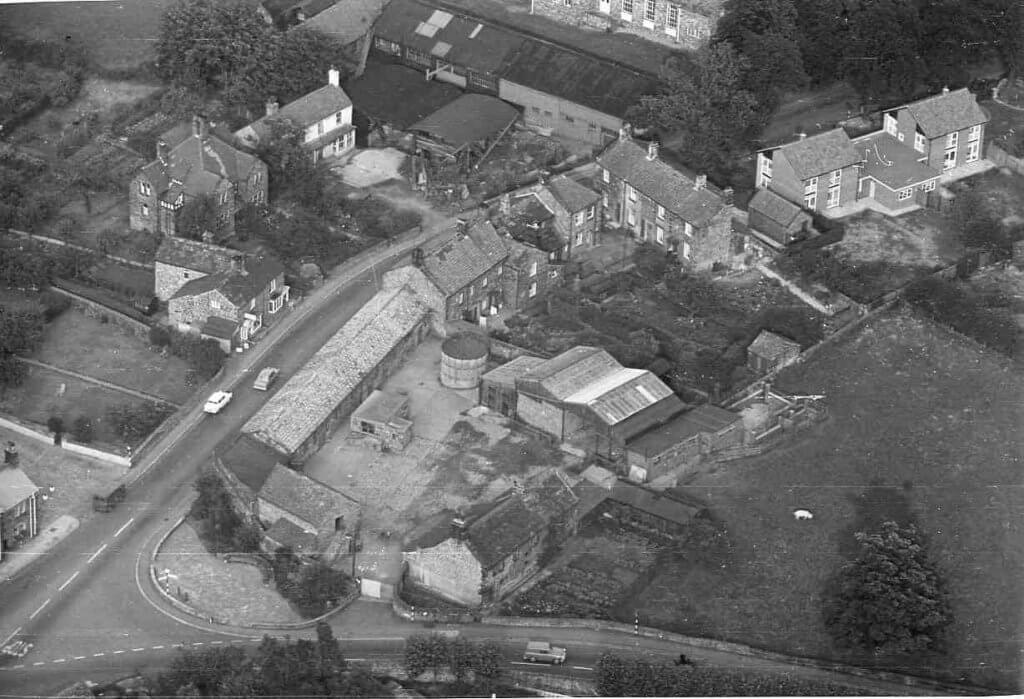
According to deeds of Brayton Cottage, Plainville was also called Rosedene. This Georgian residence of around 1800, is on the map of 1847 and possibly the map of 1756. Known originally as Plainville. The house was built on the foundations of a farm with some splendid large cellars (photo above). According to SHP “John Milthorp bought a large piece of land from Edmund Maude and built Plainville with money left by his father, William Milthorp (1731-1801), (retaining the old cellars) It is also said that Plainville was built on the site of a farm which had been given to John Milthorp (1768-1847) by Edmund Maude who died in 1829. (the Maudes of Burley began in 1550). John’s sister, Mary Milthorp after marrying Edmund Maude in 1776, died in 1786. According to the Maude family tree she had 9 children! It appears that Edmund Maude (1749-1829) and William Milthorp (1731-1801) owned Low Mill. A further suggestion, which is probably correct, is that when William Milthorp died in 1801 he gave the farm to his son John who then demolished it and built Plainville. “Maude Esq” is shown on Thomas Jefferson’s map of 1775 as living at Leathley Hall. A sundial was found in the grounds marked TTM -1684.(SHP ).

After John Milthorp sold his Pool House, (opposite the White Hart) and farm at in 1822/23 (Leeds Mercury) he pulled down an older building which was probably similar in style to the nearby Pool Farm Cottage, with a date above the door ATF 1725 but retained the cellars from this, for his new house, Plainville. To the front of the house was a large barn, demolished in 1870.
When John Milthorp married Elizabeth Nicholson, of Pool Hall, (aged 16 ) in 1802 the two Pool mill owning families came together and lived at Pool House, later moving to the newly built Plainville, In 1861 Elizabeth Milthorp (nee Nicholson) aged 70 lived there. (census) The will of Michael Nicholson dated 21.7.1857 was found in Pool Hall and documents in the loft of The Rock, Mill Lane, during alterations c.1990. These are in Otley museum (p/dc/34 1B). Michael Nicholson bought Low mill in 1808/9 from John Milthorp and in later life, possibly after selling Pool Hall to Samuel Fieldhouse in 1840 (SHP) moved from Ryddings House on Otley Road, to live in Plainville/Park House/Pool Court/Monkmans with his sister Elizabeth,( wife of John Milthorp) where he died in 1858.
Michael Nicholson Milthorp Snowdon, returned in 1912 to live in his family home. He was described as “having a very helpful attitude” when the Whiteley brothers ( B.S.&W. Whiteley Ltd) were setting up their paper business on Otley Road in 1886 and were struggling financially
“Mr. Snowdon was not one of those gentlemen who are out for their pound of flesh, he was willing to help his new tenants as much as possible. The mills had previously manufactured sugar bag paper and wrappings: much of the machinery installed being of no use to the new tenants who were Press Board makers. The landlord offered to dispose of all the machinery not required and loan to his tenants the money he obtained for it. Who can say how much treatment such as this, has had on the prosperity of the village”.”Recollections of My Native Village”- Holmes Whiteley (son of a founding member William L.), born 1888 written 1951.
In 1876 land owned by Plainville stretched from the house to north of Pool/Harwood road approx. 4 ½ acres, it had earlier included Sim Ing (Pool school, cricket and football playing field areas)
Around 1868 the house was let to various tenants, they included ; 1871 William & Louisa Hodgson, cut glass manufacturer (census); Allan Booth in 1889 (W.O.); J.L. Jackson of Jacksons Arcade, Otley. c.1880; 1891 Herbert Gill (census).
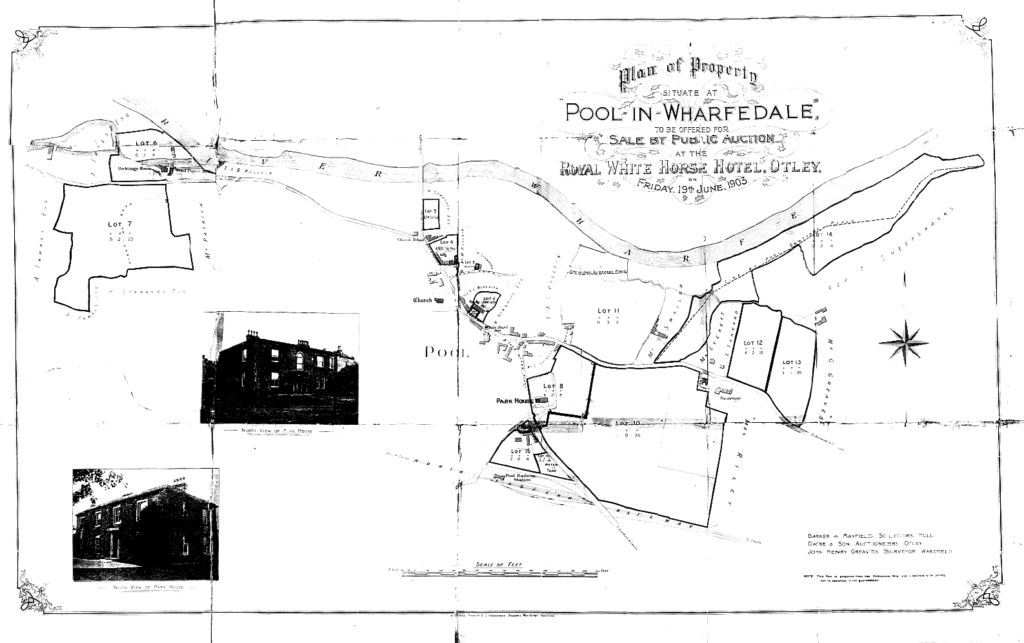
Details of a sale of property (not the house) and a map of land to be sold and show a small tithe due. The sale took place at the Royal White Horse Hotel, Otley 19.6.1903 Michael N.M. Snowdon(1846-1918) returned from Hull to reside there in 1912. It was owned by this family until the mid 1960’s and at times, rented out. Col. Dawson was there in 1951.
Lot 16 Land with water pipes, tank, income £19.16 per annum. (Pool private water supply) Tythe 1/- Mr. Whitehead. Small Dole payable on Lots 8 -10
Lot 6 £2,000, Paper mills; Lot 7 £1225; Lot 5 £190 Old school playground;
Lot 4 £15.5s. Chapel Row, St. Wilf Terrace, Old Post Office Row; Lot 2 £1,952; Railway to west £360
Lot 9 £850; Lots 13 & 14 not sold (Otley Museum)

Letter from Leeds Civic Trust of 2001
In November 1966 approval was made to convert the house to become Pool Court Restaurant Ltd., later c. 1980 bought by Monkman to be Monkman’s Bistro. After much opposition from the village, local councillors and Leeds Civic Trust and a number of attempts to have it Listed therefore saving the house, it was finally sold by Monkman and demolished in 2002 to make way for Consort to build 7 houses and 3 blocks flats named “The Hollies”. The land to the east and south was sold for building Parklands (1960) and the Redrow Estate (2002)

POOL BANK CHAIN BAR Grade II listed– Old Pool Bank. This toll bar house was built in 1847 after the main A660 Leeds and Otley Turnpike Road was built in 1841. No stones were to be removed from Caley Crags or defaced in any way, said the owners of Cayley Hall, the Fawkes family. A scale of tolls was prepared in 1845 part of which were: For every Horse or Beast drawing any Coach, Berlin, Chariot, Post Chaise, Calash, Phaeton, Hearse, Litter,Chaise, Chair, Gig or and such like Carriage, the Sume of …1st Bar 8d. .. 2nd Bar 4d. According to the census of 1851 the Bar House keeper was Ann Spencer, wife of a wool comber. On the dissolution of the Trust in 1873 the bar house was offered for sale for fifty pounds. The old chain was said to have later been used in the gateway to Cartref House on Otley Road. The occupant in 1851 was Ann Spencer and her son Thomas. (1851 census) The Toll bar was later converted into a Post Office and general store and in 2002 become a private residence, (See “Turnpike &Toll Bars”, and “Old Pool Bank”)

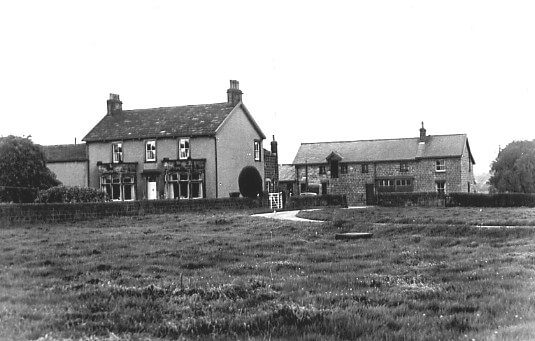
POOL CROOKS (FARM), The name “Crooks” will be found frequently alongside winding rivers and denotes a bend. (F.M.) In 1646 known as Poule Crookes. The farm is shown on a map of Harewood Estate dated 1710. Occupants: Henry Ricroft 1646 (Otley Parish Registers) Anthony Ricroft 1692, Thomas Cooper 1770- 1813 (Mem.Insc.I.2.13)., Thomas Dawson 1846 (marriage of daughter), 1849 Tythe map; Abraham Stead, railway contractor, to 1860 (Arthington House(see below): John Labron, merchant, from 1860; George A. Jowett farmed there in 1871; census.1891 census shows Charles Ingle, clothing manufacturer and farmer. Early in the 1900’s it was sold by the Tankard family to Ben Mills who lived here until 1960 when the farm was sold to Alexander Cartlidge (Ben Mills has the winning cow “Wharfedale 1938” .Tythe map indicates a field area is named “Far Cork Leg and cote”.
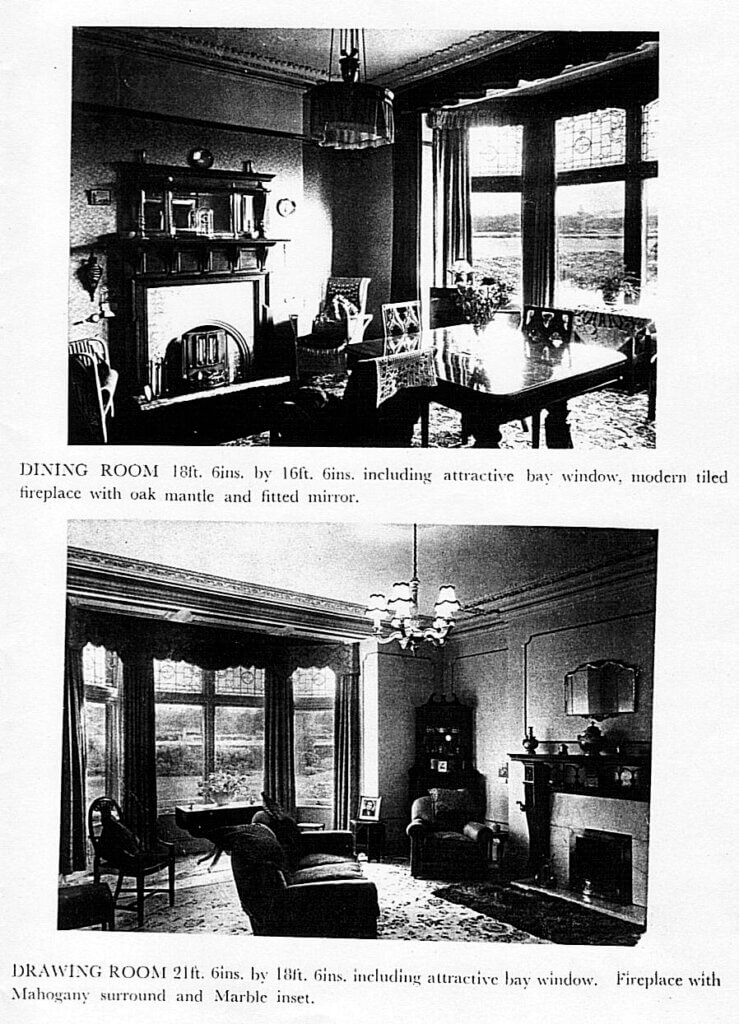
Inside of house in 1960
A sale of Pool Crookes House and Farm took place in Nov. 1960 was withdrawn at £27,500, eventually sold for £24,000
The sale also took place in 1960, of the two semi-detached houses known as Brooklea and Sunnyside on Arthington Lane (Houses post 1850) They were withdrawn at £3,000. (converted to one house by Ian Lomas c.1960)
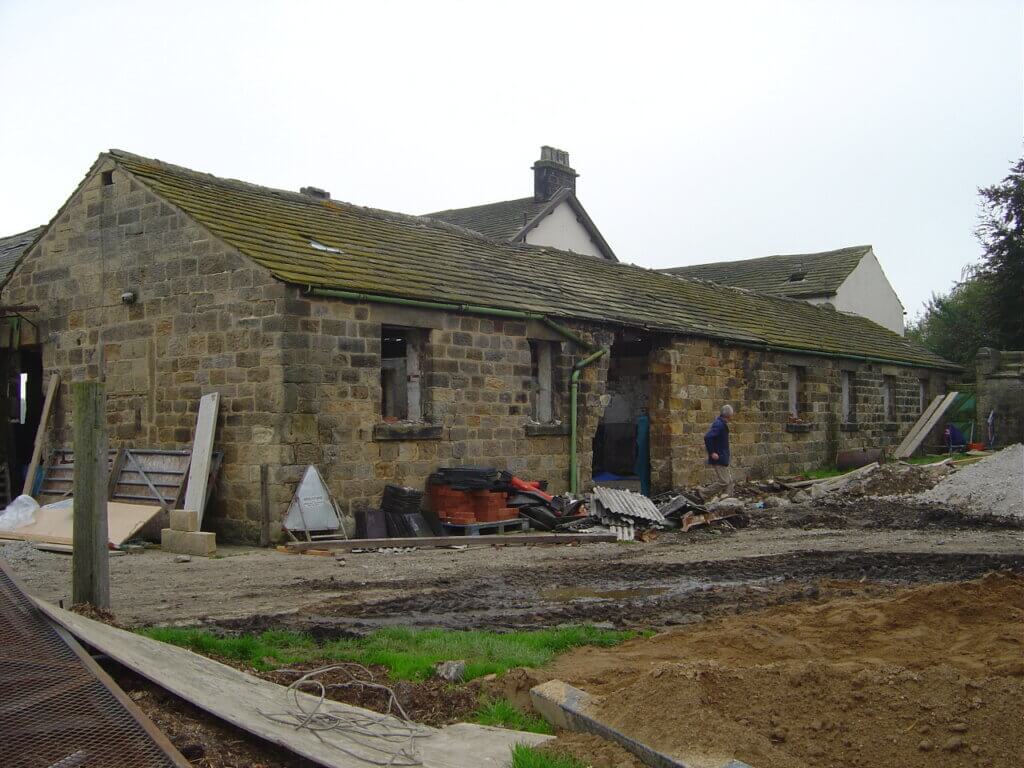
Plans for conversion of Pool Crookes house and farm into housing submitted in 2003/4. Owners in 2005 Andrew Cartledge. Conversion into 5 residences began in 2005 by Craydale Developments Ltd. With the sale of each house came the option to purchase the individual adjacent fields.
During WW2 in case of invasion Mr. Ben Mills, farmer at the time, was to take charge of milk and farming activities and to have contact with Otley butcher, Middlemass who was a resident living on Sandy Lobby.
Leeds Mercury. May 19th 1860
To be sold by private contract by order of the trustees and executors of the late Mr. Abraham Stead of Arthington, near Otley, Railway Contractor the following valuable freehold estate. Arthington House in 2016, was sold with land of 63 acres.)
Lot 1 All that Estate called ARTHINGTON HOUSE and farm with the large stables, loose boxes and cowhouses, outbuildings and yards and about 150 acres of excellent grass and arable land, late in the occupation of the said Abraham Stead.
Lot 2 All that Estate called POOLE CROOK HOUSE and Farm with the garden, barn, stabling for five horses, outbuildings and about forty acres of grass and arable land, now in the occupation of Mr. John Labron.
Lot 3 All that HOTEL, (Wharfedale) with cottage, stabling for twelve horses, ?bathhouse, brewhouse, garden and about seven acres of land immediately adjoining the Arthington Station, now in the occupation of Mr. Millwater
All the above property is freehold. It adjoins the Arthington Station of the North Eastern Railway is in the best part of the beautiful valley of the Wharfe, near to Harewood and Otley and only a twenty minutes ride from Leeds by the railway. It is well supplied with water being bounded on the north by the river Wharfe and affords admirable opportunity of any one wishing to have fishing or other sport, or to have a residence within the Bramham Hunt, or a convenient country residence with business at Leeds or Bradford. For further particulars and to see the property apply to Mr. William Stead on the premises or to Payne, Eddison and Ford Solicitors 11th May 1860
Leeds Mercury 31st Jan. 1846.
Death by Drowning – About four o’clock on Friday afternoon, the 23rd inst. Wm. Dawson, the eldest son of Mr. Thomas Dawson of Pool Crookes, near Otley, farmer lost his life in the following manner. He had gone to the mill at Arthington, occupied by Messrs. Wade and Sons and while waiting for some corn being finished grinding, two excavators connected with the Leeds and Thirsk railway, called from the North side of the Wharfe for the boat to fetch them over. Although the river was much swollen, Dawson got into the boat and put off, unknown to the owners, and when about half way over, the stream carried the boat on the dam stones, where it upset and he was precipitated into the water. He was carried by the stream on to a piece of ground about twenty yards from the dam stones, where he regained his feet, and stood with the water reaching only to his waist, when, unfortunately the boat drifted towards him; he endeavored to get into it but failed, fell again into the stream and rose only once afterwards. The deceased was 21 years of age and greatly respected. The body has not yet been recovered. though daily search has been made for him and 5/- offered to anyone who finds him. The unfortunate young man’s elder brother was killed some years ago near Harewood, by the upsetting of the coach in which he was returning from the boarding school.
Bradford Observer 19th Feb. 1846
The Lost Found – Wm. Dawson, the son of Mr. Thomas Dawson, of Pool Crookes, near Otley who was drowned in the river Wharfe on the 23rd January was found by an old man last Saturday, in the Harewood Dam, having been driven down the river between three and four miles from where the fatal accident happened.
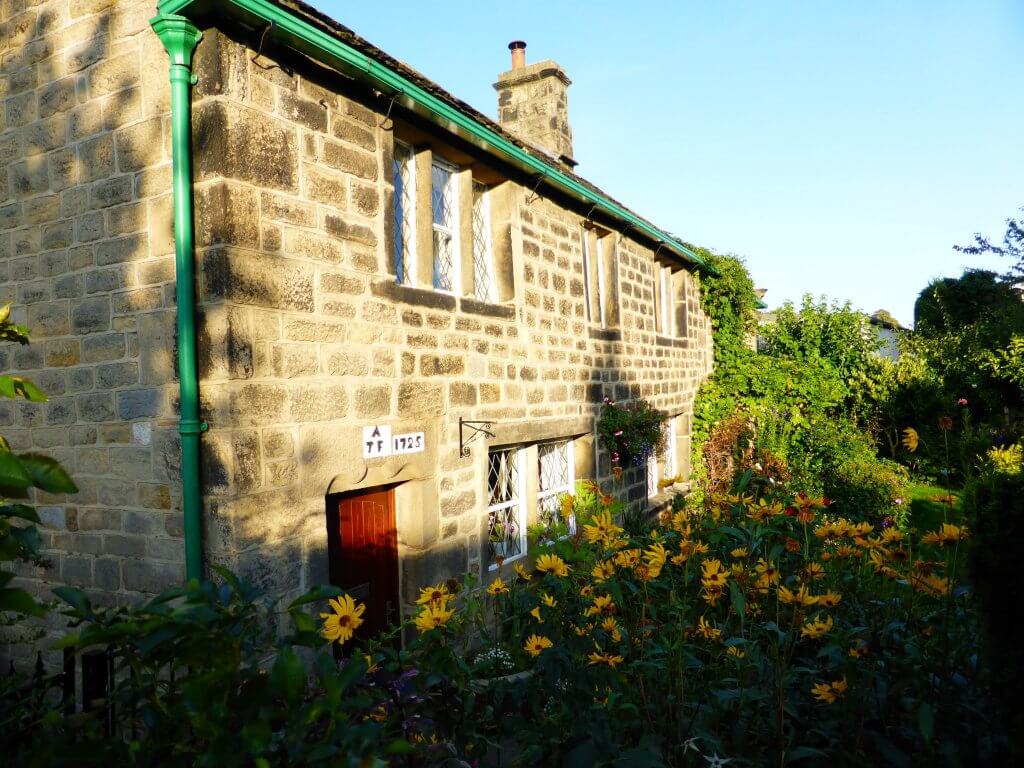
POOL FARM COTTAGE Grade II listed built behind Stocks Hill. Originally a malting house, at the bottom of Pool Bank New Road. “1725 A T F” is the date stone above the door – Anne and Thomas Fourness. “In the name of God, amen. I Thomas Fourness of Pool in the parish of Otley and County of York, Yeoman”. In his will of 1727 he gives to his son Tobias Furness all his lands messuages and tenements being in Pool, Menston & Slaiborn (Stainburn?), my freehold and copyhold lands lying in Otley” “all my Husbandry gear, all my malt and what is due for same and in any wise belongs the business of malt making, one third part of all my household goods and horse beasts and sheep by him to be freely possessed and enjoyed” He also states: “ I give the sum of five pounds to be distributed to the Poor of Pool and Otley at the direction of my Executor.” The father of this Thomas was Tobias and is described as a Yeoman farmer and linen draper living at Creskeld Hall in 1692 (Don Cole)
The inventory of goods in the 1727 will of Thomas Fourness includes “brewing vessels, malt kiln, malt soon stool, sacks and other materials” This confirms it was originally a malting house probably converted into a farm some one hundred years later when some of the barns were added. (Tom Grange) Peter Thornborrow , Conservation Consultant, states the farm “is more like a 17th century building” and that the farm buildings were possibly built around the time of the building of the railway 1865, as the stones are of a “railway” appearance.
As occupiers of the farm in 1733 Otley Church registers records a Marmaduke Dunwell as a “carrier in Poole”. In Bains Directory of 1821 James Dunwell (1781-1856) was a carrier to Knaresborough on Wed. and Bradford every Thursday at Pool Farm Cottage till after 1849 (SHP). His eldest son, Joseph Rhodes Dunwell (1807-1835) a Pool Methodist missionary, went to Ghana in 1835 where he died 6 months later (see “Churches”)i
The Award Map of 1774 shows Thomas and John Fourness (or Furnish) owning land on Old Pool Bank. According to Poole Doles 1727, it appears to have been part of Pool Farm. A conversion by Tom Grange c. 1990, on the east side of the farm, which was originally a barn, was converted to a kitchen with bedrooms above. There is an original inglenook fireplace with stones 4’6” thick supporting the outside wall of the farm. The pink granite cobble stones were thought to have been laid c.1930, some of the areas underneath are laid with flag stones.
The property was owned John Milthorp of Pool House in 1822 purchased Mrs. Ann Nowell Stott relict of the late Nowell Stott Esq. of Manchester, she died on 8th April 1839 and Pool Farm Cottage was included in the sale. This and other property was inherited by Miss Susannah Stott of Pool House who died in 1873. Pool Farm Cottage then came to her cousin Miss Susannah Greene Stott who died on 25th October 1883. In 1921 her deeds confirm that “a farm with farm house and buildings and 12 closes of land in all 69acres. 9 roods. 39 perches, was in the tenancy of George Newby, when he paid an annual rent of £140.00. It was owned Mr. R. Feather in 1922.
Tom Grange now farms from here. At certain times he grows the old fashioned type straw used in thatching cottage roofs. He uses an old binder loaned from Harry Denton on Castley Lane, building stooks to dry the straw. The photo above was taken before the removal of a barn with outside steps to the left of the entrance. The area above the pig in the field, was the bull pen. Pool Bank Court houses were built on this land c. 1970.
As a lifelong local former he unearthed many interesting items including a quern found on Farnley Hall land. From John Cruse: Secretary of the Prehistory Research Section of the Yorkshire Archaeological and Historical Society who is an expert on their assessment “The ‘Celtic’ quern, with a drilled horizontal handle hole, is a fairly typical, largely intact, upper stone of a beehive quern of Late Iron Age to Romano-British date. A location near Farnley [Hall] , c. SE 21 48, well away from Roman Roads, would be typical of Romano-British settlement.
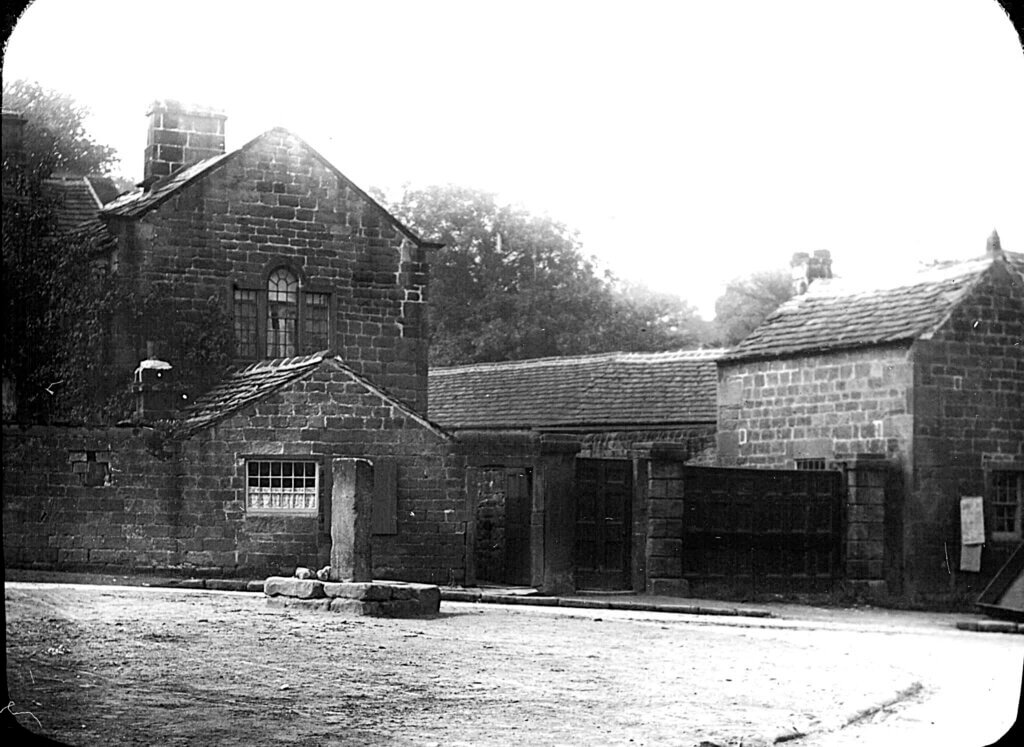
Pool Hall and Stone 1890 north, at junction of Arthington Lane.


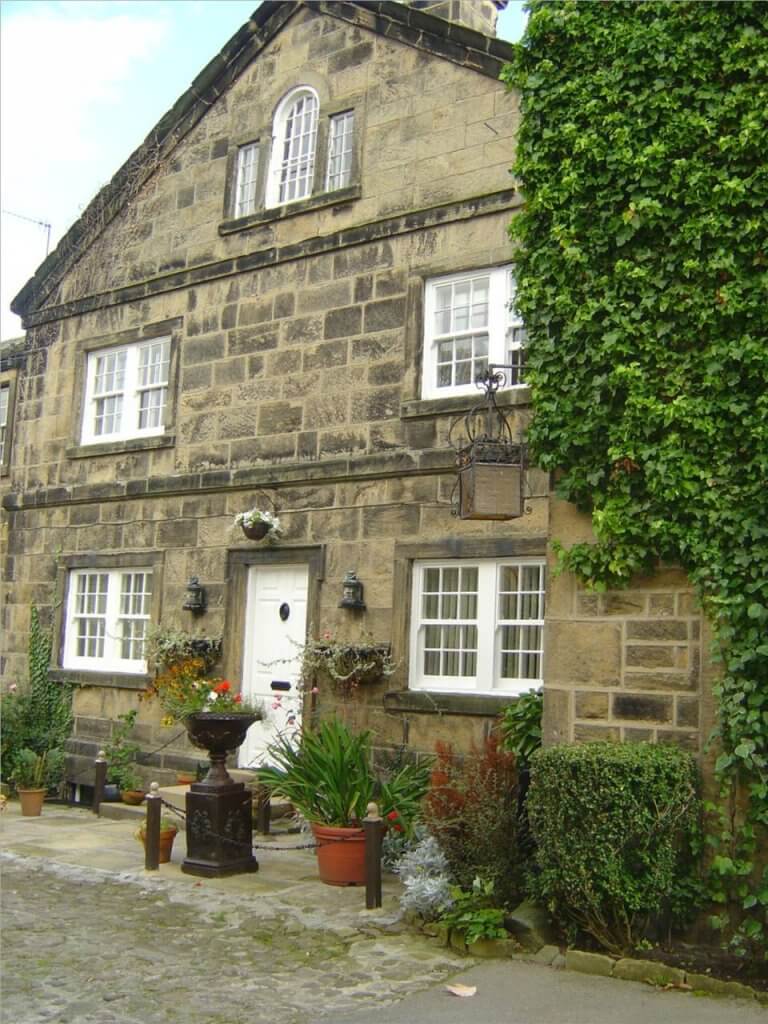
POOL HALL. Listed building Grade II, (2004 address is No.1. Pool Hall) Believed to be the oldest house in the village. The main Hall was originally built in 1578. (G.H.) 1593 is a date taken from an old painting in the Hall in 1928, when much of the woodwork had to be removed. (SHP)
According to Gordon Hinchcliffe, the recent owner, during alterations in 1727, the main entrance was changed from north facing to south facing. He has also unearthed a stone which was broken in two bearing the words “Pool Poll” also some mullion windows. (Pol was the Anglo-saxon word for large pond or marsh). A sandstone “angel” has also been found in the garden. During internal alterations to No. 2 Pool Hall, he discovered a Priests Hole on the l.h.s. of the fireplace. (This was possibly used for the doorman as it is placed near the doorway. – P.T. ). Some parts of the will of Michael Nicholson (Pool paper mill owner) were also found. (now in Otley museum) which according to SHP is where he lived until 1840.
Mr. Hinchcliffe has a ghost story (also seen by previous owners) When Hinchliffe’s first arrived, they heard footsteps coming from a stone staircase which used to lead to the servants quarters. When one of the neighbours came to live in one of the converted outhouses she brought her young baby and all sorts of strange things happened i.e.. all the lights going out. The tenant of No.2 Pool Hall in 2007 told me she felt someone nearby and that something touch her knee which her husband said was not him! She was also told that there was a servant girl named Gwen who had an illegitimate baby to the owner, but she died at childbirth. (I have had a lady enquiring at Pool Feast in 2009 if I knew of anything strange as she had rented the property, knew nothing of the history but was uneasy when in there!) Strange things have also happened in the past in nearby cottages, previously the paper shop, North View Stores.
“The roof retains an original queen-post truss that is surmounted by a fish-bone king-post, an unusual combination.” (Architectural Historian Peter Thornborrow) There was a well in the garden (now the pond) and one under the now converted barn, filled in but causes much dampness and should have been “topped”. (GH) There is also a soak away under the Hall and there are culverts to divert any water away from the house .
1675-6 ” at Pool, near Otley, in the Wapentake of Skyrack, a trifling Annuity, the gift of Mrs. Fleetham of Pool Hall, for teaching 6 children”.(DD) A grave is in Leathley churchyard to Mr.” F_eetham of Poole” d. 1758 aged 74. The Otley Parish Register April 13th 1717 – John, son of John Fleetham of Poole has his birth registered. Later in1719 John Fleetham is described as being a “maltster.” Land Tax returns for 1753 show John Fleetham paying 19/-d. (W.Y.A.S.)The Fleetham Charity is also mentioned by H. Speight when in 1675/6 John Thomlinson is mentioned as Curate of Pool when he was “licensed to the curacy of Pool”
James Dinwiddie, a solicitor, was there in 1819 and (John Dinwiddie owner in 1826 Poole Doles also on Thorpe map of 1822 and owner of land on Old Pool Bank ) buried in Leathley churchyard. James Dinwiddie is mentioned in the Land Tax returns in 1784 to 1802 for the paper mill, when he was a proprietor (of property?) and Michael Nicholson in 1821 being the occupier, paying £1.7.6d.(possibly Pool Hall) He (M.N) is also mentioned in deeds connected with Pool Bank Quarry. James Dinwiddie’s death was recorded in Leeds Mercury on 25th May 1836, aged 85 and “was formerly an eminent cotton spinner in Manchester” (see also Manor House) The fifth grandson of the late James Dinwiddie, Cornelius Whittenbury married Eliza Hargreaves at Pontefract c.1.7.1839
Michael Nicholson (Pool paper mill owner) sold the Hall in 1840 to Samuel Fieldhouse (1781-1850), wife Mary died 1877, whose sons were William Fieldhouse, with James and John (died 1893 aged 86) living there. Census of 1871 shows James and wife Sophia (died 1879) were there and owners with 40 acres employing 1 man. Two windows were erected in St. Wlilfrid’s Church by Ann, wife of James, in memory of John Fieldhouse of Pool Hall in 1874. The occupier Herbert Gill ( see Poole Doles) living there in 1891 with wife Lucy, 3 sons and 1 daughter (1891 census)
The gravestone records shows Samuel Fieldhouse died in1850 aged 68; William son, Mary wife of Samuel, James son and Mary (died 1877); Sophia wife of James died 1879 and John Fieldhouse 1893 aged 86 years.
When occupied by B.H. Mallinson the sale of Pool Hall, farm buildings, garden and orchard, 2 cottages occupied by Denton & Johnson and 42 acres was sold by auction at the White Hart, Pool on 31st Oct. 1894. The house consisted of 3 reception rooms, 6 bedrooms, 2 attics, kitchen, domestic offices including large arched cellar. Garden & orchard. Farm buildings ranged on two sides of large yard, comprising 5 stalled stables, chamber over, mistel for 5 cows, large barn, coach house, cart shed, piggeries and hen houses.(O.M. O/P/dc/1, including map)
The land and houses in 1894 was passed from B. H. Mallinson to John Yeadon from Mathew Cranswick, J. G. McCandlish & R. Hutchinson. 1897 J. Woodcock, David Brook and John Yeadon. 1913 Sarah Ann Yeadon, Joshua Fearnside Sinclair and John Bramley Yeadon. Mortgagee Mary Elinor Yeadon. In 1928 Conveyance of Merger of Tithe commutation of rent charge of 2/3rds of 6/8d. between F. H. Fawkes and J.C. Jackson. Original payment in 1866 made by Clough Jackson, for Railway land. John Bramley Yeadon moved from The Nunnery, Arthington to Pool Hall, which he bought, in1901 died there in 1913, buried at Arthington Church.(The Nunnery Arthington- Don Cole) John Bramley Yeadon owned Pool Hall and Pool Hall Farm in 1910. (Electoral Roll)
S. St. M. Delius came to the Hall in 1922. (SHP) They were related to the composer and were in the Bradford woollen trade. Delius is reputed to have played the piano in the Hall. J. C. Jackson there in 1929. J.C. Jackson lived in Pool Hall c.1928 to 1931. In 1931 the farm passed from Jackson to W. L. Whiteley for £4,500. The house and shop was sold to Harry and Gertrude Foster for £2,300.
The intended purchaser in 1931 was Elinor Stewart Johnson (deeds in Wakefield Archives). In 1937 during the occupation of Walter Johnson, a garden party was organized with guest speaker, Sir Oswald Mosley, leader of the British Union of Fascists. The high walls which surround the Hall were daubed with anti-fascist slogans. As a friend of Mosley, during WW2 Walter Johnson was interned in the Isle of Man and returned in 1941.
The residents in 1948 were Captain and Mrs. Bulay-Watson, their Christmas card dates the Hall back to 1593. Stephen Smith (Garden Centre) lived there in the mid 1970’s, now converted into several houses. (see “Houses Pre 1850” and “Terraced Cottages/Houses.”
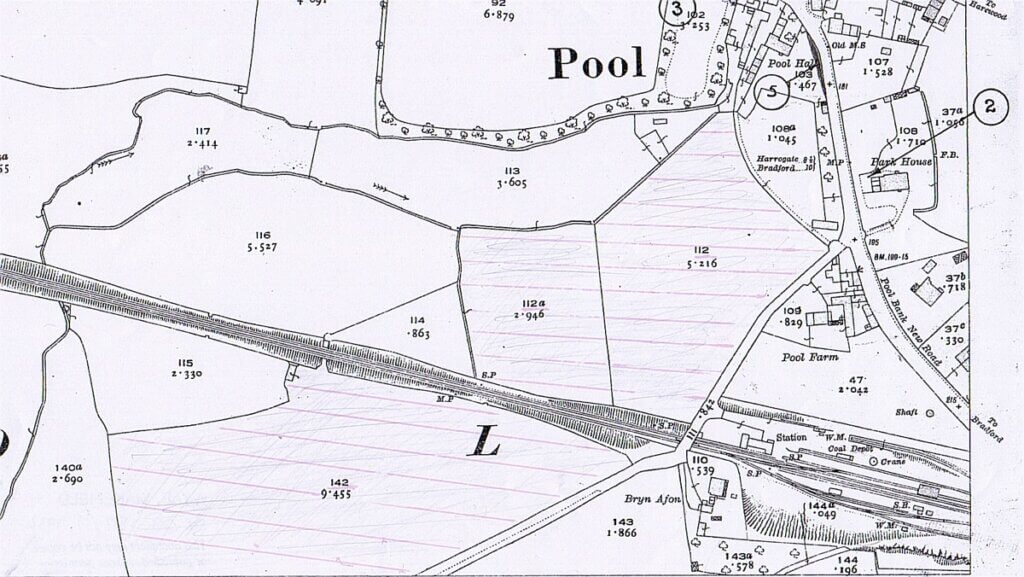
The West Yorkshire Archives in Wakefield (2013) show a covenant is on fields 112, 112a & 142 to the west of the Hall which on 6th June, 1931 was passed to William Lumb Whiteley who agreed with the restrictive covenanted which stated he was not to erect or cause to be erected any buildings in certain fields mentioned. The purchaser hereby covenants with the vendor (1) for the protection and benefit of the vendors adjoining property known as Pool Hall that neither he the purchaser nor his successors will at any time hereafter erect any buildings in the fields numbered 112, 112a, 142, (2) to forthwith at his own expense make up all doorways. (West Yorks. Archive Service 29th May 2013.)
March 27th. 1900. Drove to Otley and took 10.59 train to Leeds and went to Mr. Beevers office to sign contract for farm buildings at Pool Hall. Contract £750….nearly £100 higher than the next highest tender. No doubt we stand well in reputation for making good work, otherwise we should not have got the job….” Timble Man , Diary of a Dalesman by Ronald Harker – Hendon Publishing. This was possibly for the building added to the west of the row of cottages which became Hall Farm run by the Holmes family until 2000 approx. when David Holmes then converted it into rented accommodation.