THE STORY UNFOLDS
“Many of these trees in the fields about Pool, are from twenty to thirty feet high and bulky in proportion; in Spring they usually put on a lovely mass of snowy blossom which yield a profusion of crimson fruit. Beautiful looks the valley too when viewed from some convenient standpoint.”
Harry Speight “Upper Wharfedale” published in 1900


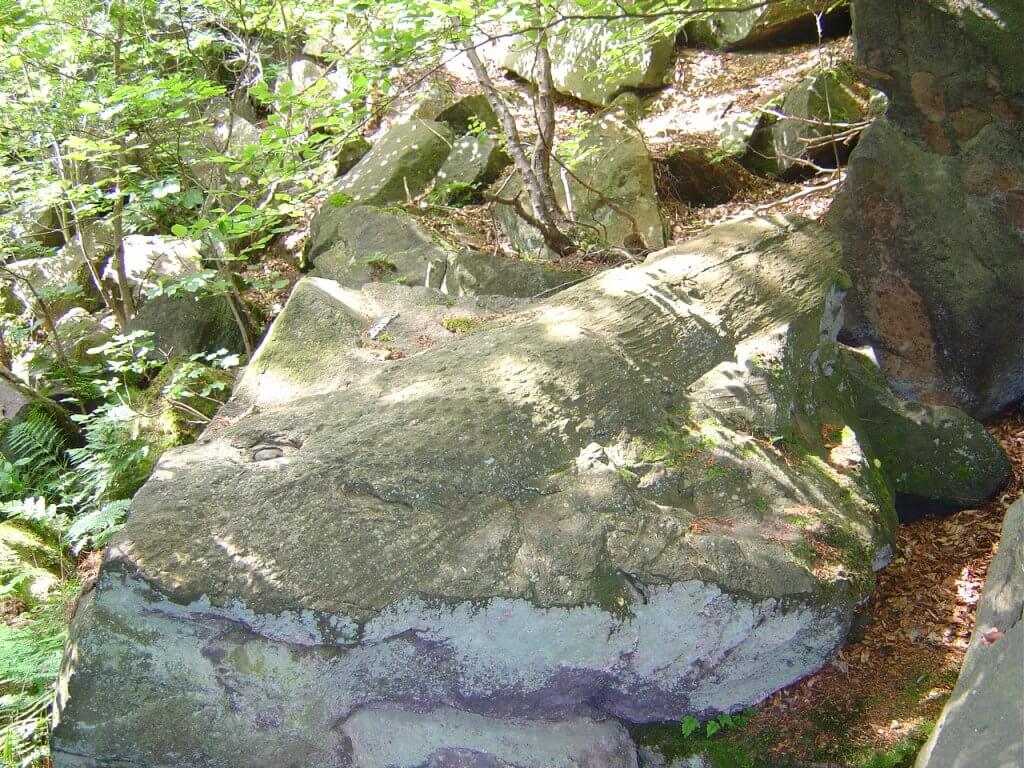
A number of fossils can be found in the Old Pool Bank Quarry, off Old Pool Bank (road). These are in the form of tree branches and roots from the Lepidodendron, a tree which resembled a gigantic Christmas tree. These ancient forests existed approximately 280/300 million years ago. The fossilised tree root is named “stigmaria”. Another fossil in the quarry shows the groove that ran down the centre of the branch which was formed as the fascular tissue collapsed. It is because of these and other fossils that the area could be considered worthy of being designated a Site of Special Scientific Interest.
A Flint (Dictionary definition “implement used by primitive human beings.”) found on Old Pool Bank is now in Otley Museum. This was discovered during 2000 in a mole hill, just below the two bungalows on Old Pool Bank. The type of stone indicates the flint was brought from the East Coast. Neolithic flints and beehive querns were found during tree planting on the Danefield Estate on the Chevin giving evidence of an Iron Age settlement.
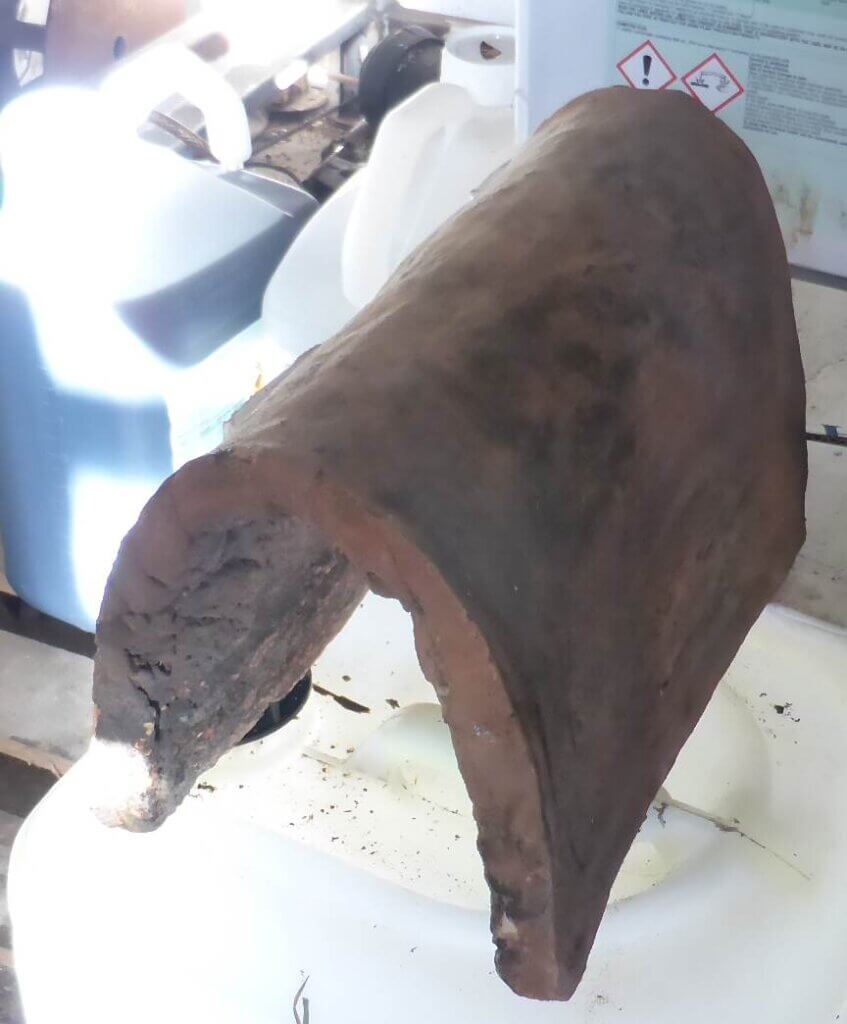
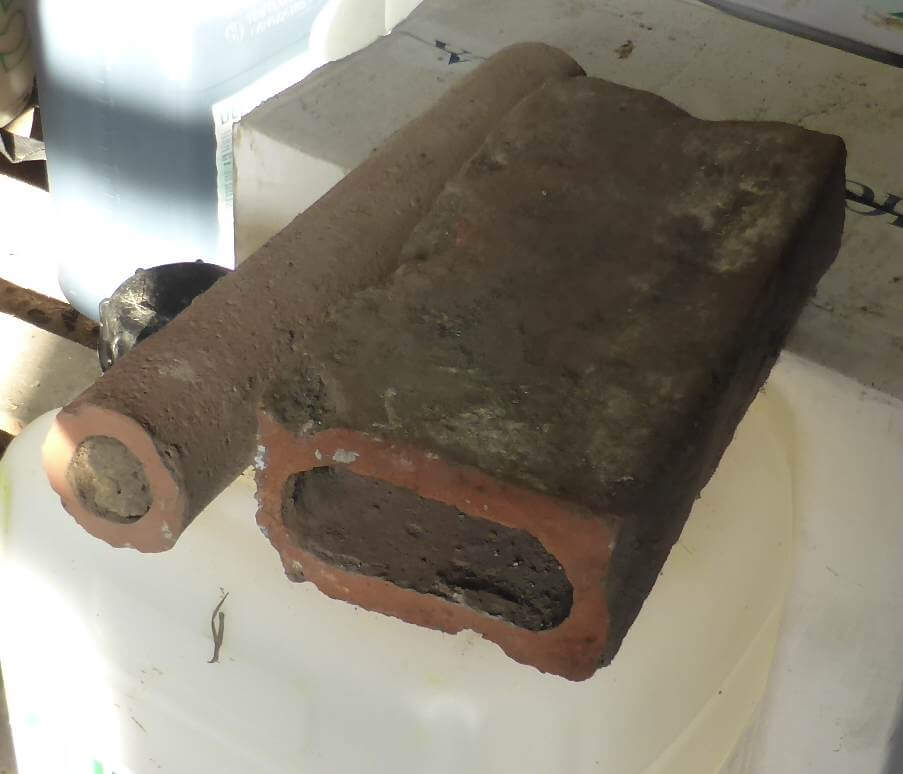
Old Drainage pipes found by local farmer c. 1999

A Quern was found by local farmer just to the north of the River Wharfe on land owned by Farnley Hall. “The ‘Celtic’ quern, with a drilled horizontal handle hole, is a fairly typical, largely intact, upper stone of a beehive quern of Late Iron Age to Romano-British date. A location well away from Roman Roads, would be typical of Romano-British settlement. (Prehistoris Section of the Yorkshire Archaeological & Historical Society)

4th Century AD A Roman gold coin of Valentinian 1 dating to 364-375 AD was found just below the surface of a rockery in the garden of Firs Hill Court on 4th Sept 1957. Monument No 51664 (Cartwright Memorial Hall Museum, Bradford). It would appear this was originally recorded in the book AD 1500 WYAS as being found in a garden at Old Pool Bank
1030 The spelling of Pool is Pofl. (Leeds Library, West Yorkshire Archaeological Survey to AD1500)
1086 The Domesday Book was begun in 1086 by William the Conqueror. It was to contain the records of a survey of England giving details of ownership, extent, value, population and stock at the time of the survey. This was to be used for taxation purposes and a government reference book. Pouele (Pool) is mentioned as part of the Liberty of Otley held by the Archbishop Thomas of York. Pool was to be taxed on 6 Carucates, this making its farmland the same as Otley and Guiseley. (see copy of entry in “Introduction” )
When William began his reign the annual value of Otley was £10 but by the time the Norman invaders had conquered the land, Otley’s value had been reduced to £3. *Dictionary of 1899 says “the size of a Carucate is the amount of land ploughed by a team of 8 oxen in one year.” Or between 80-160 acres, the area needed to support a family for a year
1135 Marriage of William Gascoigne with the Heiress of Gawthorpe (Harewood) about the reign of Stephen. William Gascoigne, (c.1570) owner of Caley Hall c.1550, the last male descendant of the House of Gawthorpe, had only one daughter, Margaret, his heiress, who married Thomas Wentworth of Wentworth Woodhouse.
1164 At the time of the Domesday Book families in the area had the names de Caylli (Caley), de Pouil (Pool), de Castellay (Castley), and Huge de Cressekelde (Creskeld) These families are believed to be pre Norman conquest families. Although mention of the Pool family occurs in earlier local deeds the first date of de Pouil seems to be in the Great Roll of the Exchequer where Hugo de Pouilla renders account of five marks due from lands in 1164. (H.Speight)
1166 Pool was owned by Serlo de Povel. (Map in Leeds Library). He married Agas de Vavasour of Weston and was the son of Peter de Arthington, founder of Arthington Clunic Nunnery in 1166. (H.Speight). Pool Corn Mill, Mill Lane, was owned by the Nuns of Arthington (West Yorks. Archive Service)
1100’s “Manorial ponds in medieval Yorkshire are frequently mentioned. A reference to the fish pond complex at Pool is made in a late 12c. grant of land lying next to Pool Fish Ponds. The use of the plural suggests a series of fish breeding tanks. The context of the grant places them beside one of the medieval routes which led out of the village, possibly the major route along the southern side of the Wharfe valley connecting Skipton with Harewood via Ilkley and Otley” (West Yorkshire Archaeological Survey to AD 1500). These tanks were also used to breed and store fish to be used at a later date and were usually a series of large pits dug out of the land. At the marriage in 1120 of Cecilia Romille to William de Meschines this road connected their Skipton Castle with Harewood Castle. (History of Leeds – 1834)
1202 Thomas fitz Hugh and Serlo de Pouele and others are fined for claiming 30 acres of land and farms in Farnley. (H.S.)
1221 c. Ralph son of Hamell of Pouil was a direct descendent of Peter de Arthington, founder of Arthington Nunnery in 1166 (H. Speight – lineage map). He gave a messuage and two tofts, with half an acre of land here.(a messuage was a dwelling with outbuildings and land owned by the Lord of the Manor to be worked partly for his benefit) in Pool which belonged to Holbert of Hevat. The witness was Hugh Lelay, who gave the church of Weston to York Cathedral in 1221. The Nunnery at Arthington was poor and writings dated 1449 state that “Donations betwixt John Arthington and the Prioress were given to the convent” (Wharfedale Observer. Jan 5th. 1883 also The History and Antiquities of Harewood by John Jones 1859)
1254 Thomas, son of Isaac de Pouil in 38th year of Hen. III, gave all his culture of land in Pool extending in length from Milnbeck to the highway leading to York. (As old English for mill was miln this could be the corn mill on Mill Lane, therefore suggesting the corn mill was working before 1254.) (The History and Antiquities of Harewood by John Jones 1859)
1258 Simon, son of Robert de Pouil (Robert a direct descendant of Peter de Arthington founder of Arthington Nunnery-H.Speight) in the 42nd year of Henry III, sold to the nuns all his meadows in Pool here lying near Winarderiding. (The History and Antiquities of Harewood by John Jones 1859)
1260 Robert de Pouil was witness, along with others to a deed granting Master Gilbert de Bingley one oxgang of land in Creskeld, to be held by him and of the Nuns of Arthington there serving God, by paying annually one penny, at the Feast of the Blessed Mary.(H.S)
1267 An indictment presented by the inhabitants of Pool, Otley, Bramhope and Arthington to the effect that one Ralph Brun had committed many robberies and fled. He was apprehended and executed at Otley gallows. “His land, said to be worth 24s.4d. and chattels, worth 14s. were forfeited.” (H.Speight)
1279 A number of Field Barns are likely to have existed for storage, shelter and the collection of valuable manure to be returned to the grantor for fertiliser. A grant of property in Pool in 1279 included 2 parts of the marsh and a share of “Henririding”, except the wood and part of her (the grantor’s) grange on the west side. The sequence of the grant implying the barn lay within the area called “Henririding” – (W.Yorks Arch Survey)
1279 The mills (plural) of Pool are mentioned in an inquisition taken at York in June 1279 “as yielding with other things there an annual rental of 50s. to the Lord Archbishop of York, and the said lord is bound by his charter to defend them against whomsoever it be.” (H.Speight) This would probably be a corn mill as the name of Milner (Miller) in the poll tax returns of 1379 for Pool show John de Milner as paying 4d. Cloth weavers were in Otley before 1328. ( H.Speight)
1284 Mention of the family of Pouella in Burton’s Mon. Ebor., p. 191 “Malger, son of William Pouella” gave all his land here, being three acres, on the east side of the way or ford called Haldwadford, in Poolholme, in Castley, to the monks of Fountains; which was confirmed by Robert, son of William Bram de Powel” (“William Brim of Pouile” – Philemon Salter) also spelled Pouelholm in earlier times. Poolholme on map 1847 is shown north of the river, between Pool and Castley.
“Malgar, son of William de Pouilla gave two acres of land here”.(Burton;s Monasticon Eboracense”) This was land in Stainburn given to Fountains Abbey. Another gift to Fountains Abbey “Jeremias, son of William, the clerk of Staynburn, gave 2 carcurates of land and confirmed what his father had give, which Alice, relict of Jeremias of Powel (Pool) quitclaimed and William, father of Jeremias confirmed” (Ancient History of Guiseley – Philemon Slater)
1293 Pool owned by Richard de Goldsborough (Ricardus de Goldesburgh) (W.Yorks.Arch. Survey to AD 1500)
1298 May 3rd The Feast of Invention of the Holy Cross, “John called Russelle, vicar of the church of Knaresborough leased to Sir Richard de Goldesburgh Kt. all the land with appurtenances, which the said John in the town and territory of Poule (Pool) of the demise of the Prioress and Convent of Arthington.” (H. Speight from Wentworth muniments at Woolley Park.)
1307 In The Extent of Otley, 1307 it is recorded that John de Cailli has two carcurates of land at Caley, some 60 acres or over. “Here we see the reason for Caley Hall”.(E.T.Cowling.)
1307 Lord of the Manor of Pool attends Otley Feast. (The Extent of Otley, 1307)
1318 “The Scots entered England under the command of Lord Randolf and Sir James Douglass, and wasted the northern counties with fire and sword, almost without opposition. They poured like a torrent of fire across the wapontake of Claro: murdering, plundering and burning all before them. The forest of Knaresborough suffered greatly from their ravages. They abode some time at Pannal, making the church their headquarters, which they wontonly burnt on their departure.” (Harrogate and the Forest of Knaresborough – William Grainge 1871). The Forest of Knaresborough reached south to the River Wharfe at Castley. (Boundary stone no. 7)
1334 Distribution of Wealth (Township value given in shillings per sq. mile)
Pool 10.5. Otley 8.3 Arthington 5.4. Guiseley 4. Linton 11.7
1600 Distribution of Wealth (pence per 1,000 acres)
Pool 4.9. Otley 4.3. Arthington 3.4
1379 Poll Tax returns of this date record “Poule, Wapintac de Skyrak”. Each paying 4d. were Robert de Dybbe, John Lofthouse, Henry de Thorescrosse, John Wylkynson, Nicholas Filius Ade, Robert Hirde, William Hunter, William fforester, John de Milner, Thomas Gyes, Robert Symason, William Judson, John Hogge, John filius Robert, Robert Filius Robert and John de Esseton. Summa 5s.3d”
1459 Kirkstall Abbey held lands in Pool. A small meadow known as Dipe-Ker, was let to James Cawdray who paid the monks 2s. rent per annum. The name Dipe-Ker implies a deep fen or bog. (H.Speight ”Upper Wharfedale”) This land had been given to the Abbey by Henry de Northeby of Bramhope. (History of the Ancient Parish of Guiseley – Philemon Salter published in 1880.)
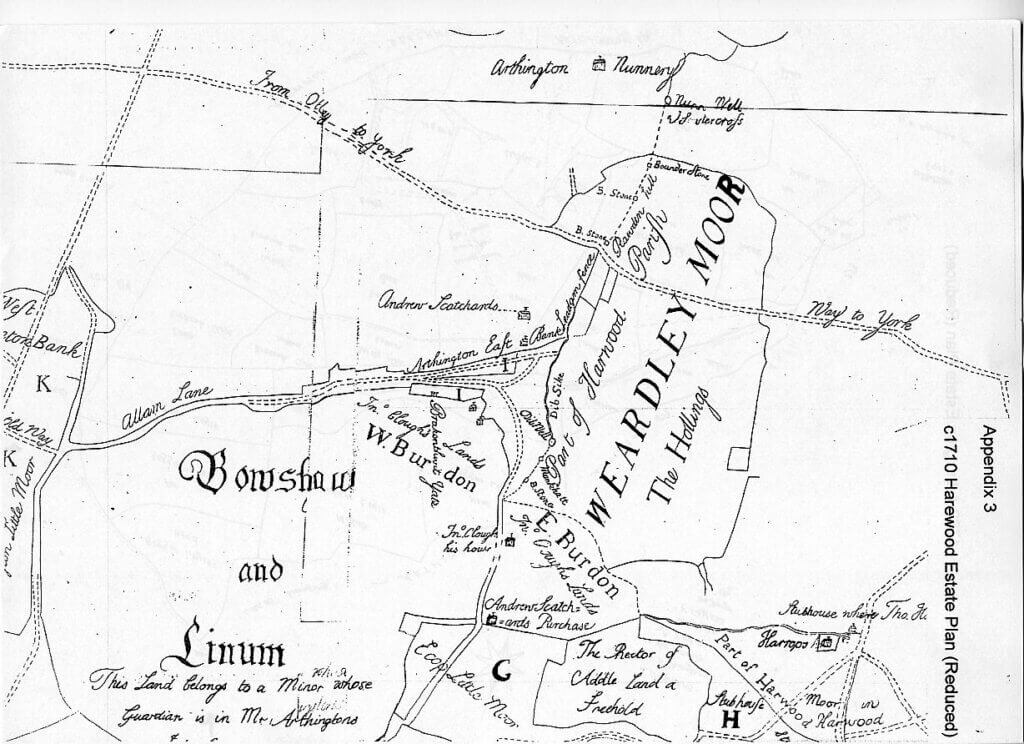
1523 The Lay Subsidy Roll for Poyll (Pool) mentions. John Yngland, Wm. Smethe, Thos Rawlynson, Henry Laghylln, Jn. Tomlynson, Henry Myrghefeld and Wm.Skachard. (H. Speight) Andrew Scatchard is shown as having a house near Arthington on map of Harewood Estate, 1710. See also Wm. Smythe under 1538, John Tomlinson under 1675 and Francis Tomlinson 1672.
1538 Pool Church is dedicated to St. Wilfrid, The Patron Saint of Ripon. The will of William Smythe of Pool, made in 1538, proves that the original dedication was to St. Swithin. (D. Dalton). It is probably about this date that the Chapel of Ease was built. The Chapel was rebuilt 1839 and became St. Wilfrid’s church in 1879.
1539 The Township of Otley Muster Rolls are produced, taken because of a threatened war with France. Volunteers had to provide their own equipment. Thought to come from Pool (see 1523) are:
James Yngland (“Archer, horsed and harnessed, abyll person”) Thomas Rawlyngson, Richard Dunwell (“Archers having no harness abyll persons”) William Dunwell (“Bylman Horsed harnessed Abyll person”) Richard Yngland (“Billman having no harness Abyll person”).
A billman used a bill which was a long stick with a hook shaped blade. (hence billhook) In this case used for pulling riders from their horses. It was also a farming tool. (Full list Otley Museum O/O/dc10)
1553 Richard Oldrede (Oldroyde) Curate. (D. Dalton)
1558 Rev. Sir John Baynes described in the Testamenta Leodensia as Priest of Pool (D. Dalton)
1563. Long lasting dispute over Manor of Pool begins between Anne Kighley, nee Goldsborough, and Richard Goldsborough. Thomas Kighley of Newhall, had married a daughter of John Vavasour of Weston, living in 1505),
1566 The will of Thomas Goldsborough leaves the whole of his property including “Powle” to his son Richard and his heirs for ever. (Huntington Archives)
1569 Manor House of Pool was rented out by Richard Goldesbrough of Goldesbrough, Yorks to Roger Morrys of High Holborne, cook, for 21 years at 63/- per year. (Huntington Archives)
1570/1 Lease of Pool Manor house and all apportionments, is assigned from Roger Morrys of City of York, surgeon & Eleanor his wife . (Huntington Archives)
1578 Pool Hall built around this time.
1586 Otley Parish Register refers to “Pool Mill” (this may the Corn Mill or High Mill/Walk Mill – fulling) (WYAS)
1595 May 15th “Alice Kyghley, daughter of Edmund Kighley, esqr. was christened”. (Otley Parish records)
1596-97 Manor of Pool sold by Richard Goldsborough to Michael Wentworth
1602 Edmund Kighley, husband of Anne Goldsborough, (daughter of William Goldsborough) appears to have left Newhall, Otley to live in Pool where he died in 1602. (H.Speight)
1608 “ Mr. Wentworth receives sums due to him from his tenants in Creskeld and Pool including a year’s rental for Creskeld Hall of £15 by Henry Atkinson and William Atkinson 10s. for his farm.”
1609 The first definite mention of Poole Fulling/Walk Mill in Otley Church register.1609. Henry Dunwell is described as of “Poole Fulling Mill” at the baptism of his son George. This was High Mill – owned by the Fawkes family of Farnley Hall.
*Fulling was the process of cloth finishing. It was cleansed and thickened or fulled in a primitive way by walking or stamping on the cloth with bare feet, and the terms “walker” and “fuller” are synonymous.(see “Industry”, Mills, High/Fulling Mill)
1624 Death of Anne Wentworth, first wife of Sir George Wentworth of Woolley (Lord of the Manor of Pool) and daughter of Thomas, Lord Fairfax. (Otley Church plaque)
1635 James Illingworth, Curate (D.Dalton)
1640-1658 Chapel of Ease (now St. Wilfrid’s) made an attempt to break away from the mother church at Otley, but this was refused. Shown in a Parliamentary Survey of this date. (F.Morrell.)
1640 John Batty (Battye) pays a half year’s rent of £10.3s.4d. for his demesne at Pool. (H.Speight) This could be Caley Hall as he succeeded the Dunwells who were at Caley Hall). Grave in Otley Church yard reads, “as I am today so you may be tomorrow”
1642 The will of Wm. Vavasour dated 3rd Sept. 1642 refers to 5 chapels within the parish of Otley one of which was Poole. (Guide to Otley & District by Charles Walker)
1646 Henry Ricroft was living at Pool Crooks Farm followed by Anthony Ricroft there in 1692.
1651 The Chapel of Ease (now St. Wilfrid’s) is mentioned in the Otley registers. A letter dated 27th April 1883 in the Wharfedale Observer gives a description of the old Chapel of Ease, “I can still remember that tiny chapel, with its uncomfortable square pews, lined for the most part with red and green cloth and which from dampness or want of fresh air, emitted a clothy odour.“ Marked on map of 1756.
1652 William Atkinson pays £10.17s. for his part of Creskeld Hall and farm and George Coates £6. 3s. for his part of the same. (HSpeight)
1661 Isabella daughter of Thomas and Isabella was baptised in October at “Powle Chappell”. (Otley Parish Register)
1661 Lord of the Manor, James Widderington of Castley and Poole The will dated 13 July 1661 of Sir Thomas Widderington knight servant at Law on the marriage of his daughter Catherine of the Manor of Castley and Sanosthorn and in Poole to Robert Shafto. His executors were Thomas Lord Fairfax, Baron of Camoron, Sir Henry Arthington of Arthington, Ralph & Nicholas Widderington, John Rushworth, Nicholas Blackboard and Robert Alderson. (Otley Museum O/cy/dc/2) The legend is that the Robert Shafto was Bobby Shafto in the old ballad, “Bobby Shafto has Gone to Sea.” For sometime Robert Shafto lived in Castley Hall, Castley.
1661 Everyld Thornhill inherits all the Manors of Kirskill and Pool and land in Leathley and Sawely from her father Sir George Wentworth of Woolley, after his death in 1660. George Wentworth married first wife Anne, daughter of Thomas, Lord Fairfax. She died in 1624. Anne Ffourniss is shown as a tenant of Everyld Thornhill at Creskeld Hall. (See 1725)
1662 “John, son of Thomas Bettee of Powle walke mylnes was baptised” (Otley Parish Register)
1669 John Sparrow is the only person remaining in Pool who, as a Roman Catholic, refuses to attend the Church of England. “Sparrow Croft” and cottage are marked on the map of 1756, possibly the Bar House, Arthington Lane. John Sparrow is also mentioned on the Boundaries of the Manor of Kirskill and Poole of 1674 when fined for diverting a stream at Cattbe Siming, (known as Town End Close on the 1849 Tithe map and now as Sim Ing.) This is the land on which the Village Memorial Hall, school, tennis, football and cricket clubs now occupy.
1672 Births registered in Otley Parish Records during this year: Sept. 26th Harry to Francis Thomlinson, (see 1674); Elizabeth to John Robinson; Daniell, son to William Dunwell of Poole; Oct. 27th Luke to William Earnshaw; Nov. 24th Ursula daughter to John Mirfeild.
1673 Mills of Pool were washed away by the Great Flood. The event recorded in Otley church register states, “Memorandum, Sept.11th 1673. This summer is remarkable for the abundant and continual rain therein. On the 11th of this month there was a wonderful inundation of water in the Northern parts. The river Wharfe was never known to be so big within memory of man by a full yard in height, running in a direct line to *Hall Hill Well. It overturned Kettlewell Bridge, Burnsey Bridge, Barden Bridge, Bolton Bridge, Ilkley Bridge and Otley Bridge and the greater part of the Water-mills. It also clearly swept away Pool Low Fulling Mills, and carried them whole, like a ship to the sea. It left neither corn nor cattle on the coast thereof.”
*Hall-Hill-Well, a spring immediately below the Roman Catholic Church running east of Bridge Street)
1674 Pool Manor Court Rolls show fines made by the Lady of the Manor to villagers not using her Pool Corn Mill also removing stone from the hillside.
1674 The Manor Court Rolls of Kirskill and Poole include the names Arthington (Arthington Hall), Atkinson (William of Creskeld Hall see also Henry of Caley Hall 1682), Earnshaw (bayliffe)(see 1672), Thomlinson (see 1672-5-6), Bradley, Dawson, Allan, John Sparrow (see 1669 above), Mirfeild (see 1523 & 1672), Rycroft (lived at Pool Crookes Farm), Coates (land at Creskeld Hall see 1652), Smith (see 1523, 1538 & 1711), Hobson (see 1727-8), Dunwell (see 1672), Brown, Sargeant, Murrow, Shaftoe (see 1661)
1674 William Mirfeild is fined 15/-d. by the Lord of the Manor for removing stone from Pool Common to build a house in Leathley without his permission.
1674 Birth registered in Otley Parish Register records on 1st Apl Sibil to Thomas Dunwell.
1675-6 John Thomlinson is mentioned in the Fleetham Charity as Curate of Pool (D.Dalton.) He was licensed to the curacy of Pool (H.Speight.Yorks. Archl. Jl.ii.110))
1680 “Cloth was woven and taken to Esholt, Pool, Baildon, Arthington and Harewood to be fulled or milled.” (Philemon Slater)
1682 William Atkinson of Creskeld in his will left to his son Henry, lands in Pool called Hardcastle Farm. (H. Speight)
1694 The Atkinson family sold messuages, etc. at Pool called Dawcroft, Red Ing, Sun Ing. etc. (H. Speight)
1711 Otley Parish Register records the birth of “Elizabeth daughter of Mr. Matthew Smith, an officer of ye Excise at Poole”.
1711 Monument found during refurbishments of Otley Parish Church Room in June 2011 which reads, “Here lieth the Body of Thomas Mirfield son of John Mirfield of poole who departed this life ye ? day of May in the year 1711 being 33 years of his age. Also the body of Margaret wife of the above said Thomas Mirfield of Poole who dyed April ye ll 1752 aged 68″
1717 The Otley Parish Register April 13th 1717 – John, son of John Fleetham of Poole has his birth registered. Later in 1719 John Fleetham is described as being a “maltster.” (brewer)
1719 Otley Parish Register records William Tyas – Fellmonger of Pool (leather worker.) Washleathers were being manufactured at Pool High Mill along with paper and paste-board c.1740.
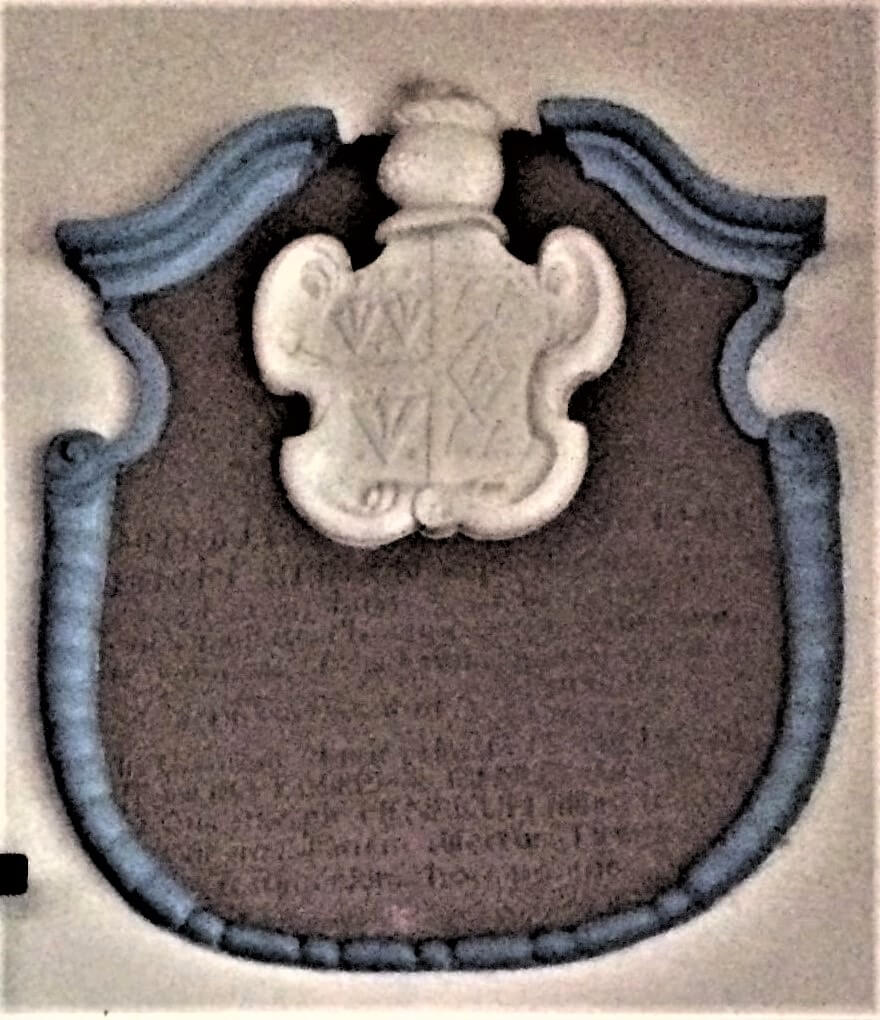
1722 Henry Atkinson of Caley Hall married Frances daughter of Francis Fawkes, M.P. of Farnley. They had a son, also Henry who died without children. A plaque in St. Wilfrid’s Church is dated 1743 to Henry Atkinson of Caley Hall, “the memorial raised by his wife Frances Fawkes of Farnley Hall. It features a heraldic shield forming a conjoined achievement of arms set within a shaped cartouche with an open-pediment.” (Peter Thornborrow G.N.S.M; P.G.Dip..E.L.H.(CNAA) “Proposed Conservation of Pool-in-Wharfedale” 2005)
Around the year 2000, due to accidental damage to the flooring in the church, the floorboards were replaced to reveal the grave of Henry Atkinson.
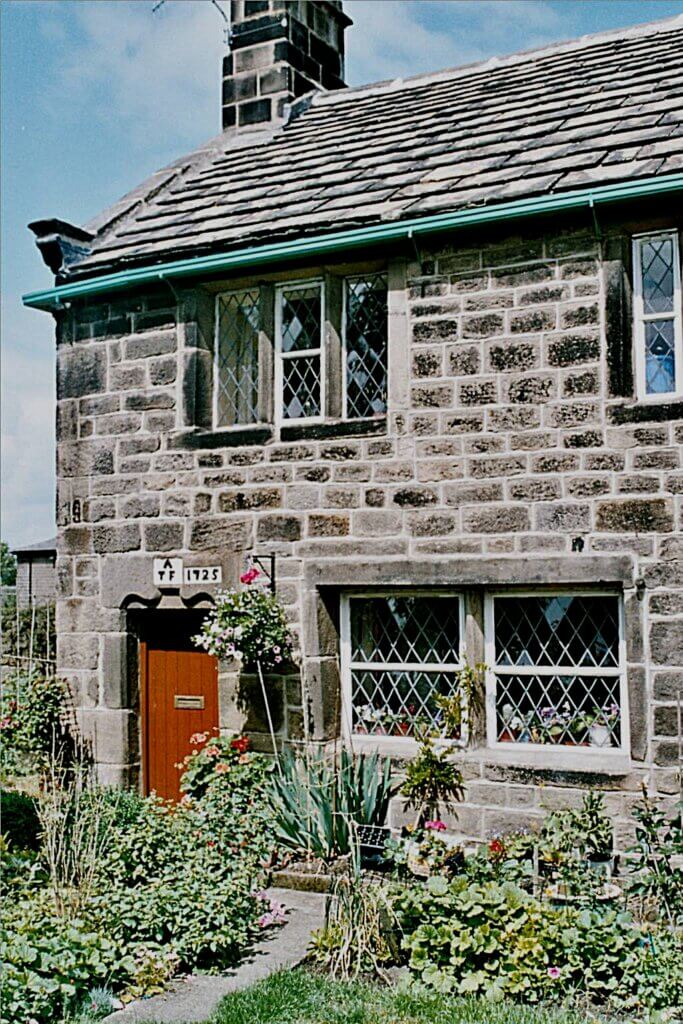
1725 Date above Pool Farm Cottage, “ATF 1725” Anne and Thomas Fourness. In his will of 1727 he leaves “to my beloved son Tobias Furness” all my lands, messuages and tenements being in Pool, Menston and Stairnburn”. He also gave all his malt and any belongings in the business of malt making. The cottage, originally a malting house, is shown as owned by Thomas Thornhill, Lord of Manor of Pool on map of 1756, Anne Ffourniss is tenant of Lady of the Manor, Everyld Thornhill, at Creskeld Hall in mid 1600’s and Thomas Ffurnish, (father of Tobias) Yeoman, there in 1692. Later owned by Susannah Stott, Pool House c.1850. Leigh Feather 1940 who ” installed lighting and inside loo, also updated the outbuildings.” (Kendal Newby)
1725. 11th Dec. An inventory on the death of “William Norfolk of Poole, Yeoman”* reads, corn barn, barn containing cows, horses, swine. House with 12 pewter dishes, plates and spoons and tin vessels, South Parlour, North Parlour, 3(?) bedrooms, a Buttery with wood vessels. Signed by Jon Fleetham, Thomas Metcalf, Mich Coates, Tom Flesher. (OtleyMuseum.O/P/iv/1). 1730 Joseph Norfolk had daughter Anne, he is described as a fulling miller. *A yeoman was one down from landed gentry and would normally have more than 100 acres.
1727 “Poole Doles” was begun by a Mr. Laycock who gave an annual amount of £1.00 from land payable to the poor of Otley Parish to be distributed at Poole Feast. Mr.(William) Hobson 10s. in 1728 and John Dixon 3s. in 1749. This, together with the sum of 7s. or 7/6d. a year being a portion of Queen Elizabeth’s grant of £5.6s.8d. for the Poor of Otley Parish and with money collected at the sacrament to be distributed among poor persons of the Chapelry of Pool not receiving regular parochial relief. (Charities Document in Otley Museum) A William Hobson is mentioned in 1674 in the Manor Court Rolls of Kirskill and Poole. (See Poole Doles & Poole Feast under “Living”, “Events”)
1732 Otley Parish Registers records William Rawling a blacksmith in Pool, at the birth of his daughter Mary. Also a record (gravestone) of William Rawling of Pool, Blacksmith in 1782, believed to have been on Stocks Hill.
1753 The road from Dudley Hill (on the Bradford – Wakefield Road) to Killinghall was turnpiked. The route ran via Pool, Leathley, and Beckwithshaw. The road at this time was considered barely passable in bad weather.
1753 Toll Bar Riots takes place when an angry mob of 200 pulled down a toll bar at Pool, just nineteen days after it had been built. The mob then marched along the road to attack Harewood bridge turnpike, but as they surged through Arthington, were met by the mounted trustees of the turnpike who were meeting at Arthington Hall. The mob was eventually turned away. The following day they again gathered near Harewood turnpike where a pitched battle ensued between Edwin Lascelles of Harewood and his armed retainers. The mob was eventually beaten off. (Otley Museum.)

1754 Pool Bridge was built by subscription (J.Bigland. “Topographical & Historical Description of the County of York” 1819). This replaced a ferry (Jennings). A ford (W.Y.A.S). The ford was possibly called Rother Ford, east of the present bridge as the field name on the Castley side suggests. (still named Rotherford 2022)
1754 “The Curate is entitled to the annual sum of five shillings a year payable by the Church warden for preaching a sermon at Tollerton on Poole Feast Sunday.” (Rev.Mercers notes)

1756 A map of Pool is prepared showing part of the estate of Thomas Thornhill, Esq. Lord of the Manor of “Kirskill” and Pool. This map indicates two township gates leading into Pool. One on the Pool side of the bridge, the other alongside St. Wilfrid’s Church adjacent to Church Lane once named Lodge Lane. These may have been toll bars (Peter Thornhill, Architectural Historian). The original map is in Creskeld Hall, it was traced by Don Cole in 2002 and is now in possession of Pool Archives by kind permission of John Stoddard Scott.)
1762 “J.M. 1762” faded date on circular window of Pool Paper Mill, Low Mill. “J.M.” refers to John Milthorp, mill owner at the time. (David Whiteley.) However this may have been M for Maude..Another version of 1929 is M. for Martin, who was at the mill in 1801 and may have rebuilt the mill after a fire in 1808.
1765 Christopher Alcock, Curate.(D.Dalton.)
1765-8 John Thomlinson “curate of Poole” (F.Morrell.)
1767 Thomas Jeffrey produced his “County of York” map, surveyed in 1767 showing Pool. Kers Kilns are marked and the mound it still there 2004, topped by a large tree, still called Lime Kiln Tree. (This is south of the old rail track towards Arthington)
1770-8 William Smith “incumbent of Poole”. (curate) (F.Morrell)
1773 “Moor or Common called Poole Common from the said Common containing 2r:8p bonded by ancient inclosed Lands of the said Thomas Thornhill on the North, by an ancient Inclosure of Francis Fawkes and Lands therein awarded to him in lieu of Tithes on the East, by Caley Low Road on the South, and by Lands therein awarded to John Milthorp and Wm Milthorp on the West.” (Pullein Papers)
1774 The Tythe Award Map is completed.
1775 Date above door of the Old Mill House, Mill Lane though the mill house had previously been up for sale.
1778-89 Roger Wilson LL.B “minister of Pool” living at Grove House, Bondgate Otley. Succeeded by another William Smith living at Rottten Row, Otley. (F.Morrell.)
1788 Born 1788, Elizabeth Rhodes of Menston and Bramhope, married James Armitage of Farnley Hall, Leeds. In 1805 the “Manor of Poole” was sold to Edward Armitage of Farnley Hall, Leeds.
1793 Chalice, Paten and Flagon presented to the Township of Pool. New ones given in 1923.(D.Dalton.) The originals are now apparently in Ripon Cathedral Treasury.
1795 Pool High Mill, woollen cloth mills of Close & Co. almost wholly destroyed by fire with damage done to the extent of £2,000., soon to be carried on by Weir & Co. Subsequently woollen manufacture was carried on by John Milthorp and Samuel Burnley
1796 In Feb. 1796 the dwelling of James Thompson in Pool is licensed for Methodist preaching. A school master also a shoemaker of this name is noted in Bains directory of 1821.
1802 The marriage takes place between Elizabeth Nicholson (sister of Michael, see 1808/9) and John Milthorp eventually binding together the two influential Pool mill owning families to live Pool House and later in the Georgian house, Plainville. Later known as Park House, Pool Court Restaurant and Monkmans, demolished by restaurant owner Monkman, in 2002 to build The Hollies housing development.
1805 The estate of Poole and Kirskill (Creskeld) pass from George Thornhill of Diddington, Hunts to Edward Armitage of Farnley Hall, Leeds, ironmaster, for the sum of £21,000.
1808 20th Jan. The paper mill of Ebenezer Martin is completely destroyed by fire with all its contents
1808/9 Michael Nicholson, farmer, maltster, purchases Low Mill from his in-laws, the Milthorp family who were also farmers and maltsters (brewers) in Pool.
1811 Lawyers Draft (found in 2000 now in Otley Museum) Pool Pound “wrongfully feeding and depasturing upon grass growing and upon the distress for the damage then and there done” “Unlawfully did rescue take and lead and drive away of all others in the like case offending and against the peace of the said Lord and King his Crown and Dignity Lord George the Third” (George Third 1738-1820) The name of the offender is not filled in.
1815 Pool Bridge widened. A date stone is on either side of the bridge. A temporary Bailey bridge was built in 2002 whilst strengthening of the old bridge to take 44 ton vehicles took place to comply with E.U. regulations. Stone cobbles were revealed on the original eastern side of the bridge only, which had to be removed individually as they were so well constructed. The engineer stated that the bridge was so strong it would have withstood the weight of the lorries which were to pass over it. Some of these cobbles were retrieved and placed under the map/notice board in the Memorial Gardens in 2003. A copy of the original plans of the widening in 1815 are now in Pool Archives. Original in Wakefield archives.
1816 A coach named the Royal Pilot runs daily between York and Liverpool taking 18 hours, travelling via Harewood, Weardley, Pool and Otley
1816 Work authorised by an Act of Parliament to build road and turnpike improvements and construct a new line between Old Bramhope and Pool on the Dudley Hill – Killinghall turnpike, to provide an easier gradient on Pool Bank. (Jennings History of Harrogate and Knaresborough) Meetings held in Half Moon. This road became known as Pool Bank New Road.
1821 Thos. Flockton is a pasteboard manufacturer on Mill Lane known as Paste Board House, now Brook Cottage. This was “a pasteboard manufactory”, a small home factory where cardboard rolls were made for cloth by pasting paper together. Around 1920, was home to Mr. & Mrs. Joe Whiteley. Mrs. Whiteley (nee Tankard) served on the Pool Parish Council for 23 years. Thomas Hollis is shown as a pasteboard maker in 1841 census.
1821 Bains Directory dated 1821. Population 294. Richard Bickerdyk – victualler White Hart: James Dinwiddie, (The Manor House ): Thomas Flockton – paste board manufacturer, Samuel Grunwell – corn miller,
John Hartley – maltster, Joseph Mathews – cattle dealer, John Milthorp – farmer, Nicholson & Co. – paper makers, Wiliam Philips – wheelwright. John Raistrick – Caley Hall, steward to Walter Fawkes.
Samual Stead – victualler, “Moon Inn”, James Thompson – schoolmaster. Blacksmiths:Thomas Blakey, Joseph Snell. Grocers, etc.: Mary Perkins, Nancy Heaviside. Butcher: Willam Ramsden. Shoemakers: Jarvis Hirst, James Thompson.
1829 John Pullein purchases “The Manor of Poole” from Edward Armitage, Farnley Hall Leeds, for £6,000. Mentioned on a deed dated 9th July 1849 are John Leathley Armitage, James, Edward and William. Edward Armitage of Farnley Hall, Leeds, ironmaster, of Farnley Iron Co. (Armitage & Co) Iron and Coal Masters. (Pullein Papers). James Armitage was a rich Leeds merchant with many connections in this area. James’ daughter, Elizabeth, married Peter Rhodes (1759-1837) of Menston and Bramhope, leaving the majority of his money to his daughter Elizabeth. Peter Rhodes brother Richard, re-built Menston New Hall. Through the Rhodes family there are connections with the Sheepshanks at Arthington and Francis Darwin (born 1825 at Bramhope Hall) of Creskeld Hall. (H.Speight.)
1833 July. Pool Cricket club are beaten by 50 runs in a return match at Rawden
Events of the past
1834 Rev. William John Ridsdale becomes Curate for Pool’s Chapel of Ease remaining in charge for 45 years. He was under the control of the Parish Church of Otley, being responsible for the building of the present church in 1839. Constitution of the Parish of Pool in 1880 saw it had become St. Wilfrid’s church. The Rev. Mercer wrote in 1929 that William John Ridsdale would ride on a white pony from Otley to Pool to take the service, carrying a milk can of hot soup for the poor of Pool. (See “Living” Churches, St. Wilfrid’s)
1835 24th June. Joseph Rhodes Dunwell (1807-1835) dies after only six months as a Wesleyan missionary in Cape Coast, Africa. Grave stone in St. Wilfrid’s church grave yard.
1839 Pool Wesleyan Methodist Church built in the garden of a cottage on Chapel Row was purchased for £15 from mill owner of Pool paper mills, Michael Nicholson. (Chapel notes). Evidence of Wesleyan worship in 1796.
1839 The rebuilding of Chapel of Ease in Pool is completed at a cost of £330, official opening 14.6.1840. This became St. Wilfrid’s church in 1880.
1841 Leeds & Otley Turnpike Road built (A660)
1841 Census discloses Sarah age 13, Benjamin 11 and George Hirst age 9 employed in Pool paper mill (Low Mill). Henry age 15, Sarah 13 and Johnathan Parson 11, all employed in the fulling Walk Mill/High Mill.
1846 Building of Arthington Viaduct beings. The stone supplied by James Bray of Pool Bank Quarries. Estimated stone required 50,000 tons. The length of the viaduct is 1,510 feet with a road width of 30 feet. There are twentyone arches, each with a span of 60 ft. with the greatest height 90 feet and lowest height of 60 feet. (See “Transport” Arthington Viaduct)
1846 The Pool railway navvy riot took place in the Half Moon and White Hart Inns. (Details https://www.poolinwharfedalehistory.co.uk/19-inns/
1846 March. Foundation stone for Arthington viaduct laid with thousands of people attending.
1847 Ordinance Survey map of this date shows “Rotherford” as the field on the Castley side of the River Wharfe. It is assumed therefore that the name of the crossing at Pool was Rother Ford.
1849 The Tythe map is completed when money was given in lieu of corn from Francis Hawkesworth Fawkes of Farnley Hall amounting to £30.3.4d. and Michael Nicholson, £8.0.0d. for the whole of Pool.
1851 Census shows John Milthorp of High Mill or Walk Mill, employing 34 hands. Nicholson & Co. at Low Mill employing 22 workpeople.
1858 Michael Nicholson, owner of Pool Low Mill dies at Plainville/Park House. Pool Waterworks are included in the sale of his property in 1903.
1860 Stephen Kaye starts his joinery business on Main St., later traded Stephen Kaye & Son Ltd, Arthington Lane.
1861 The P.O. directory relating to Pool, under the heading “Commercial”
James Bradley – Post Office and shopkeeper; John Bramley – Tailor; Thomas Cowley – Parish Clerk (Parish Councils were established by the Local Government Act of 1894)
Farmers: James Fieldhouse (Pool Hall), John Labron, Micah Lamb (Caley), John & Wm. Milthorp, John Pullein, Thomas Pullen, Andrew Todd.
James Harrison – Corn merchant and miller, John Milthorp – Woollen spinner, Joseph Osborne – wool stapler. Publicans: Andrew Proctor, White Hart; Wm. Simpson, Half Moon; Wm. Shires, beer retailer (Fox & Hounds). Paper manufacturer, Pool Mills – Matthias Shann. Boot and shoe maker – Wm. Thompson. Blacksmith – John Wood. (Memoirs David Holmes Whiteley.)
1861 March 1st. The first meeting of the Wharfedale Board of Guardians was held in the White Hart. Matthew Whitaker Thompson was elected first Chairman.
1862 Sept. Leeds Intelligencer newspaper records a fatal accident on Pool Bank of Francis Kendall of Weeton, a local Wesleyan preacher.
1865 North Eastern Railway Co. open Pool-in-Wharfedale Railway station named “Leathley/Pool”.
1865 Sept. Pool cricket team have a decided victory over Leeds Caledonians.
1868 William Yates and Frank Parker form partnership as Pool paper manufacturers
1870 Pool High Mill partnership of John Clayton and William Yewdall, 1870-1873
1872 Pool National School is founded on Main Street, built on land called Water Croft purchased in 1870 from William Milthorp and the executors of Michael Nicholson. (D.Dalton)
1872 Sale of land by Aysgouth Fawkes at Pool Bank with “important Beds of Free stone”.
1874 Pool Corn Mill is leased by Thomas Mallorie Pullein at £31. 10s per quarter to Thomas Grunwell. Included is a Close or Parcel of Land called The Yellands (Old English for sloping)
1874 The first meeting of the Wharfedale Union was held in the White Hart Hotel, Pool in 1874, with Matthew Whitaker Thompson appointed Chairman of the Board of Guardians. The Union was an outcome of the Poor Law Act of 1861.
1875 Attempts made to let the failed High/Walk mill – wool fulling mill.
1877 The earliest reference to the name “Pool-in-Wharfedale” so far found.
1879 Pool’s Chapel of Ease becomes St. Wilfrid’s Church after separating from the mother church, Otley Parish Church. The first vicar, Rev. A.P. Bainbridge, living in the newly built Stone House on Arthington Lane.
1881 William Law of Pool Bank Quarries secures contract for supplying the stone required in the making of the proposed Hull and Barnsley Railway.
1881 25th March. The first confirmation ever to take place at St. Wilfrids Church. Service was taken by the Bishop of Ripon, organist H. Woffindale. The number of new communicants were Pool 21, Arthington 14, Leathley 15, Stainburn 14 and Bramhope 3, making a total of 67.
1882 “Feb. 10th An unusually large stone unearthed at the Pool Bank Quarry belonging to Mr. Wm. Law. The width of the stone is 60ft, its breadth is 44ft. and its depth no less than 30ft it is calculated that the stone will weigh 6,000 tons. The stone is now being actively broken up and large blocks sent off to be used in the making of the docks at Hull.” (Wharfedale Observer)
1882 Overcrowding in the school. “Six to a desk and still some have to stand”. (School Log Book)
1883 Disagreement between St. Wilfrid’s church and Miss Greene Stott of Pool House, over the allocation of a pew after refurbishments, claiming “the whole of the pew to belong to her and her house in perpetuity and that no-one else should use it”. (Wharfedale Observer)
1883 11th May. Pool Cricket club played and beat Weston.(Wharfedale Observer)
1883 9th Oct. Children given half day holiday to see the Duke of Albany and his bride, whilst being entertained at Farnley Hall when they attended the Leeds Musical Festival.
1884 Pool School reports; “boys particularly, are only attending half time as they are sent by parents to gather mushrooms and blackberries.” Typhoid fever is reported.
1886 Bankruptcy is declared of William Yates, Pool Paper manufacturer. The Statement of Affairs showed liabilities of £1,315.10s.3d. Assets £631. 19s.1d. leaving a deficiency of £639.11s. 2d. (Wharfedale Observer)
1886 The brothers Ben, Sam and William Whiteley rent Low mill from the executors of Michael Nicholson for £100 per year including the Mill House (Riddings House now demolished).(David Whiteley Memoirs) (See “Business” Mills, Whiteley)
1890 Fox and Hounds, Chapel Row, beer house, converted to a Parish Room by Pool vicar Rev. A.E. Meredith
1891 The census shows the village having 108 dwellings with 554 inhabitants.
1894 School reports; “Jan 8th Weather very severe. Although pipes hot, temperature one degree below freezing.”
1894 The Vicar the Rev. A.E. Meredith buys the Half Moon Inn, some of the adjoining cottages and the land around it, to become a temperance hotel known initially as The Riverside Temperance Hotel.
1894 Wesleyan Chapel, in Old Pool Bank Quarry, named “The Cabin”, re-opens after refurbishment.
1896 First meeting of Pool Parish Council, Rev. A. E. Meredith appointed chairman. (Wharfedale Observer)
1897 Church Rooms, Mill Lane is built to celebrate the year of Queen Victoria’s Diamond Jubilee. To contain two rooms to be used for church purposes. Estimated cost £250
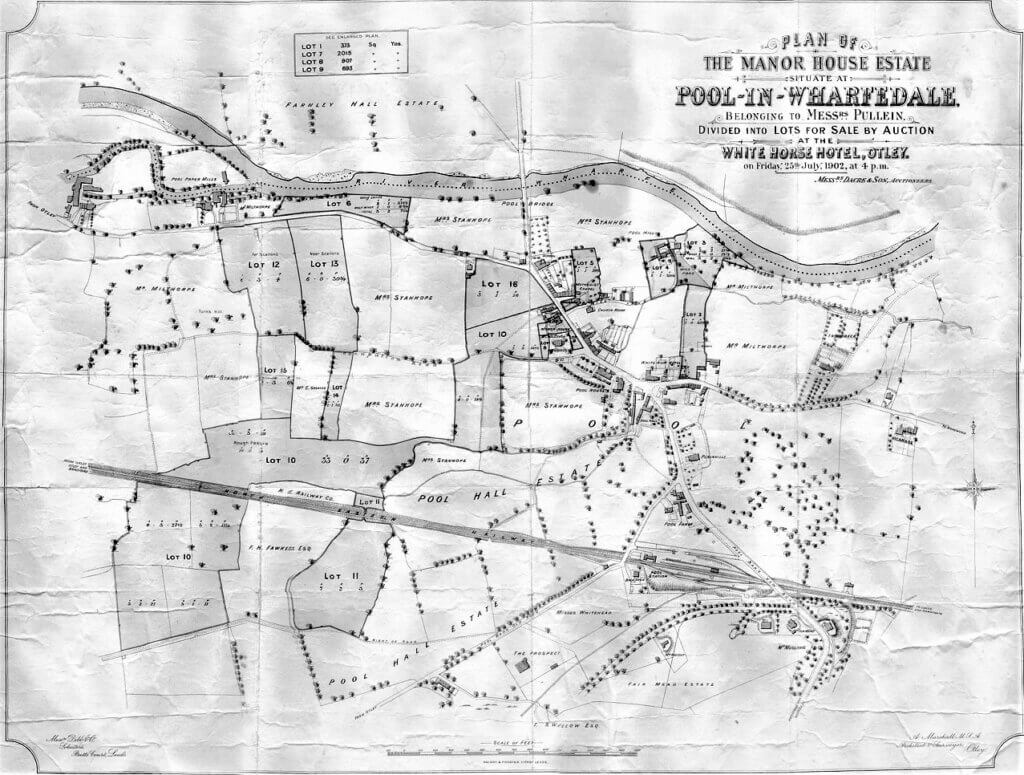
1902 Sale of The Manor House Estate by Messrs. Pullein held at the White Horse Hotel, Otley on Friday 25th July 1902 at 4pm. Signalling the end of a Lord of the Manor for Pool.
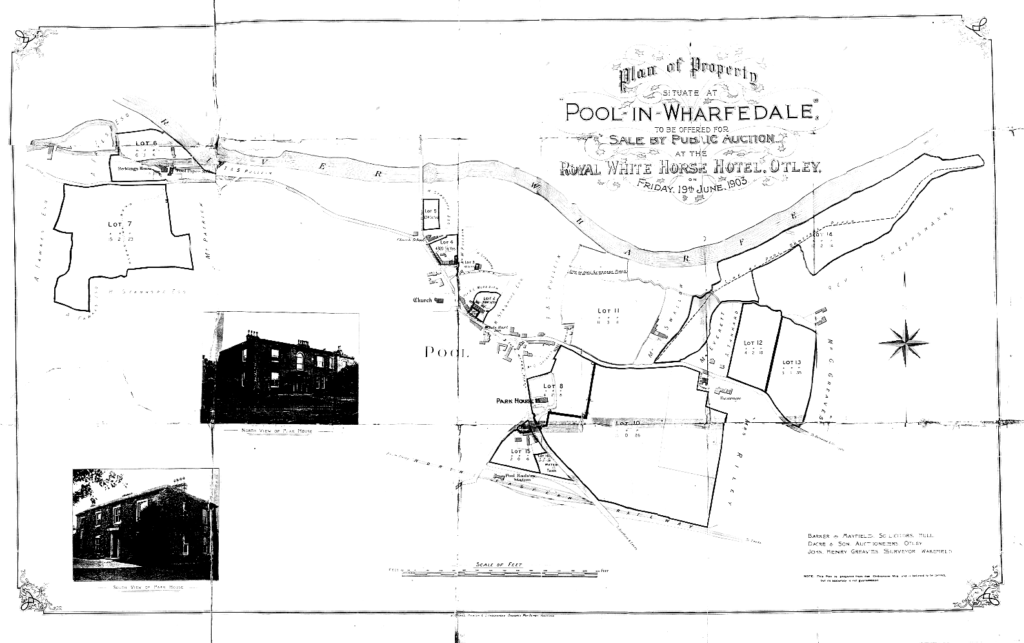
1903 Sale of Park House Estate (Milthorp/Nicholson). Held at Royal White Horse Hotel Otley on 19 June 1903
1906 Sir E. A. Brotherton. Bart. LLD, is the first President elected to the Arthington, Bramhope and Pool Horticultural Society. (Arthington Show). 1931 Earl of Harewood is President. (Brotherton Library)
1907 Wharfe View built by Tankards of Pool, intended for the use of quarry workers to rent at 3/6d. per week.
1908 G.A. Tankard of Pool install their “Sunlight Acetylene Generator” in the White Hart replacing candles and paraffin lamps. Also installed in the Methodist Chapel and Plainville/Park House.

1908 8th May. School reports that many children attending the funeral of Mrs. Todd, mother of Annie, John and Arthur, who was found murdered and mutilated on Pool Bank Details https://www.poolinwharfedalehistory.co.uk/18-events-of-the-past/
1908 Wesleyan Methodist Chapel opens on Main Street. Dedicated 13.4.09.
1918 B.S.& W. Whiteley Ltd. purchase Low Mill for £3,000 from Leeds Corporation Waterworks

1920/1 “Elephantide” electrical insulation pressboard is first produced by Whiteley’s mill.
1920 On 2nd April. High Mills, the Mill House (The Rosary) and two islands are bought from the Fawkes estate for £2,250.00. by William L. Whiteley. (David Whiteley Memoirs)
1921 Staircase Lane, the medieval route to Bramhope, is resurfaced by the Council.
1922 S. St. M. Delius (Bradford wool merchant) moves into Pool Hall. Related to composer Delius who could be heard playing the piano in the Hall.

1923 Aug. 4th the War Memorial (Grade 2 listed), is dedicated. The land a gift to Pool Parish Council on 22.6.1920 from Emily Swallow of Troutbeck, Arthington Lane, originally purchased by her from Hannah Pullein, of the Lords of the Manor family, on 4.11.1902
1929 Riddings House, the mill house for Low Mill, is demolished by Whiteleys paper mill to allow extension to their Low Mill.
1929 Pool Parish Council notified that “Pool-in-Wharfedale” would be used for postal and telegraph purposes.
1930 15th March. Methodist Sunday School opens. Cost of building £1,800
1931-2 Football season, Pool wins the Church League Cup.
1931 B.S.&W. Whiteley Ltd taken to court at Leeds Assizes for “public nuisance caused by the noise created by machinery at Whiteley’s Mill” signed by 32 residents. Rubber pads had to be inserted before work could continue.
1933 13th Oct. The opening of The Jane Whiteley Memorial Homes, Lodge Lane, (off Church Lane)..
1933 The Diocesan Report of Pool Church of England School is made; “The opening of the school is always impressive at Pool and I feel sure it will have its effect on the children’s idea of religious values”.
1935 6th May Silver Jubilee of King Georg V and Queen Mary. Celebrations include a procession of floats, crowning of Jubilee Queen, children’s sports, Church service, tea and dance.

1936 Last buildings of old Corn Mill on Mill Lane are demolished by owner William L. Whiteley.
1936 4th July. Employees of B. S & W. Whiteley Ltd. Pool Paper Mills entertained to a Golden Jubilee celebration commemorating the founding of the company. (for copy of the celebration booklet see “Books”in “Living”)
1937 Sir Oswold Moseley, British Union of Fascists, addresses a gathering at Pool Hall.
1937 14th Dec. The death of William Lumb Whiteley, co founder of B.S.&W. Whiteley Ltd. (born1863)
1937 Coronation of George VI and Elizabeth. Celebrations include a procession and floats, maypole dancing, sports for all, Church service, crowning of Coronation Queen, dance and whist drive.
1938 16th Dec. Pool Parish Council report that the proposed Pool by-pass had not yet been finally determined and it is “not anticipated that a scheme will be carried out for a number of years”.
1939 Cricket ground off Arthington Lane is opened on 10 year lease at £15 per year, on land owned by B.S.&W. Whiteley Ltd.
1944 25th March. A resolution is sent to the authorities by Pool Parish Council requesting a new school be built after the war as the “school is neither suitable nor modern enough to meet modern day requirements”.
1944 30th Dec. 1.35 a.m. severe earth tremors are recorded by Holmes Whiteley.
1945 22nd Sept. Pool Victory Queen celebrates the Otley & Wharfedale Thanksgiving Savings Week.
1946 12th Sept. Land, owned Squadron Leader Boddington, is purchased by Holmes Whiteley for £250 plus costs, for the building of a village memorial hall at Old Pool Bank. Later sold by Holmes to the village for 10/-d.
1947 June Pool joins Branch of British Legion with the Huby, Weeton & North Rigton formed in 1946.
1948 British Legion order War Memorial plaques for those who fell in WW2. Dedicated at Pool Arthington, North Rigton, Huby and Weeton.
1948 Midland Bank is opened 2.2.48 on Main Street alongside the North View Stores. (now cottages)
1948 New Whiteley’s sports field planned in front of Cartref, Otley Road to include bowling green, tennis court and cricket field.
1950 Stocks Hill is purchased by Pool Parish Council for the “betterment of the village” from Gertrude Harmer Swallow-Verall for £85 plus costs
1951 11th May. Sale of various portions of the Swallow estate sold to Holmes and William Whiteley, including 5 cottages at Far Row, two on Sandy Lobby and mainly old quarry land. Total price £2,030.
1952 17th Sept. The Fire Brigade is called to a fire at Pool School with a promise to supply fire extinguishers!
1952 H.R.H. the Princess Royal opens Old Pool Bank Village Memorial Hall, 17.5.1952.
1956 The Rosary, the 17c. mill house for Pool High Mill, is partly demolished by Whiteleys (now Blue Barn)
1958 The Countess of Harewood opens Pool-in-Wharfedale Village Memorial Hall on 2.8.58.
1960 Pool School Inspectors Report: “The high standard of work is maintained. The teachers have a room but no modern toilet or washing facilities.”
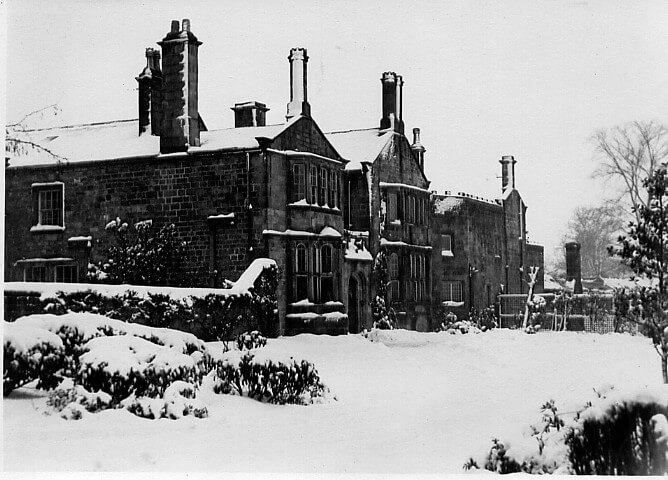
1964 The 15/16th century Caley Hall is demolished by William Whiteley, against orders from the Ministry of Housing issued in 1952. The entrance porch is now placed alongside the Old Grammer School in Manor Square, Otley.
1964 March. An alcohol license is requested for the Riverside Hotel. (Half Moon)
1964 B.S.& W. Whiteley Co. Ltd. build a large extension to their mill, named “1964 Mill” to house a new machine producing in 1965 the widest precompressed board in the world. A sheet 4 meters x 4 meters, up to 6mm thick.
1965 20th March. The last passenger train leaves Pool-in-Wharfedale station.
1968 Pool Parish Council notified correct postal address will be “Pool-in-Wharfedale, Otley, Yorkshire.”
1968 Mar. Pool Parish Council report that 58% of all houses in Pool owned by the Rural District Council.
1971 There are 580 dwellings with 1670 inhabitants shown on the census
1972 Old Post Office Row or “Fatticake Row” is demolished by Council replaced by Wharfedale Court.
1975 July, official opening of Pool Church of England school on Arthington Lane.
1977 Silver Jubilee celebrations for Queen Elizabeth II floats, processions & tree planting round cricket field.
1981 April. Receivers sell B.S.&W. Whiteley Ltd. to H. Weidmann for around £1.2 million
1983 Mrs. Ethel Mitchell moves from her grocery shop after 50 years (part of the Bar House, Arthington Lane), to become Jepson’s pie shop.

1983 30th Dec. Sub-branch of the Midland Bank on Main Street, closes.
1983 The use of Pool’s water supply by Pool Waterworks Co. is drawn to a close. The shareholders, directors and land existed until 2020 when the land was sold for the building of The House in the Woods on Pool Bank New Road.
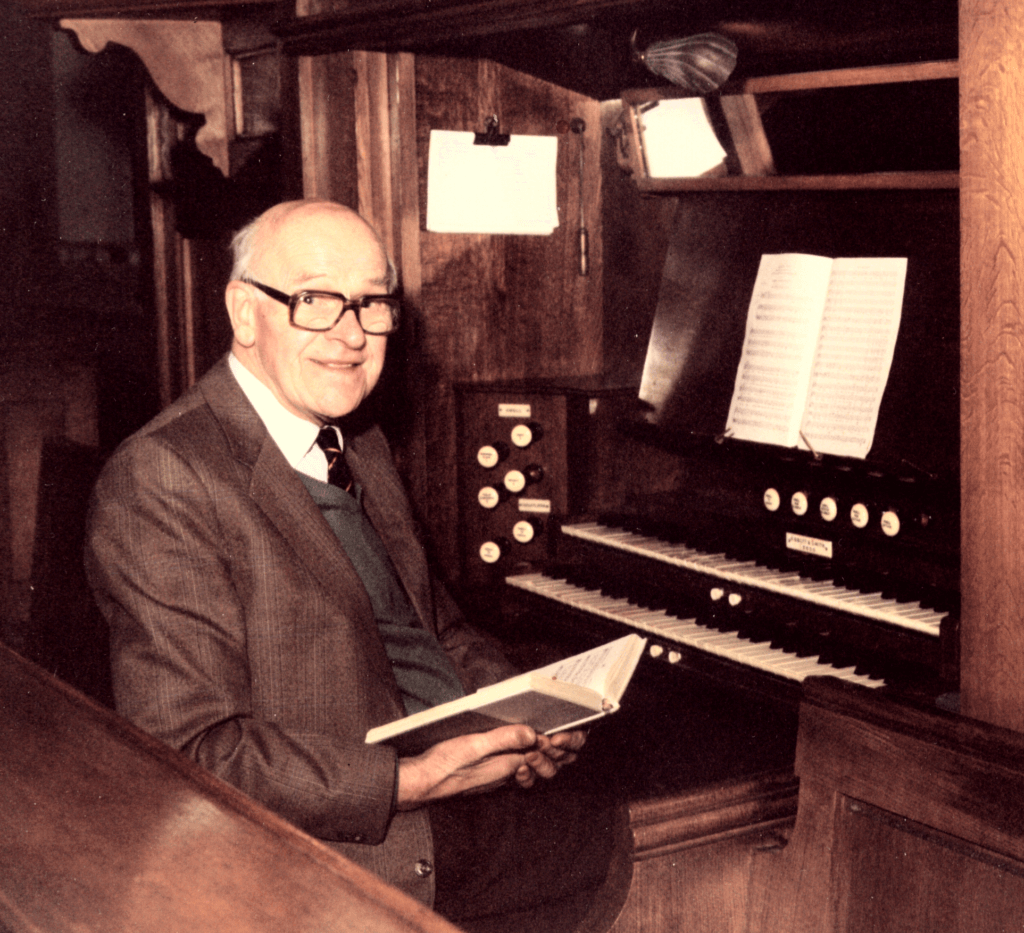
1985 Eric Cryer receives Maundy Money from the Queen in Ripon Cathedral in recognition of over 50 years as organist and choirmaster at St. Wilfrid’s Church.
1994 The Doctors’ surgery closes.
1994 W. A. Jepson, butcher’s shop in Main Street closes. Eventually converted into a home.
1995 15th March. Stephen Kaye & Son, Arthington Lane, wood work factory burned down. The Beeches built on the site.
1995 West Yorkshire Archaeology Service carry out survey of Corn Mill, Mill Lane, stating “it has medieval origins“.
1997 March 10th Madge Wainwright dies, last surviving member of Dunwell family (see 1539)
2000 Holmes family move from Hall Farm to Castley. after 100 years
2001 22nd Jan. The old C. of E. school on Main Street is burned down, leaving only the School House standing.
2001 Building of large housing estate by Redrow begins – approx 170 private homes.
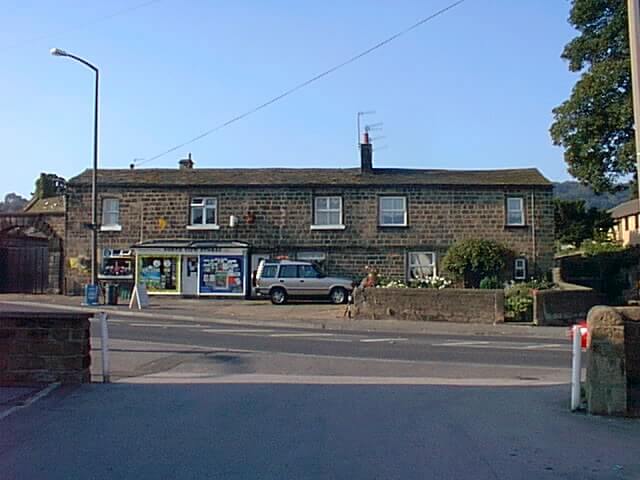
2001 North View Store, selling newspapers and groceries, Main Street closes. Believed to have been a shop since 1821. Converted into two cottages.
2002 August. Marton Mills, Otley Road manufacture three quarters of a mile of tartan to decorate the home of comedian Billy Connolly for his 60th birthday, also make clothing for Harry Potter film.
2002 Pool Feast is re-introduced, first mentioned in 1727.

2002 Plainville/Park House/Pool Court/Monkmans Bistro, is demolished by the owner Monkman against the wishes of villagers, Leeds Civic Trust and some Leeds City councillors. Georgian home of mill owning families Milthorp, Nicholson and Snowdon from c.1800 and built on foundations of an older house. Houses and flats built on land – The Hollies.
2002 16th May Children’s skate board park opens on site of old school playing fields, Main Street.
2002 Pool Bridge is strengthened to take 44 ton lorries, to conform with EU regulations
2002 Pool Parish Council confirms the A659 between Pool and Knotford Nook is named Otley Road.
2003 £10 million refurbishment of Bramhope Railway Tunnel.
2003 Pool Mills Cricket and Sports Club is closed.(Later used as junior football pitch)
2004 11th June. £1.1 million Castley Lane Flood Alleviation Scheme opened, with help from DEFRA and Yorkshire Regional Flood Defence Committee.
2005 18th Dec . Death of David Holmes Whiteley, son of Holmes and grandson of W. L. Whiteley, Pool paper mill owners.
2005 Dec. Proposed Conservation of Pool-in-Wharfedale, completed for Pool Parish Council submitted to Leeds City Council, to be reviewed in 2006 “as more time and money become available” to Leeds City Council.(see 2009)
2005 The village is awarded first prize in the “Building a Community Life” section of the Yorkshire Village of the Year awards presented by Calor Gas backed by DEFRA..
2006 The first Honorary Citizens Award to be given annually by Pool Parish Council.
2009 Sept 21st. Leeds City Council make the majority of the village, including part of Old Pool Bank and the quarry, into a Conservation Area stating Pool-in-Wharfedale is “a place of special character and historic interest”.
2013 Leeds City Council propose to allow the building of over 540 houses to the west of the village.
2014 An amendment to the locality name from Pool to Pool-in-Wharfedale.
2014 Tour de France passes through the village.
2014 An Information Board is erected at the war memorial to commemorate WW1 and subsequent wars
2014 Oct. Leeds City Council carry out a traffic survey showing 15,000 vehicles a day pass along Main Street over 24 hours and over 12 hours 11,500 from 7 a.m. to 7 p.m. Local survey in 2015 – vehicles along Main St at 6 pm is 66 in one minute
2016 Dec.21st Fire destroys kitchens of White Hart
2016 A Government document, protecting the village from developments, is begun by volunteers for a Pool Neighbourhood Plan
2019 April Death of John Holmes Whiteley, 2nd son of Holmes and Kate. Grandson of W. L. Whiteley, Pool paper mill owners.
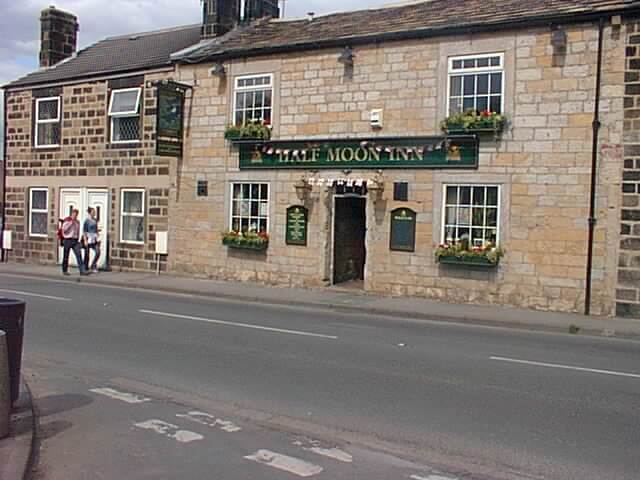
2020 The Half Moon closes. An inn dated c. 1725 Details: https://www.poolinwharfedalehistory.co.uk/19-inns/
2025 Jan The Neighbourhood Plan is put before the village. Accepted by Leeds City Council later that year.
.