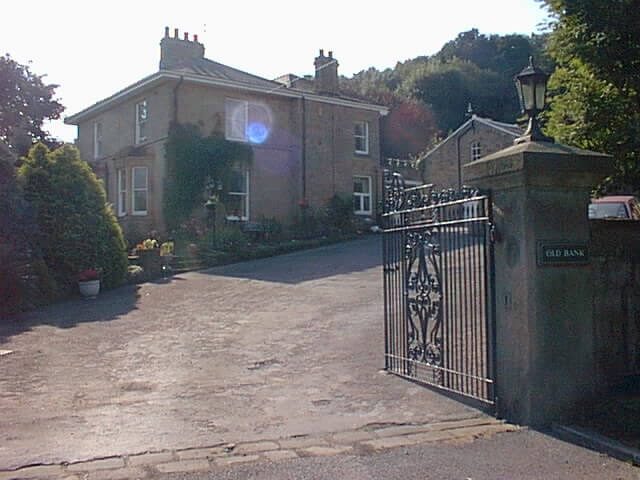
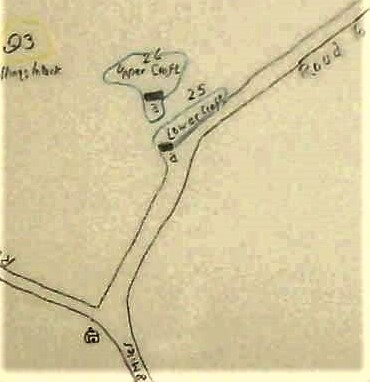
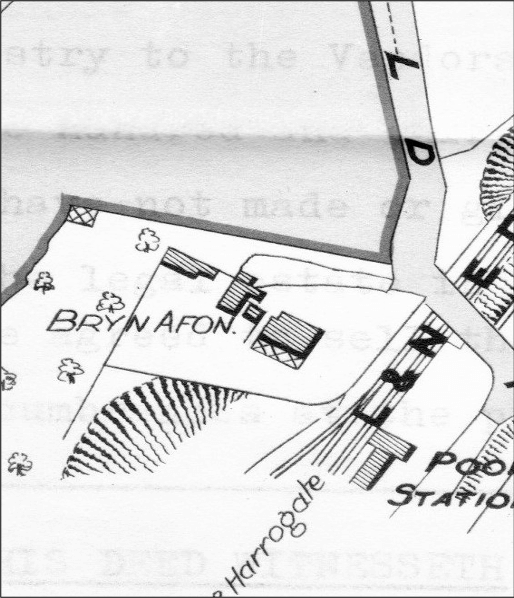
BANK HOUSE/ OLD BANK /BRYN AFON on Old Pool Bank, (road) known as Bryn Afon in 1847 and for many years, now Bank House. A map of 1756, above, shows there to be two houses here, one a little behind the other named High Croft and Low Croft when owned by the then Lord of the Manor of Pool, Thomas Thornhill,. The Award map of 1774 now shows three properties on the land, the new added property being alongside the western edge of the land and possibly the same as can be seen today. The present house was enlarged at the front, the enlargement is already shown on a map of 1894. According to a Short History of Pool-in-Wharfedale, written in 1929, the house was occupied before 1849 by Robert Edmondson (1790-1848 grave 119) ; Capt. Child who built several houses in the village, including Troutbeck, died in 1889; Mr. Richardson from 1894 and A. Whitehead (1839-1910.grave 69) and in 1929 by Mr. Lightowler, a manufacturer of embossed tin boxes used by biscuit and chocolate companies, also Will’s cigarettes. The architectural historian, Peter Thornborrow dated the older northern part of the house at c.1740.
Sagar Jackson of Jacksons Arcade, Otley, born in 1883 lived at Bryn Afon and went to Pool School, leaving to be a despatch boy, at the age of 11. Several other members of the family lived in Pool; Gaunt Hudson (wife was Miss Jackson) who lived at Furze Hill, Pool, Bank New Road. A brother, J.L. Jackson at Plainville, rented, (known also as Park House, now The Hollis estate built on the land) and a sister on Arthington Lane. J.C. Jackson lived in Pool Hall c.1928 to 1931.

In 1894 Bryn-Afon was owned by Alfred W Whitehead. He also owned White House Farm (electoral roll 1910) together with the Pool Waterworks which he bought in 1903 from Michael Nicholson’s estate. The income from the water works at the time was £19.l.6d. He extended the water supply to the village. He was also a Governor and an important benefactor to Pool School, making several gifts. “1901. Have a good light from a new lamp given by Mr. Alfred Whitehead to the school.” At his death in 1910, the school gave the children half a days’ holiday to attend his funeral. Alfred Whitehead Born 29.5.1839. Married 26.1.1864. Died 19.7.1910. Two stained glass windows are in St. Wilfrid’s Church in memory of Alfred Whitehead which were erected in 1910.
In Dec. 1922 the house and water works passed to his daughters, the Misses Amy and Gertrude Whitehead, having by now moved to the White House. Lovely story about Miss Amy in “Memories” by Roland Tankard in Pool Water Works. Local children would giggle when they mentioned “Miss Whitehead’s water was not too good today!”
The house was sold in 1920 by Arthur Whitehead, son, for £2,764.17.9d.
Amy Elderhorst Whitehead b.. 16.11.1864 d. 11.10.1946
Gertrude Elizabeth “ b. 15.5.1866 d. 10.1.1925
Arthur Langley “ b. 1.12.1868 d. 5.10.1930
John Langley “ b. 20.7.1884 d. 22.11.1894
Details of house inventory made in 1910 includes an item, “About 3 gallons of whisky”.
Extension to rear of house made in 2008 by the owner
(see also “A Village Water Supply”)


BAR HOUSE Arthington Lane. Built c.1725 or earlier. Shown on the map of 1756 as “Sparrow Close” on land owned by the Lord of the Manor of the time, Thomas Thornhill. In 1669 a John Sparrow was the only remaining Roman Catholic in the village refusing to join the Church of England. The property was sold in 1902 by the Lord of the Manor of the time, The Pulleins to Mr. S. Hextall Lot 1, for £205 with land stretching to the Corn Mill Pond. Deeds of the Pulleins state Lot 1 with the name of “Sparrow Croft” had tenants by the name of Clapham and Lupton paying an annual rent of £6 and £5.12.0d. respectively.
The Turnpike Act of 1662, for the making and repair of roads, was not popular. During the 18c there came a need to hasten traffic from Otley to the Great North Road at Tadcaster. Local landowners and gentry including the Lascelles, Thomas Arthington and members of the Fawkes family became turnpike trustees. They obtained an Act of Parliament which enabled them to repair the road, erect toll-bars and levy tolls to maintain the roads(Otley Museum.TP/dc/3 1750-1890) The act described the existing road as, “ruinous and bad.. that the winter season it is impossible for wagons or other wheeled carriages to pass along the same and very dangerous for travellers.” So a rough plan was made dated 12th Feb 1753 and work began. But ordinary people were opposed to the turnpike and on 23rd June 1753 an angry mob of 200 pulled down the toll-bar at Pool, just 19 days after it had been built. The mob marched along the road to attack Harewood bridge turnpike, but were met by the mounted trustees of the turnpikes and were turned away. (See Turnpike & Toll Bars)

Toll collection ceased in 1874. The last keepers were Wm. and Arabella Steele (SHP). The Bar House became a general grocers shop ,occupied by Mrs Lupton(certainly there c. 1900). The toll collector at Arthington c.1870 was James Lupton (Whites Directory). Prior to the sale of 1902, it was the home of Mr. Lupton (the west side) and Claphams (the east), the Clapham’s home, soon to become Mrs. Temple’s haberdashery shop, who also sold a few groceries and cigarettes. In 1902 when the property was sold to Mr S. Hextall who was a debt collector working for a firm of solicitors, he bought both houses and land stretching to the river, for £205. This family living in the eastern house. Later Miss Audrey Hextall inherited both cottages which she owned till her death, then both houses were sold and converted into one house in 1999. The fish and chip shop, see painting left, (now a house under construction, 2002) was built by Mrs Hextall in the garden to be run by her daughter, Audrey and herself. The house to the east remained the home of the Hextall family whilst Mrs. Mitchell, the shop to the west, later kept the general grocery and sweet shop, becoming a pie shop prior to the conversion.
During the conversion in 1999 an old Yorkshire Range was uncovered in the house to the west, bearing the name “W. E. Turner, Otley”. These were manufactured at Church Gates, Otley, a foundry which was where Jackson’s Kirkgate Arcade, Otley now is. The Yorkshire Range has been left in place. Another large stone fireplace with an Aga, was in the house to the east. Pool Parish Council reported that the Bar House still had an earth closet in 1946. A similar Yorkshire Range with the name “W.E.Turner, Otley and Harrogate” is still in a cottage on Church View.

BRAYTON COTTAGE. has also been known as Nunroyd Barn. Michael Nicholson (Low Mill) died in 1858. After his death he left Brayton Cottage to his neice Emma Snowdon, a member of the Milthorp Snowdons of Plainville/Park House/Pool Court/Monkmans. Originally two cottages, one named Chestnut Cottage c. 1910 when occupied by Alison and Matthew Clapham, who worked at White House Farm. The other, Plainville Cottage, was occupied by Perkins in 1940. Originally service cottages for both White House Farm, which dates from c.1740, and no doubt for Plainville as along with White House Farm, (then known as Pool Farm), they were owned by executors of Michael Nicholson in 1879, who had lived at Plainville c.1840. (see White House) also Pool Hall which he sold (Plainville/Park House was demolished and the Hollies built in 2002) The two cottages were combined into one house c.1961. Owners have been: Michael Nicholson, 1858 Emma Michell Snowdon (related to Michael Nicholson through marriage of his sister, Elizabeth to John Milthorp in 1802) to 1937, then M.W. and M.I. Hill to 1944.(also owned White House Farm/Pool Farm, see also see A Village water Supply) 1944 Arthur Sutcliffe; 1953 David Ackroyd; 1961 E.H. Prentice & O. Robinson; 1970, Mr. & Mrs. A. Maben; 1977 Mrs. J. E. Watson.
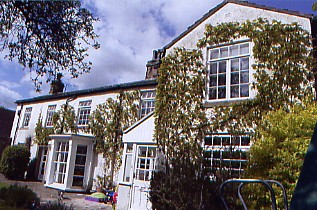
BROOK COTTAGE Mill Lane, originally known as Paste Board House, Mill Lane. “A good trade of pasteboard making was carried on in “Paste House” by Thos. Lockton” lived 1779-1858. The following advert appeared in the Leeds Mercury on 14th June 1823 when an auction of Pool House was taking place by owner John Milthorp. “A PASTEBOARD MANUFACTORY situate in Pool aforesaid in the occupation of Thos. Lockton with a Close of Land occupied therewith called the Mill Garth and containing in Statue Measure 1A. 1R.36P or thereabouts,” This was part of a large number of properties and land owned by John Milthorp including a “Mansion House” (Pool House) which appears to have been bought by the Stott family, as Mrs. Nowell Stott died there on the 8th April 1839
The continued ownership of Brook Cottage by Pool House is shown in the will of Miss Susannah Greene Stott of Pool House made in 1880, which shows Brook Cottage with garden of about half an acre in the occupation of George Portway, let in 1921 at an annual rent of £32. 4. 0d. to the Stanhopes of Pool House “An 18c house of some importance” – high wall signifies (P.T.) extended at some time to the north. Property Tax shows in 1922 the house was owned by Herbert Stanhope (Pool House). The stream which ran from Pool Bank through Hall Farm and under the main road, was re-routed when building Millcroft and had passed in front of Brook Cottage. Thomas Edmunson Walker was living there sometime between 1814 and 1874. George A. Stead a cloth merchant was living there, according to the 1881 census. The house was a small factory where paper was pasted together to make a kind of cardboard used for rolls of cloth, no doubt supplying Pool High Mill/Walk Mill. Herbert Pepper, carting agent to Otley & Ilkley for the Joint Railway Co. was an occupant in 1891 (census).
Bertram Jowett Pepper. Lived at Brook Cottage, Mill Lane. Corporal in the Royal Field Artillery. Unit Text: “D”Bty. 321th Bde. Died 26.5.1917. Service No. 786074. Son of Clarice Helena Pepper and the late Herbert Pepper. Born Pool. Grave Ref. III. B.29. Cemetery: H.A.C. Cemetery, Ecoust-St.Mein, Pas de Calais, France.
In 1929 it was also the village Post Office run by Mrs. Joe Whiteley who was Pool Parish Councillor for over 23 years. Operating the post office from the south side of the house, she would keep her customers waiting for perhaps 20 minutes whilst she finished her gardening!
Thomas Hollis is recorded in the 1841 census as being a pasteboard maker
(Much of this information was taken from the deeds of Susannah Green Stott. Pool House)
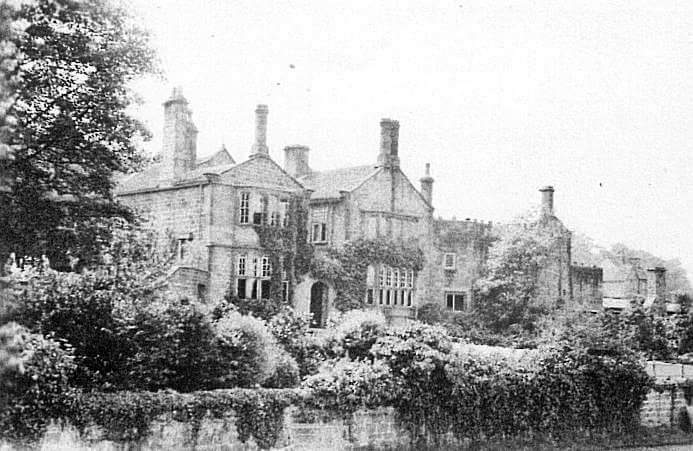
CALEY HALL (- Otley/Pool Road near Knotford Nook demolished 1964)– A Tudor residence. (Map of 1720 spelled Kayley) Probably the only survivor of an ancient hamlet of that name which gave its name to an old family in the reign of Edward III, one John de Caylli de Poule Around 1500 it was built as a hunting lodge by the Gascoignes (H.Speight) of Gawthorpe Hall, Harewood. Renovations of the farm took place in the1980’s when it was stated that one of the walls was dated 1430.
It was occupied in 1550 by Marmaduke Gascoigne (S.H.P.) Indications of the hunting lodge are “Lodge Lane” (map of 1756 ) now alongside Church Lane, also “Dog Kennel Close” near Caley Hall (tythe map); and reference to late 12c. fish breeding ponds (West Yorks. Arch. Society to AD1500). also “Medieval North Yorkshire”, Robin A. Butlin)
(Much more of this information can be found under “Caley” in “Living”)


CALEY HALL FARM COMPLEX was originally all part of Caley Hall estate. It was sold by Whiteley’s in 1973 and consisted of Caley Farm, Caley Farm Cottage, The Garden House, Crag Cottage, East View Cottage and Caley Lodge and site of the demolished Caley Hall. In 1932, when owned by G. C. Waud. The Lodge was rented on a weekly tenancy at 12/6d per week inclusive. (see Caley Hall above). Richard Maltby & wife Sarah, were gardener and domestic servant at Caley Lodge in 1871. Caley Hall Farm estate was sold by Ogdens in 1983 to Frank Dee who especially renovated all the farm walls. He rented his land to a Pateley Bridge farmer for his sheep c. 1990 for £7,800. Farm and land sold in 1996 by Frank Dee to Bryn Tennant, who registered it as Caley Hall Farm Ltd. (2005) – he added many trees and stocked alpaca & Highland cattle.

After renovation of Caley Farm in 1983 it was stated by Ogdens that the west wall of the farm was dated at 1430.
Census of 1851 shows 200 acres being farmed by John Anderson with 4 men working for him. Micah Lamb and his wife Mary A. farmed Caley Farm in 1871. (1871 & 1891 Census). Leeds Mercury 13th May 1882 Wharfedale Agricultural Show Mr. Micah Lamb, Caley Farm, Pool, won the plate for the best ram.
A sale of property in 1927 states “Caley Farm a “Well-placed Dairy Holding” with modern 5 bedroomed farmhouse”. Amongst the outbuildings were: Refrigerator House, Meal House and Barn, various mistals, Manure Pump, stables and granary. The rent paid by Messrs. E. & C. Harrison in 1927 was £112 per annum.

CALEY NEW HALL This was built soon after the original Caley Hall was demolished in 1964. Recently re-named “Caley Manor” (c. 2020)
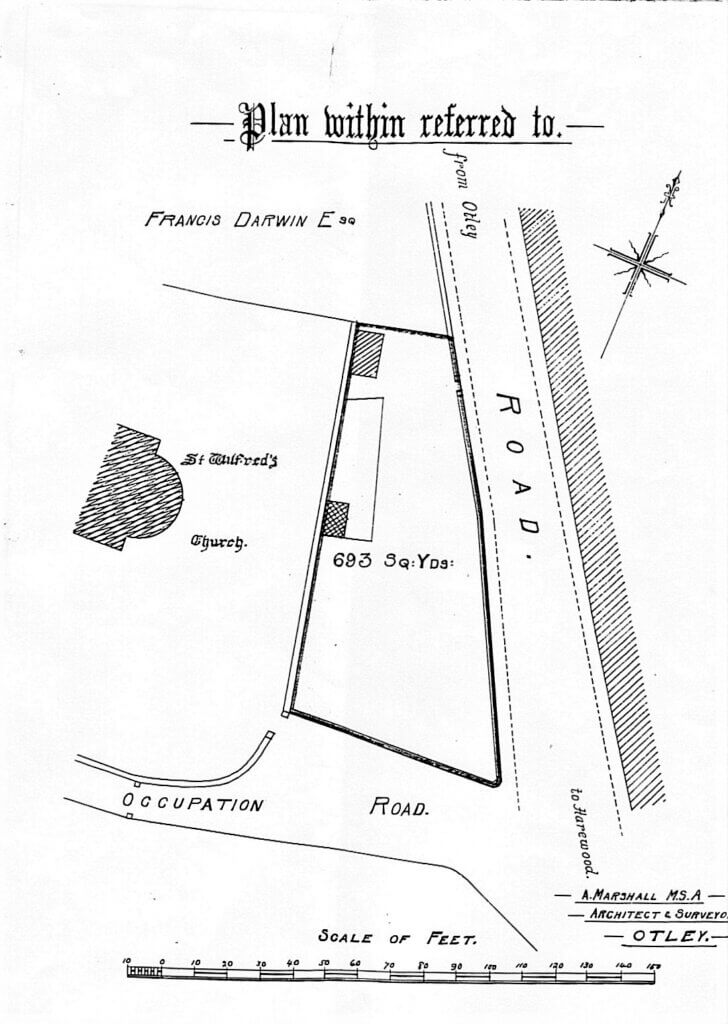
CHAPEL GARTH, Main Street was to the front of St. Wilfrid’s Church (area now known as Memorial Gardens) consisted of two cottages, now demolished. Because of their name presumably they were built before the time of the church when it was a Chapel of Ease. The map of 1756 shows there to be three cottages at that time. One of which may have been a toll bar house as the map of 1756 shows a township gate at this point being the entrance to Lodge Lane, possibly leading to Caley Hall, a hunting lodge to the Gascoignes c. 1500. (see also War Memorial )
FARFIELD HOUSE Arthington Lane built c. 1849 by Mary Greaves for her son George (a relative of Rhodes who lived at Creskeld Hall in 1825.) In Sept.1888 Mary Greaves, along with her sister and brother inherited money and goods on the death of her father Charles Greaves Census of 1871 shows Mary Greaves and son George & in 1891, landowner of 10 acres and in 1896 George Greaves and wife Fanny. In Feb. 1960 it was sold for £2,500. Large extension to the west of the house was added in 2010.
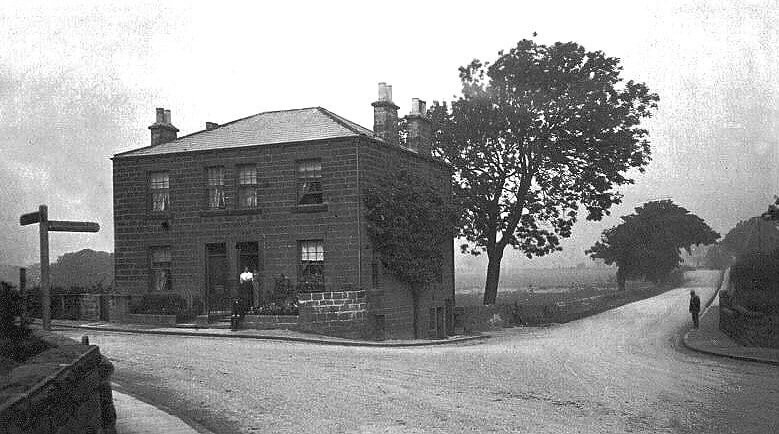
FIR TREE COTTAGES. The two houses demolished c.1960. (on Map 1847) near bridge. SHP says that before they were built, there was a cottage which was a bar house bought by Wm. Greaves, pulled down by his son Edward who built the two houses. There may well have been a bar house here, as according to the 1756 map it was here that a “township” gate lead into the village. Occupied 1871 by Edward Greaves, born in Pool and his wife Sarah, born in Otley. Jim Dennison lived in the house to the west. He came from Burton Leonard where he worked in the paper trade (according to grandson also Jim) to work as a beaterman at Whiteleys paper mill. He would also cut hair in the corner of the beater house.
“As a little boy I never knew what the inside of a barber’s shop was like as my hair was always cut in a corner of the beater house by Mr. Jim Dennison” (Memoirs of David Holmes Whiteley 1917-2004)
In 1907 his son Walter, was born there and in 1929 his grandson Jim (1929-2002) Jim snr. became one of the first of four occupants of the Jane Whiteley Homes, built by William L. Whiteley in memory of his wife Jane, which opened in 1934. A small garage with single hand operated petrol pump stood behind the cottages. Many WW2 vehicles used this operated to fill up after being offloaded from Pool-in-Wharfedale railway station en-route to the military camps of Riffa and Farnley.
Around 1960 the houses were demolished. After the refusal of a request from the White Swan Inn in Otley to build an hotel, a new petrol station opened, known as Toothies Garage”, now a Shell petrol station. It is understood to have been the first self service station and that, after winning money on the Irish Sweepstake, was built by John Tooth.
The house to the east was home to Ted Hunter, “Dirty Gerty” and “Black Jack” Edwards where their daughter was killed by a passing car. This house was also c.1950 used by a visiting doctor also used as his surgery. Later became a shop, tea room run by “Dicky Dripping”. He also rendered down pig fat to sell to fish and chip shops. (granddaughter)
HARDY’S LAIR (name from SHP). situated immediately north of old railway line and was on the original Staircase Lane, and Bramhope Lane. Ribbon Lane on 1756 map ran off this lane leading to the village. House and barn shown on map of 1756. The 1847 map shown as a pair of cottages each with what appears to be outside loos, all now demolished. Remains of barn were there before building of Redrow estate in 2001.

HUNTSMAN’S LODGE Grade II listed adjoins of the Manor House, see Manor Houses below. In the 1800’s the Lodge was added to the Grade 11 listed Pool Manor House. Now a private house.
IVY FARM A farm was attached to Stanhope cottages now converted to 2 garages (2020). Census of 1871 shows William Yewdall owning the farm, but not present, a cloth manufacturer employing 31 hands. Records show that between 1870-1873 was the partnership of John Clayton and William Yewdall – Pool High/Walk Mill. In 1901 it was farmed by Thomas Pullein (Lords of the Manor of Pool from 1829). In the Manor House Estate sale of 1902 the farmhouse, with three cottages attached, outbuildings and 35 acres of grassland was sold to Mr. Weatherill for £2,200. Inhabitants 1849 Wm. Scott, his daughter Fanny known in the village as “Granny Pullein” died 1924 aged 90; Mr. & Mrs. Molyneux, son J. R. Long; Mr. Pepper, Edgar Roscoe; Mr. Whiteley, H. L. Steele, L. M. Smithson (SHP). See “Families” A Pullein”)
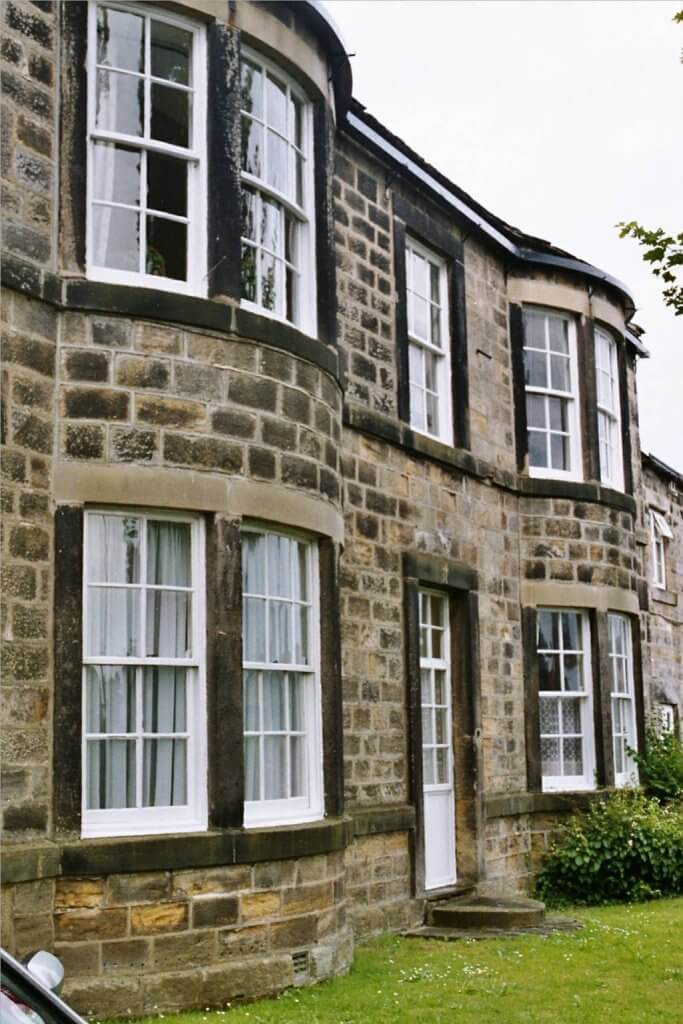
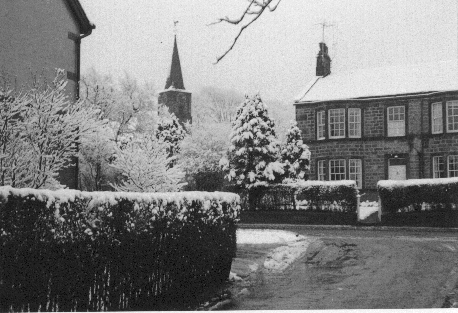
MANOR HOUSE. Grade II listed building. There has been a Manor House in Pool from at least 1569. In 1569 Manor House of Pool was rented out by Richard Goldesbrough of Goldesbrough, Yorks to Roger Morrys of High Holborne for 21 years at 63/- per year. (Huntington Archives) 1570/1 “Lease of Pool Manor house and all apportionments is assigned from Roger Morrys of City of York, surgeon & Eleanor his wife” In 1676 Everild Thornhill is listed as “Lady of the Manor of Poole and Kirskell”.( Huntingdon Archives ) The Manor House is on a map of 1756, drawn up for the then Lord of the Manor Thos. Thornhill, living at Creskeld Hall.

In 1563 William Goldsborough died leaving a young daughter Anne. Her uncle Richard Goldsborough then quietly claimed almost the whole of the family property. When Anne married Edmund Kighley of Newhall, Otley, a litigatation followed. Anne claimed her rights to the manors of “Goldsburgh, Kryskelde and Powle, etc.” (Goldsborough, Creskeld and Pool). The dispute was bitter and protracted between her and her uncle, Richard.
Eventually in 1586 the property at Goldsborough was judged to be owned by Anne and Edmund Kighley.
In 1602 Edmund Kighley, appears to have left Newhall, Otley to live in Pool where he died in 1602.
Description by Architectural historian Peter H. Thornborrow G.N.S.M; P.G. Dip. E.L.H. (CNAA)
The Manor House is a double-pile Georgian gentry house (appears on map of 1756). It is an ancient site, there are documentary references to a Pool Manor House in 1569 owned by the Lord of the Manor Richard Goldsborough (in Huntingdon archives). The house has quoined angles, coped gables with ashlar stacks the coping line carried across its squared apex, indicative of an early-to-mid 18th century building. It has a 3-bay symmetrical façade with full-height segmental bow windows with12-paned sashes and unifying ashlar sill-bands and a central doorway with glazed door and over-light.
Prior to 1819 James Dinwiddie was first at Pool Hall, later at the Manor House. His death was recorded in Leeds Mercury on 25th May 1836 aged 85 and “was formerly an eminent cotton spinner in Manchester”. James Dinwiddie is mentioned in the Land Tax returns in 1784 to 1802 when he was a proprietor of property?Walk Mill and Michael Nicholson being the occupier, paying £l.7.6d. (for what) in 1821. (see Houses pre 1850 Dinwiddie family)
The 1841 census shows Dr. Joseph Curry (wife Sarah, son Matthew) was running a boys’ school here (possibly a church school) with 17 pupils, Joseph Oldfield, was a medical student who was his assistant. Joseph Curry compiled a time-line of the bible events, the book called “Curry’s Chronological and Geographical Family Guide Holy Scriptures”, written in Dewsbury in 1846. A plaque is on the wall of St. Wilfrid’s church commemorating the death of his and his wife Sarah’s baby daughter Maryann Whitworth Curry who died in 1840 aged only 13 weeks.
Occupants: Thomas Newsam died 30.5.1862 aged 61 – Thomas Newsam, land agent and surveyor living there, youngest daughter Sarah Jane married Matthias Shann (Pool mill) in 1869; 1872-1892 G.H.L. Rickards (see “Families of the Past”; In 1892 the Manor House is advertised to let by “Mr. Pullein” in the Leeds Mercury.
A metal disc shows “G.S. Whitaker Manor House Pool-in-Wharfedale KSXM-97-3”; According to Kayes account ledger Mr. Dixon was there in 1901. Holzmann in 1919 (gift of land by Swallow to build War Memorial) Francis Darwin lived there in 1902. (War Mem.details) The house came up for sale in 1902 when owned by the Pullein family (Lords of the Manor of Pool) but was withdrawn at £1,275; 1911 census Mr. Robinson; Col. Sir Frank Brook 1945-approx 1960. Now four flats. (2000)
A cutting shows George Henry Lascelles Rickards, (6.3.1819-1892) Her Majesty’s Sub Inspector of Factories for the West Riding was in1858 appointed Factory Inspector for Leeds district. Formerly a medical practitioner for 18 years in Armley he lived in the Manor House from 1872 till his death. On 18.12.1890 a presentation was made on his retirement one of the gifts was an album inscribed “Presented to G.H.L. Rickards, Esq, as a mark of the esteem in which he is held by the employers of labour in Leeds and district, on his retirement from the position of H.M . Inspector of Factories”. The cutting also states “Mr. Rickards death will be greatly regretted by all who knew him, but by none more than by the villagers amongst whom he resided during the past twenty years.” He had an egg of the great auk. His son Charles.A. was a silk spinner employing 30 men, 30 women, 30 boys and 35 girls (census 1881.)
Wharfedale Observer March 19th 1886. “Theft of Coal. Benjamin Greaves, mason of Pool, an aged man, was brought up in custardy charged with stealing coal, value 3d. (1 1/2p.), the property of Mr. Rickards, H. M. Inspector of Factories, of Pool.” The charge was that he stole the coal from an outhouse. He stated he did not have any coal at home but on inspection he had at least one hundredweight. “Mr. Rickard did not wish to press the case against the person who was an old man but hoped it would be a warning to him.” “The Bench ordered Greaves to be imprisoned until the rising of the Court.” He was also a Governor of Pool School often paying it visits.
Colonel Sir Frank Brook, D.S.O., M.C., D.L. and H.M. Inspector of Constabulary, and his wife Lady Brook. moved there in 1945. “Sir Frank and Lady Brook were loved and respected in the village” playing an important part in the raising of money for the building of the Village Memorial Hall, in 1957, Lieut-Col, Sir Frank Brook D.S.O., M.C., D.I. was Chairman. In Jan 1956 he was given Grade of Knight in the Most Venerable Order of the Hospital for St. John of Jerusalem. (St. John’s Ambulance). They were joined in1948 by Frances Bird, daughter of Sir Frank and Lady Brook, her son John Francis Bird aged 5 and daughter Rosemary. Their grandson John Bird became a local solicitor and author. Some of the characters in his books (Gumboot Practice) were based on people he had known in the village he loved. He later produced his autobiography “Chevin’s Lee to Silver Hill”, recounting many stories of his life in Pool-in-Wharfedale. He remembered the lovely garden with orchard and tennis court and his happy childhood. It was perhaps fitting that he married a Pool girl, Rosemary (nee Dyson) whose family lived at Braeburn, Arthington Lane.”
During WW2 the Manor House was home to approx. six families of evacuees from London.
Various past residents have confirmed that the Manor House is haunted.

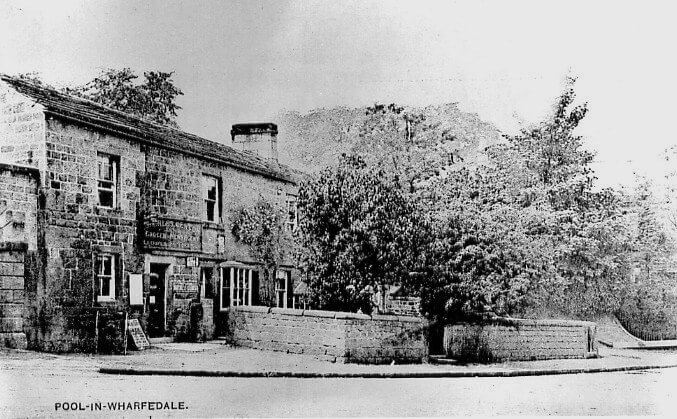
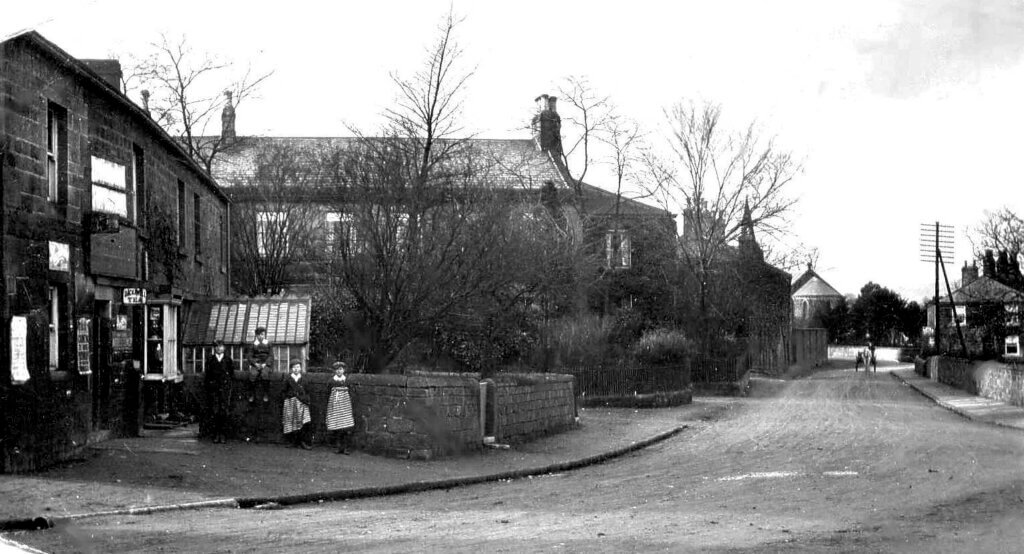
NORTH VIEW STORES Main Street,(now cottages 2010) the building appears on a map of 1767 and was part of Pool Hall. S.H.P. states this may have been a shop owned by Mary Perkins in 1821, followed by John Bramley in 1829 who lived from1798 to1873, it was his daughter Eliza who married Charles Denton. Charles Denton had the shop c. 1900. A newspaper cutting dated 1935 states that Charles Denton died at almost 90 years of age and was the oldest seller of the Evening News in Yorkshire (photo). This was a pink paper. Often delivering the newspapers in the dark, he carried a storm lamp which he would to put down to push the paper through the letter box, lads would “steal” the lamp and hide it down the passage. One of Charles Denton’ daughters, Edith married Samuel Mills Foster and in the 1920’s Fosters and later owned this store. The shop was known as “Top Fosters” as they later also owned another general store and petrol station called “Bottom Fosters” which is now the Half Moon Garage and post office. They also ran a café and grocery store from the newsagents. It would seem that the shop had been in the same family for over one hundred years. In 1929 Fosters advertised that they had been in business for 100 years so we assume the family were at the newsagents from at least 1829, certainly the same family were running the business from 1849. The first petrol pump in Pool was installed here c. 1910 selling Pratts petrol. The pump was removed in c.1974 by which time it was selling National Benzole petrol. The petrol pipe can still be seen running down the east end of the converted cottages.
During the 1950’s when owned by Neville Gladstone, (grandson of the Pullein family, the old Lords of the Manor). The east end of the shop, which had been the tea room, became a sub-branch of the Midland Bank, with limited opening hours. When the Bank was closed in the 1970’s, the shop was extended to include this.
During the 1920’s Aldi Tankard renewed a fireplace for Mr. Denton. On taking it out he found many clay smoking pipes in perfect condition, some of which were organ pipes (the long kind). Mrs. Denton had hidden them from her husband as she object to his smoking habit.
Pool Hall and Pool Hall Farm. A John Bramley Yeadon moved from the Nunnery, Arthington into Pool Hall in 1902. (2012 “Pool Hall Farm” is incorrectly named on the nearby Hall Farm which was built c. 1900
The land and houses in 1894 was passed to John Yeadon from Mathew Cranswick, J. G. McCandlish & R. Hutchinson. 1897; J. Woodcock; David Brook and John Yeadon. 1913 Sarah Ann Yeadon, Joshua Fearnside Sinclair and John Bramley Yeadon. Mortgagee Mary Elinor Yeadon.
In 1928 Conveyance of Merger of Tithe commutation of rent charge of 2/3rds of 6/8d. between F. H. Fawkes and J.C. Jackson. Original payment in 1866 made by Clough Jackson for railway land. In 1931 the farm passed from Jackson to W. L. Whiteley for £4,500. The house and shop (North View Stores) was sold to Harry and Gertrude Foster for £2,300. The intended purchaser in 1931 was Elinor Stewart Johnson (deeds)
The shop finally closed in June 2001, but remained delivering newspapers for a short while. Renovations of the North View Stores to turn it into two cottages began in Nov. 2001 when many blocked up doors and chimneys were found along with a 1917 penny . The centre part of the row was originally the 18th century house. (PT)

OLD CORN MILL HOUSE Mill Lane. 1775 is the date above door, as part of the corn mill complex. The present owner still has the deeds going back to 1775. Previous to this the mill property, was advertised to let by Lords of the Manor. The cellars were filled in about 100 years ago due to flooding. Originally two small cottages, when owned by G. A. Tankard (Vincent Parker), converted c.1940 into one by Bulay Watson of Pool Hall, for the use of his chauffeur. Grain was kept in the cellars. An old mill stone is preserved in the driveway, from the old corn mill (older than the one in the school play ground which is on loan from the R.G.M.C.) It was dug out from the mill site by the present owner. There were two other old mill houses in Pool, The Rosary,(rear survives) and Ryddings House (demolished) both were on Otley Road, which were attached to the High or Walk fulling mill and Low paper mill. The West Yorkshire Archive Service confirmed the corn mill had medieval stonework. See “Mills of Pool-in-Wharfedale”
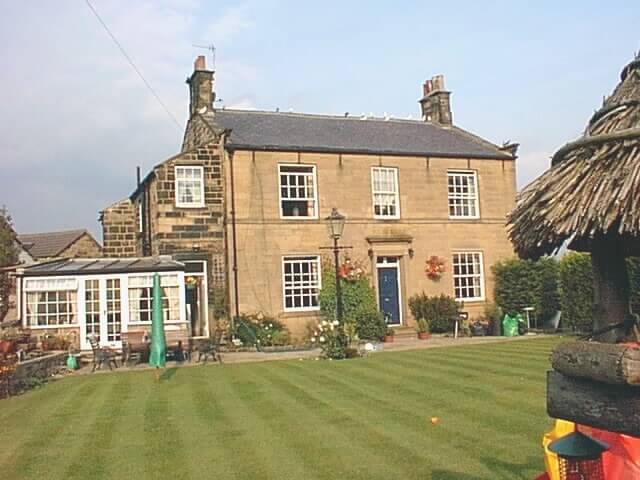
PENNDENE, Grade II listed Georgian, now known as Penndene. On map 1847 and possibly on the Creskeld map of 1756 although it is thought to have been built by the Pulleins c. 1830. Originally the smaller house (left) attached was known as Penndene whilst the main house known as The Shrubberies. On 3rd of August 1829 John Pullein agreed to purchase the “Manor of Poole”, including farms cottages, corn mill, fields, etc. from Edward Armitage of Farnley Hall, Leeds, for the sum of six thousand pounds. In a sale of property and land owned by the Manor House Estate (The Pulleins) in 1902, it stated “Country residence known as “The Shrubberies”, 1 acre, etc., excited some competition and was eventually secured by Mr. William Pullein for £700.” The last member of the Pullein family to live in the house was Mrs. Gladstone, (nee Pullein) who left in 1936.
The smaller attached house to the north, Penndene, was home to the headmaster of Pool School in the 1930’s. For a while during 1960’s was used by staff of Pool Court Restaurant. (demolished) On sale in 2011 described as “A particularly fine and spacious Grade II listed stone detached “Manorial” style property”