
A Brief History
- 1674 Poole Manor Court Rolls reveal stone removed from Pool Common.
- 1774 Award Map shows quarry off Old Pool Bank (Road)
- c. 1810 Turner produces a large pencil drawing of upper (southern) quarry (in Tate Gallery)
- 1846 James Bray part owner of the southern quarry.
- 1847 O.S. map indicates three sandstone quarries on Pool Bank
- 1849 Tythe map shows the northern Old Pool Bank quarry is unoccupied
- 1867 Bill & Tommy Law part owners.
- 1872 Sale of Pool Bank land by Aysgouth Fawkes
- 1878 Benjamin Whitaker & Sons Ltd purchase part of Pool Bank Quarries
- 1911 Stone seen to be called Bramley Fall Stone
- 1917 Quarries closes. Plant & machinery sold.
- 1923 Quarry operates again.under the name of B. Whitaker & Son (1923) Ltd.
- c. 1939 Pool Bank Quarries close.
- 1957 First notice for the filling in of the southern quarry was made by Leeds Corporation.
The exact date when these quarries began to be excavated is not known but Poole Manor Court Rolls reveal that in 1674 William Mirfeild was fined 15/- for digging out stone from Pool Common to build a house in Leathley without permission from Everyld Thornhill, Lady of the Manor of “Poole & Kirskill”. The Award map of 1774 shows the quarry on Old Pool Bank. It also names the road known now known as Old Pool Bank as Bradford Road and Sandy Lobby as Baxtongate Road. The Tythe map of 1849 states “Old Quarry is unoccupied”. By 1847 the O.S. map indicates three areas having sandstone quarries on Pool Bank. The quarry to the south of the A660 expanded after the sale of land by Aysgouth Fawkes on 30th Aug. 1872. The sale notes stated, “This lot contains, moreover, important Beds of Free stone”. The Fawkes family stipulated that any quarry workings were to remain out of sight of Farnley Hall, and Caley Hall, their properties.. The combined quarries became known as Pool Bank Quarries.
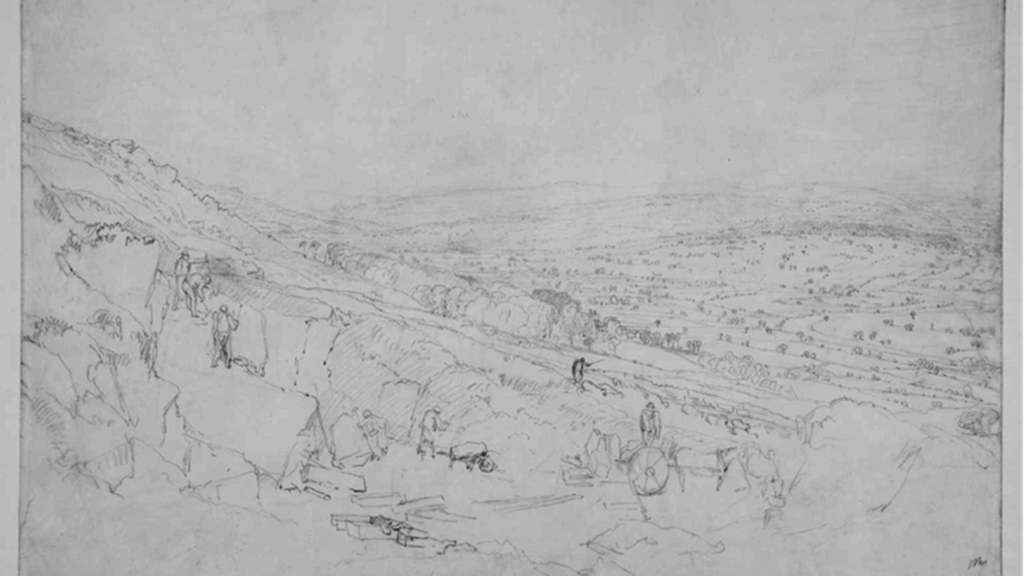
Around 1810 the well known artist J.M.W.Turner was a regular visitor to nearby Farnley Hall,. During his stay painted many areas in the Wharfe Valley. On one of his visits he made this pencil drawing of the southern quarry showing quarry men at work, horses and carts, etc. This is now in the Tate Gallery.

The quarry operating from the south side of the A660 was owned by James Bray. He was contractor to the building of the Arthington Viaduct and owner of Pool Bank quarry in 1846. James Bray provided stone and bricks, for the interior of Bramhope tunnel, and the building of Arthington Viaduct, known then as “Wharfdale Viaduct”. This was in readiness for the opening in 1849 of the Leeds and Thirsk Railway Line. It had been estimated that in excess of 50,000 tons of stone would be used. The 21 arches to each span 60 feet with the length of the viaduct to be 1510 feet. The foundation stone was laid on 31st March 1846 by Henry Cooper Marshall, Chairman of the Leeds and Thirsk Railway. Construction workers were paid between 20s. and 24s. a week with miners earning 6s. a day. (see “Pool-in-Wharfedale Railway”)
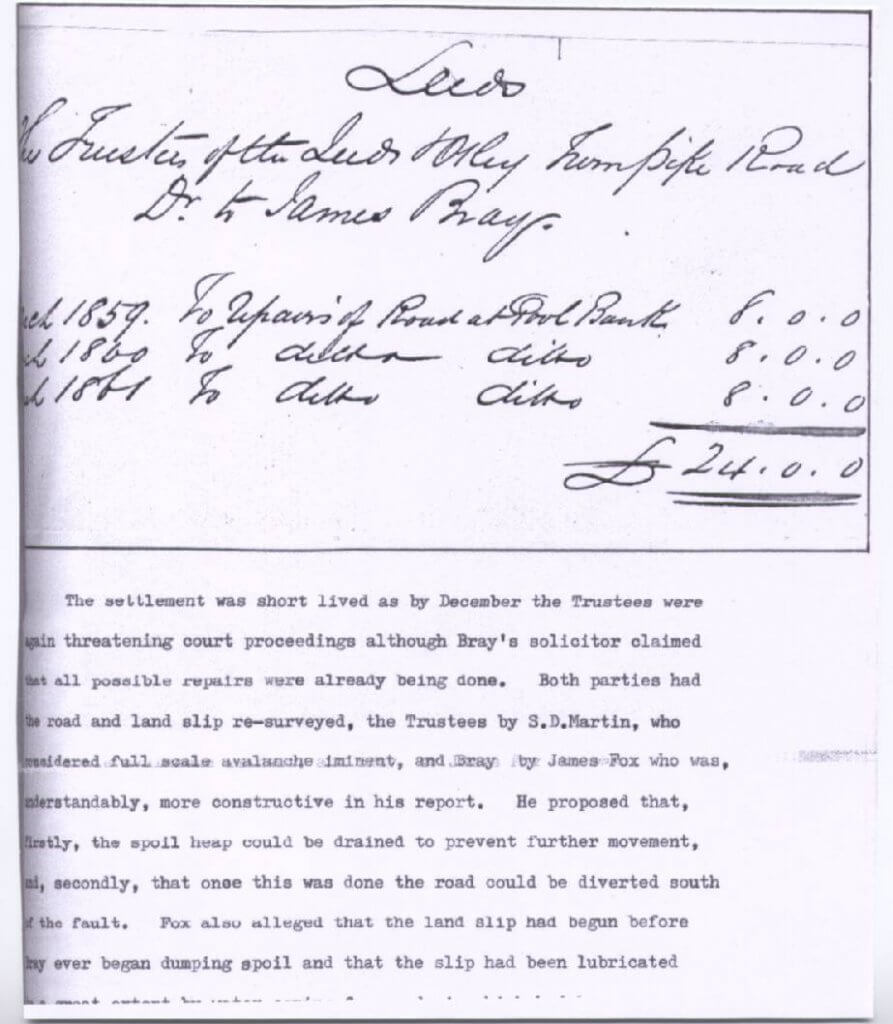
Quarrying for the stone was not without its problems. In 1852 James Bray became involved in what was to be a nine year dispute concerning the condition of the stretch of road outside the Pool Bank quarry resulting in a threat of court proceedings. The trustees of the Leeds-Otley Turnpike Trust Road (A660), built in 1841, claimed that quarrying activities and repeated crossing of the road from the quarry to spoil heaps, on the northern downhill side of the road, had caused slippage on a section of the new road and a “ full scale avalanche was imminent”. An agreement was reached on 11th October 1859 with the Trustees of the road paying Bray £8 per year for the upkeep of the road. However this settlement was short lived. The dispute continued and it was not until 1861 that the road was repaired to the satisfaction of the Trustees.
In 1867 Billy Law and his son, Tommie, were part owners of the quarry. In 1881, William Law owned 34 acres of farm land and stone, employing 19 men and 4 boys, by now working the quarry alongside Whitaker’s. According to house deeds, in 1889 an addition to the quarry was purchased by Whitaker’s from William Law. The booklet A Short History of Pool-in-Wharfedale written in 1929 by the Rev. G.H. Mercer, vicar of the village, there were many stories told of Billy and Tommie Law, Horner Bradley and other quarrymen and how the villagers feared them. In 1924, at the age of 15, Ernest Longfield became an apprentice mason with B. Whitaker & Son (1923) Ltd. at the Pool Bank Quarries. Memories of the Laws were still strong as during his interview with Otley museum in 1981, his comments were, “Older quarry men said William Law was a real old character by all accounts”.
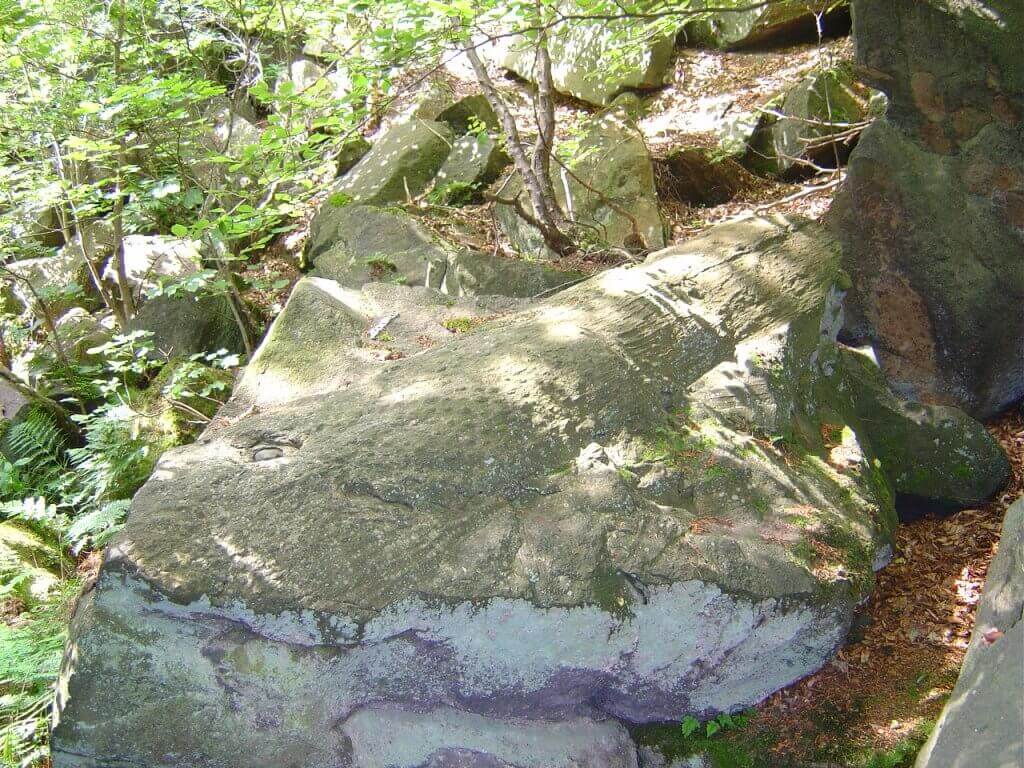
- Below Fossilised Tree branch of Lepidodendron (Scale Tree)
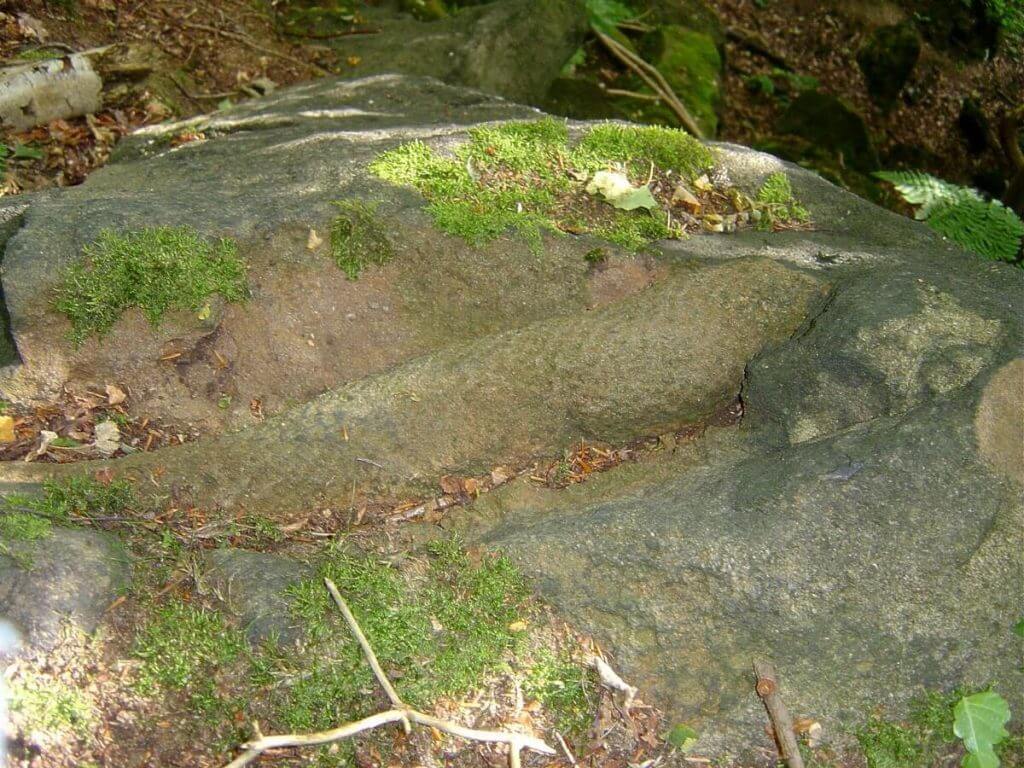
2. Fossilised Tree Root – Stigmaria
A number of fossils can be found in the Old Pool Bank Quarry, off Old Pool Bank (road). These are in the form of tree branches and roots from the Lepidodendron, a tree which resembled a gigantic Christmas tree. These ancient forests existed approximately 280/300 million years ago. The fossilised tree root is named “stigmaria”. Another fossil in the quarry shows the groove that ran down the centre of the branch which was formed as the fascular tissue collapsed. It is because of these and other fossils found in the quarry that the area could be considered worthy of being designated a Site of Special Scientific Interest.
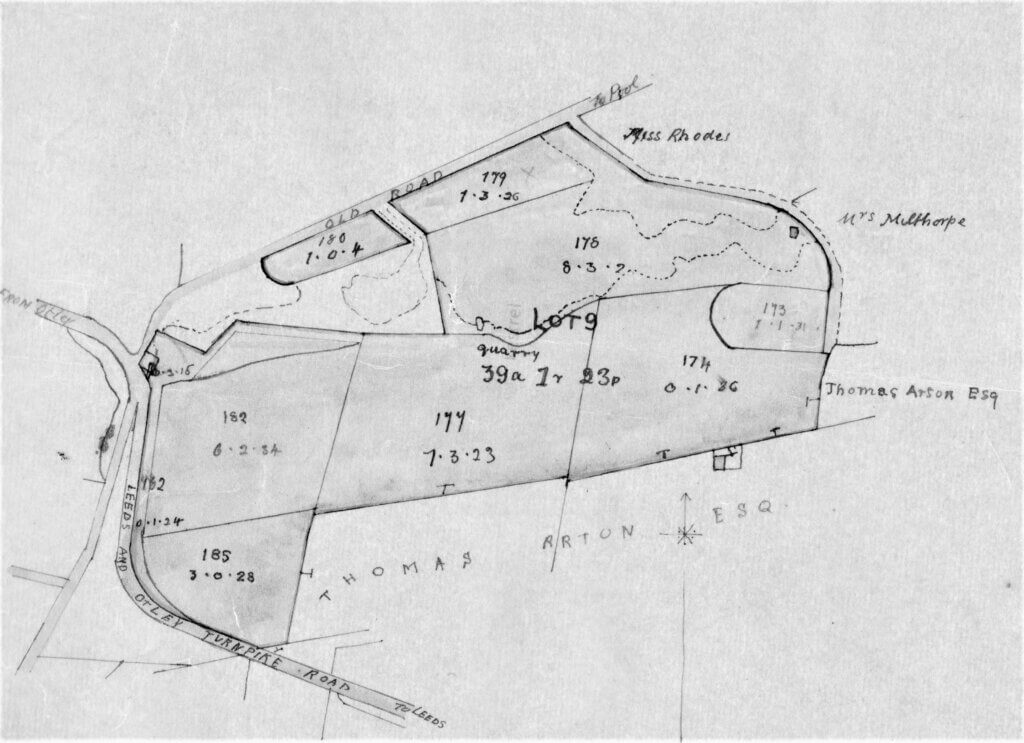
Part of the quarry was purchased by Benjamin Whitaker & Sons Ltd for £57,000 in 1878. Eventually they owned all the quarries and operated a brick works within the upper (southern) quarry on Pool Bank, which was in use in the 1930’s.
In an account of his life in Pool Bank Quarries, held in Otley Museum, Ernest Longfield states, “Although hard, gritty and porous when newly quarried, it increased in strength as time went on, making it almost granite like in endurance.”
Stone from the quarry was used in many places, the most memorable was during the re-building of the Houses of Parliament after a fire in 1834.


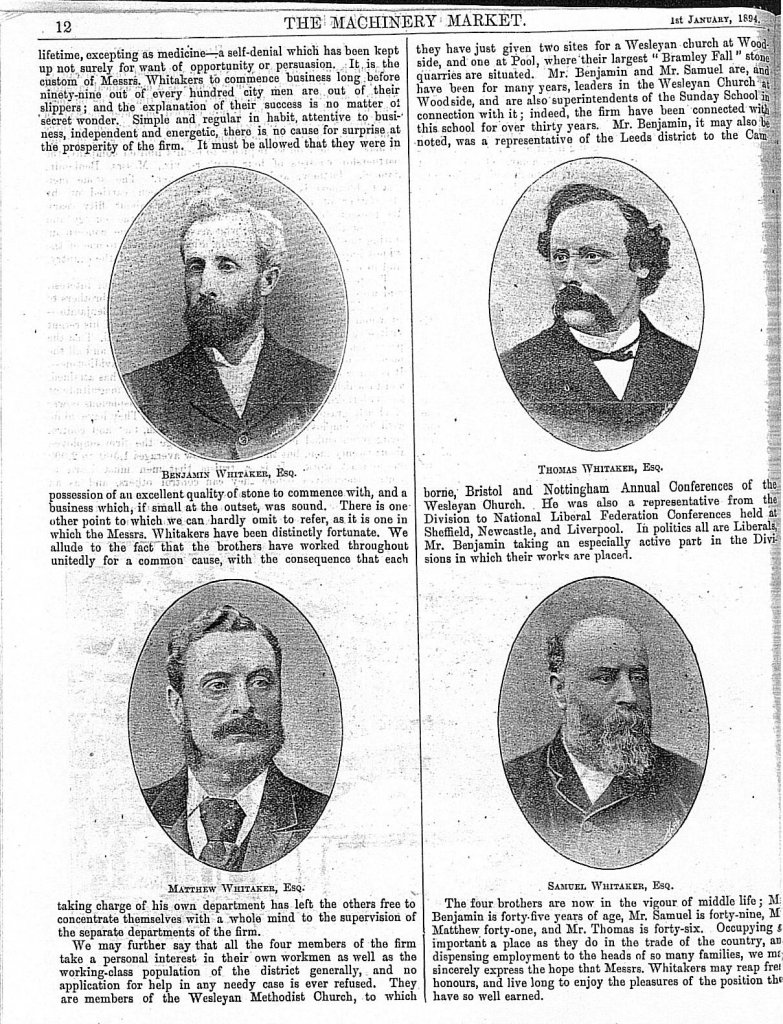
The Machinery Market of 1894 states “Sandstone grit – “It is hard , porous and gritty. Here the beds opened in the quarry are deeper than those at Horsforth without any seem or flaw. A clean depth of stone can be got as large as a house side, say 50 ft. long.. It is on record that one of the blocks got at, was of the enormous weight of 40 tons. The total depth of good stone in the beds is about 50 ft.” In one year c. 1894, 12 to 14,000 tons were sent, mostly to Manchester Ship Canal; and Tyne Docks. Employing 190 men Seventy-four stones each 7ft 6 inches square and 3 feet thick were sent to Liverpool for the building of a large goods warehouse. 12,000 tons, with each stone weighing 13 tons was for the Midland railway warehouse in Sheffield. 12/14 tons were sent away mostly for the Manchester Ship Canal and Tyne Dock”.
Others included Leeds Town Hall and Parish Church; Otley Civic Centre; Hull Docks; Hull and Barnsley railways; Tilbury Docks, Pool Bridge; Swinsty and Fewston reservoirs; extension of Marine Drive at Scarborough; the Weirmouth Bridge at Sunderland, the chimney at High Royds Hospital; Arthington Viaduct; Bar House Row; Far Row and many local houses.
On the 28th Jan and 11th Feb 1881 the Wharfedale & Airedale Observer reported that Messrs. Whitaker & Son had secured a contract for supplying the stone required in the making of the proposed Hull and Barnsley railway. This contract was understood to provide constant employment for some time to come for about two hundred men at both the Pool and Horsforth quarries.
According to The Cambridge University Press in their issue of 1911 of “Building Stones” it states, “Bramley Fall Stone – Millstone Grit from Pool Bank Quarries, Near Otley presented by B. Whitaker & Sons, Horsforth Leeds.”

There are many finely worked old head stones in the graveyard of St. Wilfrid’s church, no doubt carved by skilled masons from the quarry.
The Transportation of Stone
A pulley system was used. The difference in elevation of some 300ft necessitated the construction of an incline of some 650 yards in length and a further half mile of comparatively level track at the top, crossing the main road on its way into the quarry. The incline was operated by gravity, loaded wagons, or bogies, on their way down which pulled “empty” wagons on their way up, normally one at a time, occasionally two or three. A good day meant twenty trips.
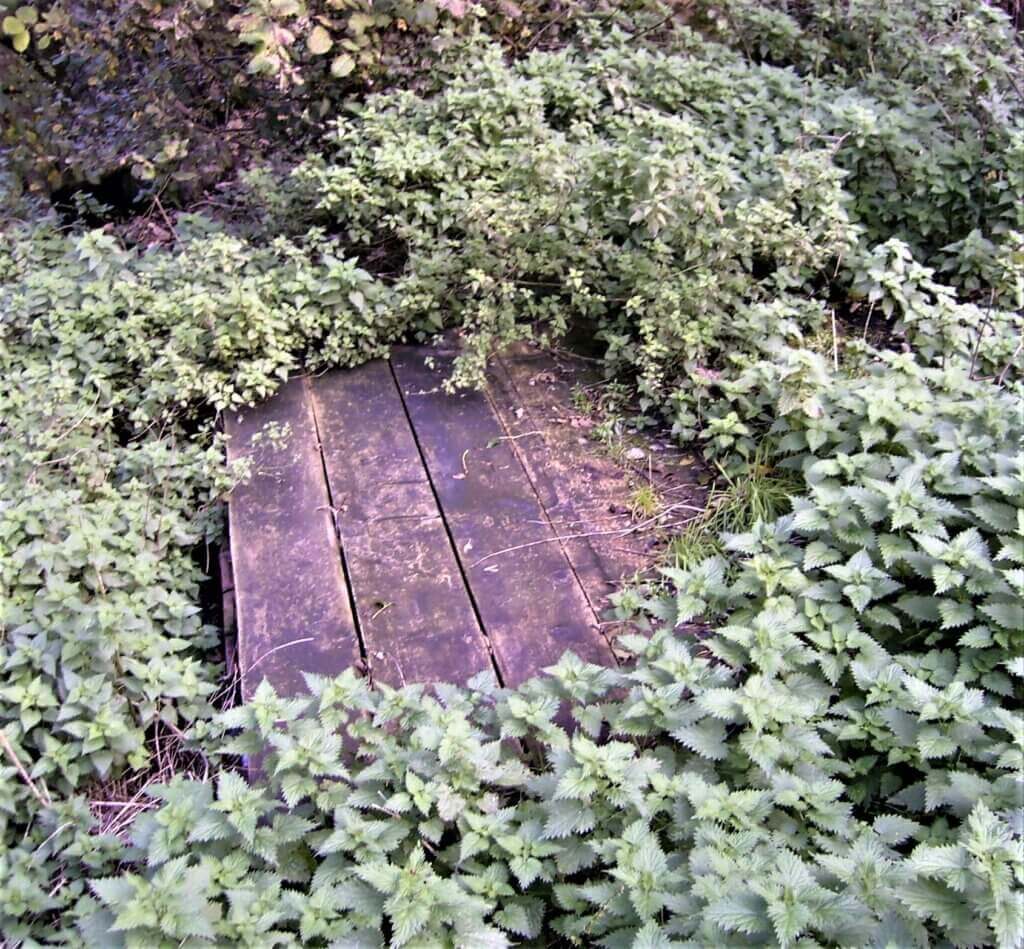
The operation was controlled by a cable break drum on the north side of Far Row cottages . Attempts to make it easy to control, meant bogies with stone and bricks down, balanced by machinery, coal to fire the brick works, etc. going up. A large piece of stone would be anchored onto a flatbed bogey. In these early days, before a bridge was built over the main A660, it was crossed by the bogey line but at such an angle that a turntable was needed. The track then ran parallel with the road to climb into the southern quarry. The quarries were bought in 1876 by Benjamin Whitaker & Sons Ltd of Horsforth.
In the early 1800’s an immense quantity of Bramley Fall stone was being conveyed to the London area using the rivers Aire and Calder.
On 26th March 1879 the North Eastern Railway agreed to provide a loading stage and crane as well as a siding exclusively for quarry traffic to serve the quarry railway at Pool-in-Wharfedale railway station. This enabled Whitakers to load stone directly at the station. It was opened the following year.

Pool-in-Wharfedale Railway Station
At the station, if the stone was finished it was loaded directly into the railway trucks but if further sawing or drilling was needed, machinery was in the dressing shed to deal with it. “Some of the masons dressed the stone at the station in a masons hut. The stone was loaded into trucks at Pool Station using hand cranes”.- Ernest Longfield. Otley Museum O/P/dc/4,
One article reports, Pool Bank quarry operated steam carts which had large back wheels, steel tyres with tipping bodies and bobbin steering chains. Yorkshire deliveries were made using Sentinal steam carts, or lorries. They had solid tyres, double steering wheels and were capable of carrying up to five tons at a time.
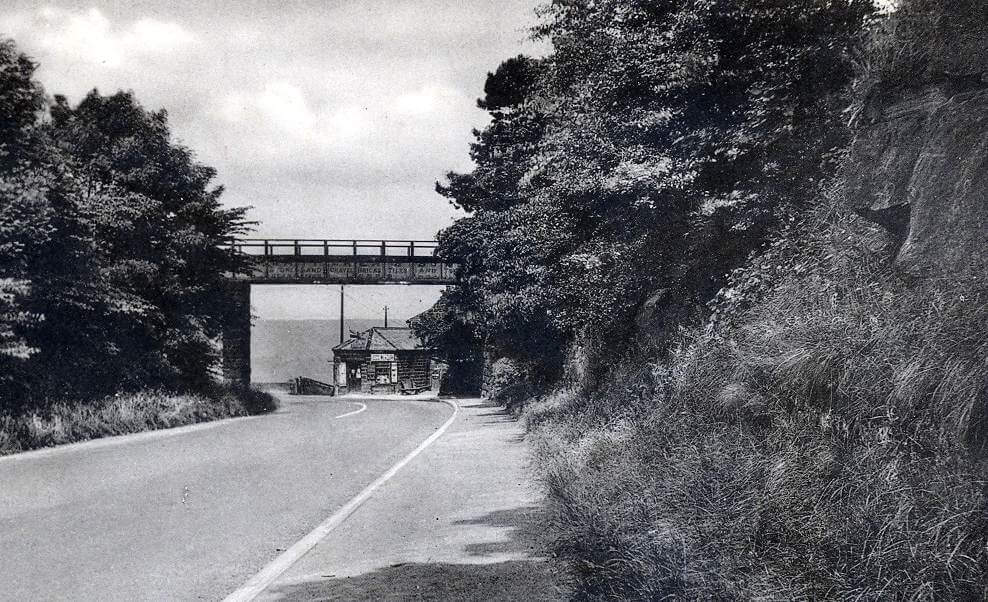
When, in 1890, Whitakers improved the route of the track, a purposes built wrought iron 60ft span, girder bridge was built, which spanned the Otley/Leeds road, so connecting the two quarries. Its twenty ton weight was supported by stone built abutments with a centralised pier. (These abutments can still be seen either side of the Leeds road.) At this stage the route to accommodate the Locos was realigned. The track was a narrow gauge of three feet six inches whereas standard gauge main lines are four feet eight and a half inches. They also decided to improve the route of the railway tack and considerable alterations were carried out. The upper half of the incline was realigned to a new summit, this time at the south end of Far Row which involved a short rock cutting some 100 yards short of the incline top.

By 1891 the brand new steam locomotive “WHITAKER”, built by W.G. Bagnall of Stafford in 1891, was working on the top section of the quarry. It is described as being an O-4-OT Inverted Saddle Tank type in green and black livery. Works No. 1120. Mr Mills, on the above photo, is shown seated on the tank at the front of the loco. The driver is holding a “sprag”, a short piece of metal or wood used to wedge the spokes of the Loco wheels to stop them moving. After about 12 years the boiler tubes began giving trouble. This was replaced in 1910 by “LEA”. (The Loco was disposed of by Whitakers at the auction in December 1917 along with LEA.)

“LEA” was an C-4-OST built by Barclay & Co of Kilmarnock in 1880. Works No. 272. It had a maroon livery fully lined out in black. By November 1899 it was with Thos. W. Ward of Greys, Essex and resold to London County Council for use on the Northern Outfall Sewer widening works at Beckton where it was given the name LEA, after the river. (Stewart Liles). “Second hand, it arrived at Pool station on a low wagon, was unloaded then pinch-barred up the incline…no easy task on a gradient of 1 in 6 When it first arrived it was taken up the wrong way round and had to be manually turned to face the correct way. When this exhausting business was over, the boiler was filled with water from barrels brought on drays from the quarry.” (Pool Quarry Railway by John Whitaker, 1976) The locos were kept in a small shed within the quarry.
In 1917 the tracks of the bridge were removed to help the WW1 war effort. In May 1941 the A660 road was closed for four hours whilst the 20 ton bridge over the road, known as “the slide”, was dismantled for scrap. This was used to help in the Second World War effort..
The Lower quarry was no longer used for extraction of stone.The 1849 Tythe map shows this was unoccupied.

A bridge was built to allow the bogey line to reach the railway and allowing quarry men to pass underneath to reach the quarry.
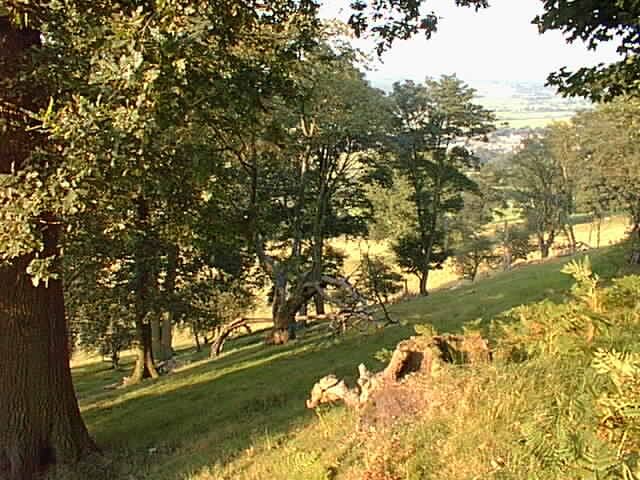
The more or less level stretch from Far Row to the lower northern quarry was worked by horses until 1895, a distance of about half a mile. The map of 1847 shows a wooded area at the top of Old Pool Bank (road), opposite the bungalows, which still takes the name of Horse Pasture Plantation where the trees are protected. No doubt this was where the horses were taken at the end of their working day in the quarry?

In the early days when the lower quarry was working and before the Loco track was laid, stone was transported down this sled track to Old Pool Bank road. It now forms a footpath signposted to Leeds Road.(2021)
A Hard & Dangerous Life
In his diary John Dickinson records, “Wednesday January 5.1881. Off to Pool by 8. Registered two deaths and one birth. The people down at Pool are chiefly poor working people who are dependent on the paper mill and stone quarry and those trades are very bad just now” (“Timble Man – Diary of a Dalesman” by Ronald Harker, Hendon Publishing.)
The stone had a 60% silica content and there was a danger of silicosis. Edward Huddleston, born in 1870, married Helen (Nelly) Slingsby from Gainsborough in 1891. He and his family lived on Church View, Pool-in-Wharfedale . For a while he was a postman before joining the quarry. However he contracted silicosis and died at the young age of 34. Nelly then had the threat of she and her six children being taken away to the workhouse as it was considered she would be unable to support them. She and her children moved to Guiseley where she washed for two football teams, sold home made lemonade and did any job she could to provide from them. She had bad memories of Pool and never returned nor would she talk about her life there. – grand-daughter. For life of Huddlestones see “Mills, Corn Mill.”
Around 1920 Steve and Peter Wilkinson’s grandfather, Ernest, was in no doubt that he just escaped being killed by a large fall of stone as he had just left the quarry face to have a drink.
Holmes Whiteley, born in 1888, describes how accidents happened. “Most of the stones were huge blocks to be used in sea wall and engine bed work, sometimes they had accidents when lowering onto these bogies. Often the full bogey would jump the lines and over would go the load, the stone rolling down the hill side.” – “In those days, there was not the appliances for easing the labour of the men who worked in the quarry, the crow-bar and sledge-hammer being their chief tools”
The following extract from Wharfedale & Airedale Observe gives and indication of the dangers of the quarry.
1st Oct.1880 “Accident at Benjamin Whitaker and Sons, quarry. Wagon came down at a furious rate when the belt was not attached correctly. Several masons and railway servants were at work and were naturally alarmed. Fortunately no one was hurt.”
And again an extract from the Daily News 7th April 1899:
“Pool Boy’s Terrible End in the Machinery. Horace Waugh, a bright, laughing schoolboy, living at the pretty little village of Pool the 12 year old son of a stone mason, named Emmanuel Waugh, was yesterday afternoon the victim of a sad accident. Waugh is employed at Messrs. Whitaker’s yard, immediately opposite Pool station, where he has charge of a stone-planing machine, which is worked by a portable engine.”
His son had visited his father and apparently accidentally leaned on the machine and was caught up in the great cog wheel, badly injuring him. “A messenger who went to Arthington Station to obtain help of the ambulance corps, was fortunate enough to meet a porter going from his work who had been through a course of ambulance instruction.The Arthington Station Master with two porters, came upon a pilot engine with ambulance appliances with which little Waugh’s injuries were properly bandaged. The boy was then removed to the station and attended to in the waiting-room until the arrival of the 6.30 train, in which he was conveyed to Leeds where he was taken to the Infirmary. His injuries, however, were of such a nature that he could not be expected to recover and he died about 7 this morning.”
The bogey line from the quarry to the railway station ran at the back of Bryn Afon, (Bank House) the home of Miss Whitehead. She had seen him only a few minutes earlier laughing as he went down the line.
Holmes Whiteley born in 1888 in his “Recollection of my Native Village” recalls, “I remember one of my school pals getting killed by the machinery at the station. He had taken his father’s tea and was playing about when one of the belts caught him.” – “They were tough lads and lasses and I have seen some fights and squabbles at and out of school. More than once I have seen the school master measure his length on the floor.”
The Leeds Mercury, November 1884. “Accident to a Quarry man. A quarry man named John Hawkridge (49) of Bar House, Pool Bank, near Leeds, is an inmate of the Leeds Infirmary. He was admitted yesterday suffering from a severe scalp wound and a fracture of the left arm, both of which injuries he sustained whilst working in a quarry for Mr. Samuel Whitaker of Horsforth. A number of heavy detached pieces of quarry stone resting lightly on the soil on the brink of the quarry rolled down upon him whilst he was stooping, the pieces having apparently become dislodged by the rain.” He later died of his injuries.
A newspaper of 1890 reports “An accident occurred on Tuesday morning at Pool Bank Quarries. One of the quarry men named Rodwell Hill was working against a huge crane when this, by some means or other, fell. Hill was knocked down by the fall of the crane and received shocking internal injuries”.
In 1924 the rate of pay for a stone mason for a 49 hour week was 12/6d with a 2/6d increase each birthday. Unlike other quarry men, a mason would not be laid off for bad weather and would be paid for holidays. An apprentice mason was paid 2/6d a week. 49 hours were worked during the summer and 46 hours in winter. There were tramp quarry men who worked in pairs. New men arriving would be told if there was a vacancy. However if there were no jobs available, the rest of the quarry men would have a “whip round” to help them on their way. When they were employed they were paid each night.
Holmes Whiteley, born in 1888 recalls, “These quarry men had to work hard, it was a rough job both in the quarry and the brick yard. They were paid a little more than most other trades but the extra was more than offset by them having to stand down during frosty weather. One winter they were off work owing to frost, for thirteen weeks. It was then a *gentleman from Park House provided many of them with soup.” Park House was a grand Georgian house in Pool, built by Pool paper mill owner, John Milthorp, originally named Plainville, demolished in 2002 by the then owner. *The gentleman referred to above was J.T.Jackson of Jackson’s Arcade, Otley, who was at that time renting Park House from the owner, Michael Snowdon. He went on to live at Pool Hall.
Layout of quarries showing both 1880 and 1890 lines.


Soon after the quarry was re-opened and renamed B. Whitaker & Son (1923) Ltd. Ernest Longfield arrived at the quarry. In 1924 there were approximately fifty men employed, mostly from Pool, Old Pool Bank and Otley. He tells us how the rock was cut.
“In the first instance, Pool Bank had very deep posts. They call ‘em posts – proper name – that’s the depth of the rock: some were as deep as this room. The getters would set off, because as I explained they didn’t do any blasting, and they set off making great big races in the rock with special picks. They’d work on planks like a kind of scaffold making a race right across the rock face. They’d have larger wedges on this first getting position, and they’d make these wedge holes so these wedges used to drive in and bite.
There was also some right fine grass that only grows round the quarry. I used to have to go and gather it, put it in these wedge holes before they lay the wedge in and it helps it to bite – it’s the same thing as oiling bike chains. Then they used to hammer away hours and hours, braying at these big wedges. Two men ’d ‘av a go and then another two would go, you see. You’d get this big lift off and then they’d go round to the back, where the bearing was, the digging, and jack it over with hand wedges and hand jacks, then eventually get it free.
The *Derrick Crane was built on a banking that was on the quarry hill. The operator would be situated here and he could get his derrick jib right over to this rock face – and all below of course was a big drop”.

Eventually they’d bring it bit by bit using paddies and hooks and slings and bray in these wedges more and more and bring this rock right down into the bottom. When they’d got it into the bottom, they’d cut again into smaller sections by means of wedges and picks called “a bottomer” that bottoms a hole out for them, so that you can put the wedges in. Then it would be lifted by the same Derrick crane onto the hilltop, the man-made area where they did all the shaping. That’s where the **Scrappler came in, got it into handy sizes – some blocks were bigger than others, some could go on the fame saw and some would go on the planing machines.”
**A scrappler, a semi-skilled worker, used an 18” long pick with a point on either end. He would swing at the rock constantly for hour after hour forming lines and eventually making a uniform block shape. A good scrappler would make the finished rock look “almost like corduroy trousers”.
Bracken was collected from the Chevin to be used as a cushion to prevent shattering of the stone whilst it was being quarried. No blasting was done as this caused fissures in the stone, “everything was done by hand, therefore it required tough men.” – Ernest Longfield.
The bases for the Derrick crane’s three legs, some twenty yards apart, can still be seen in a garden at High Ridings, Old Pool Bank.
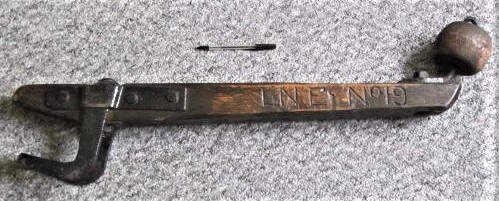



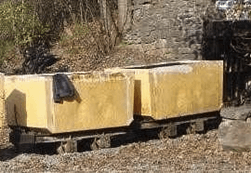
On Feb. 10th 1882 the Wharfedale and Airedale Observer records,
“A remarkable stone. No small amount of interest has been excited by an unusually large stone unearthed at the Pool Bank Quarry belonging to Mr. Wm. Law. The width of the stone is 60ft, its breadth is 44ft. and its depth no less than 30ft, without a crack or flaw. An enormous magnitude of this remarkable stone.
A great number of stone merchants and others in the trade have, during the past few days been to look at it and all declare that they have never before seen a stone of such gigantic proportions. It is calculated that the stone will weigh 6,000 tons. We understand however that the stone is now being actively broken up and large blocks sent off to be used in the making of the docks at Hull.”
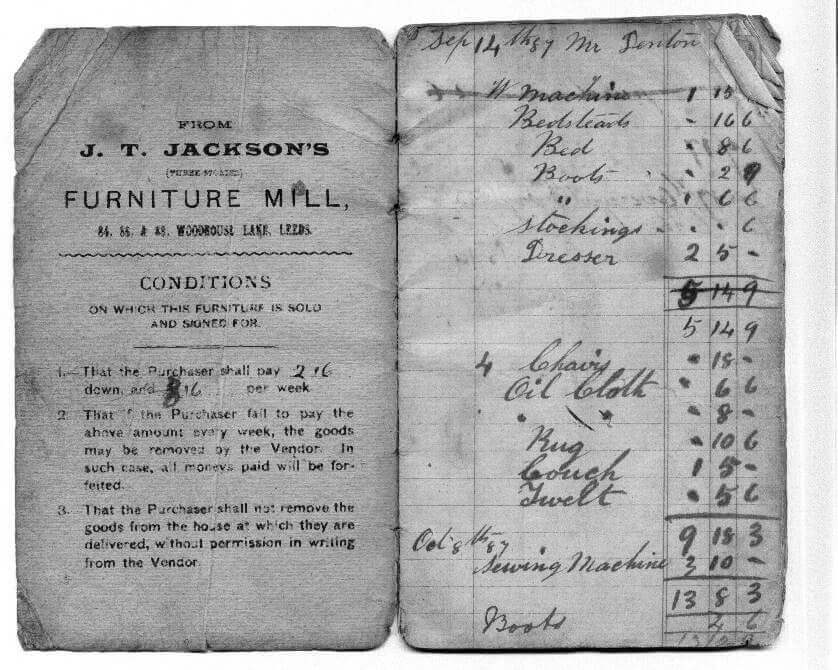
The words “Mr. Denton Pool” is written on the front cover of this small Hire Purchase book found in 1988 under squeaky boards of a staircase, in a cottage on Sandy Lobby. It is understood to have belonged to Ned Denton who worked the turntable situated near the Chain Bar. The book, with calendars for 1887 and 1888 lists goods which had been bought to set up home. These included: Sewing Machine £3. 10s.0d.; Couch £1.5s.0d; Four chairs 18s.0d; Oil cloth 6s.6d.; Boots 2s.9d. His weekly payment was 2/6d (13p)
The 1911 census shows there was a cobblers shop owned by Mr Grange, which memories recall was a wooden hut at the entrance to Quarry Road, primarily making and repairing clogs for quarry workers.
The Brick Works and Quarry Workers’ Housing

A local newspaper advert. in 1866 asks for tenders to erect at Pool a “Hoffman’s Patent Brick Kiln, with Chimney, etc.” During the building of Arthington Viaduct and Bramhope tunnel in 1845 preparation for making bricks at the rate of 50,000 a week during the winter and twice that number in the summer season was planned. At that time Pool Quarry was owned by James Bray builder of the viaduct and Bramhope Tunnel. The quarry also provided stone for the Houses of Parliament after a fire in 1834.
Mrs. Singleton’s father, William Townsend from Holbeck, was a quarry worker before the 1914-1918 war. He fought in the Kings Own Royal Light Infantry Regiment and survived three battles on the Somme. During the third battle he was taken prisoner. Because he had worked in a quarry, he was considered to be a miner so was transported to Silesia to work down the mines. Although he is recorded as “missing” in York Minster he actually returned home in 1920. Soon after he and his family moved to Old Pool Bank where he again worked in the quarry environs, this time in Whitaker’s brick works.
During WW2 finding work as a blacksmith became very difficult. Mr. J.W. Mulligan, came from Leeds with his two sons, to live in the quarry workers cottages on Quarry Road, Old Pool Bank. Among his many jobs was sharpening axes, pick heads and chisels of various types.
Names of people known to have worked at Pool Bank Quarry: 1841 Joseph Emmet, & Benjamin Greaves. 1871 Abraham & Mark Huddleston, Robert & John Ridealgh; 1886 Benjamin Greaves, a stonemason; c. 1887 Ned Denton, turntable operator; Edward Huddleston; 1899 Emmanuel Waugh, stonemason employed at Pool Station; Bradleys; Almonds; Rhodes. 1891 Frederick Davy of Pool. Between 1910-1912 Joseph Morris-Chippendale of Old Pool Bank. 1920 Ernest Longfield, stonemason; Johnsons; Charlie Gall & Ernest Wilkinson, Pool; Joe Roundhill, W.H. Martin; Townsend. Many more quarry workers are shown on the 1891 census, in fact all but one was a quarryman living at Old Pool Bank.

A 22 chamber brick kiln was certainly being operated by Whitakers c.1900 within Pool Bank Quarry making use of the clay and a sandy substance which had previously been removed to get at the quarry stone.Holmes Whiteley recalls “they were not considered a very good brick but had a large sale for underground work and out of sight walls. The price was eighteen shillings per thousand at the quarry, two shillings extra if taken to the railway station.”
Around 1930 some houses on Park Mount and Park Terrace at Old Pool Bank, were provided by Whitakers for the brick workers and their families. Deeds for these houses state a right of way must be allowed to maintain the water pipes and tramway, no quarrying or manufacturing of bricks to take place.

Around 1880 a house called Glen Royd was built below Cragg View on Leeds Road A660. A member of the quarry owning family, Benjamin Whitaker, lived there in 1880. (census). It was demolished c.1960 apparently due to subsidence.
Many houses were built for the quarry workers. On Quarry Road, the main service road off Leeds Road, on the left of which was the quarry masters house, whilst opposite were three cottages (now as one).
Groves Terrace, originally wooden bungalows, were demolished in 1939 and rebuilt as seen today.
Other cottages built for quarry workers were Cragg View, Leeds Road built c.1880, Bar House Row, built c.1879 using stone from Fairy Dell quarried from the bottom part of Old Pool Bank Quarry. Far Row was built c.1876 also Valley View. The deeds of some cottages on Sandy Lobby state that the road should only be used for quarry traffic. As late as 1950 there was a gate leading into the quarry from Sandy Lobby.

within the old Pool Bank quarry
In 1907 when Allison Tankard planned the building of Wharfe View in Pool-in-Wharfedale village, his intention was that he would let the houses to quarry workers and make a weekly rental charge of 3s.6d.
The Old Quarry Workers’ Cabin becomes a Chapel

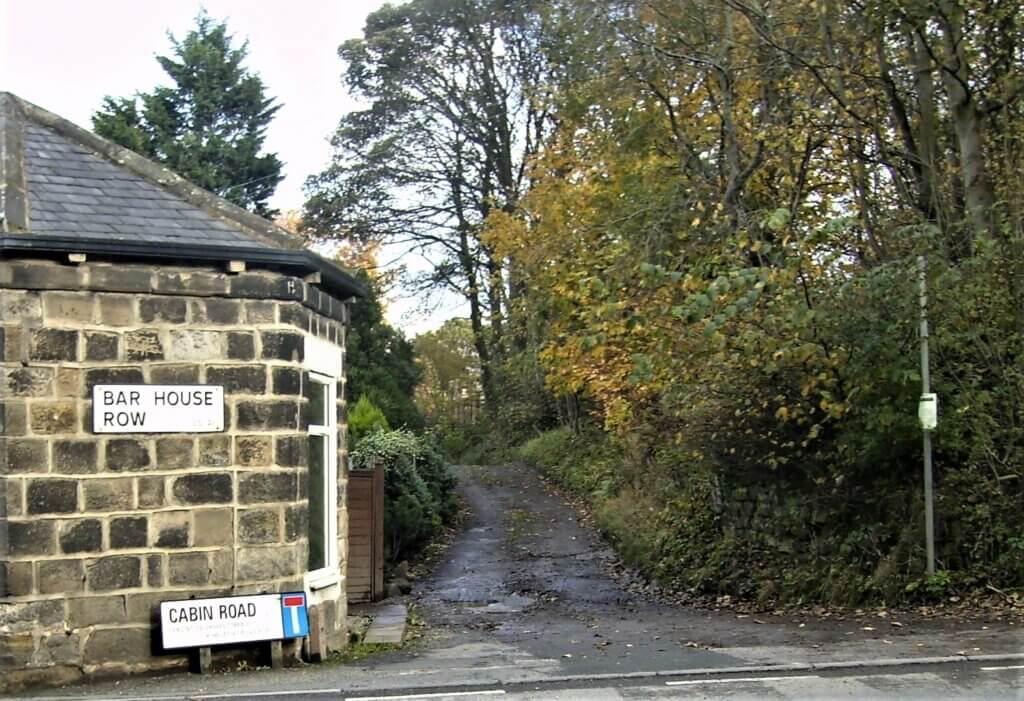
A stone cabin was on Cabin Road situated to the west of Far Row within the old northern quarry, the foundations can still be seen. This had been used by the quarry workers for meals. During the 1880’s, when no longer needed, and with the agreement of B. Whitaker & Sons Ltd, it was used, free of charge, as a Wesleyan Chapel, also by the Church of England, Plymouth Brethren and the Salvation Army, later doubling up as a village hall for the residents of Old Pool Bank. Chapel services, Parish Council meetings, polling and, during WW2, the issue of ration books and gas masks, all taking place there
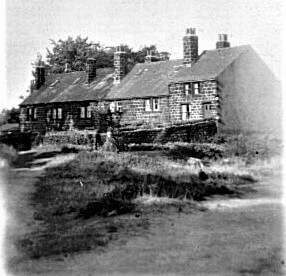
The original bogey track ran at the north side of the cottages with the rail track was to the south.
The cottage to the north of Far Row cottages was extended by Mr. Burton after moving there from Beeston in 1900. He was a lay preacher, preaching in the “Cabin”, the small converted quarry workers hut within the Quarry,
After the building of a new village memorial hall at Old Pool Bank officially opening in 1952, the Cabin became unused and demolished by Whiteley’s in 1956. The Whitakers were all prominent workers for the Church donating land for building Woodside Methodist Church.
Extract from Wharfedale and Airedale Observer. “8th Feb. 1894. “Pool Bank Wesleyan Tea and Meeting. The Wesleyans at Pool Bank held a tea and meeting on Wednesday evening last in the “cabin” which is used by them as a meeting room. The number present in the evening being so large as to render the place uncomfortable thus demonstrating the need of a larger place of worship.”
The following accounts of the Chapel renovation and enlargement were found in the Wharfedale and Airedale Observer:
“19th Oct. 1894 Pool Bank Wesleyan Methodist Society; reopening of the “Cabin”. A much needed improvement at the cabin on Pool Bank where the Wesleyan Methodists have, for a considerable time held services, have been completed. The building has been enlarged, the walls plastered and colour washed, the ceiling raised, boarded and varnished and the building now has a very comfortable and pleasing appearance. On Saturday a public tea was held and a large number partook of the excellent repast provided.
A public meeting was subsequently held, presided by B. Whitaker of Horsforth. He announced that the firm of Messrs. B. Whitaker and Sons Ltd would send a donation of £10 towards the cost of renovation and continued by stating that he himself would give a further sum of £5, with certain conditions. “We are notified that the conditions named have since been complied with. The total cost of the alterations amounting to £73.2.7d. leaving a small sum of £18.9.10d. owing, which is a satisfactory state of affairs.”

The onset of WW1, caused many cancellations, making it difficult for Whitakers to stay in business and local deeds show that around this time many loans were made to the quarry in an attempt to keep it open. Pool Bank Quarries closed, with a sale of “Valuable Plant, Machinery, Tools and Effects” being held on 11th Dec. 1917. The land attached to the quarry to the south, was sold by B. Whitaker & Sons Ltd. on 11th April 1917.
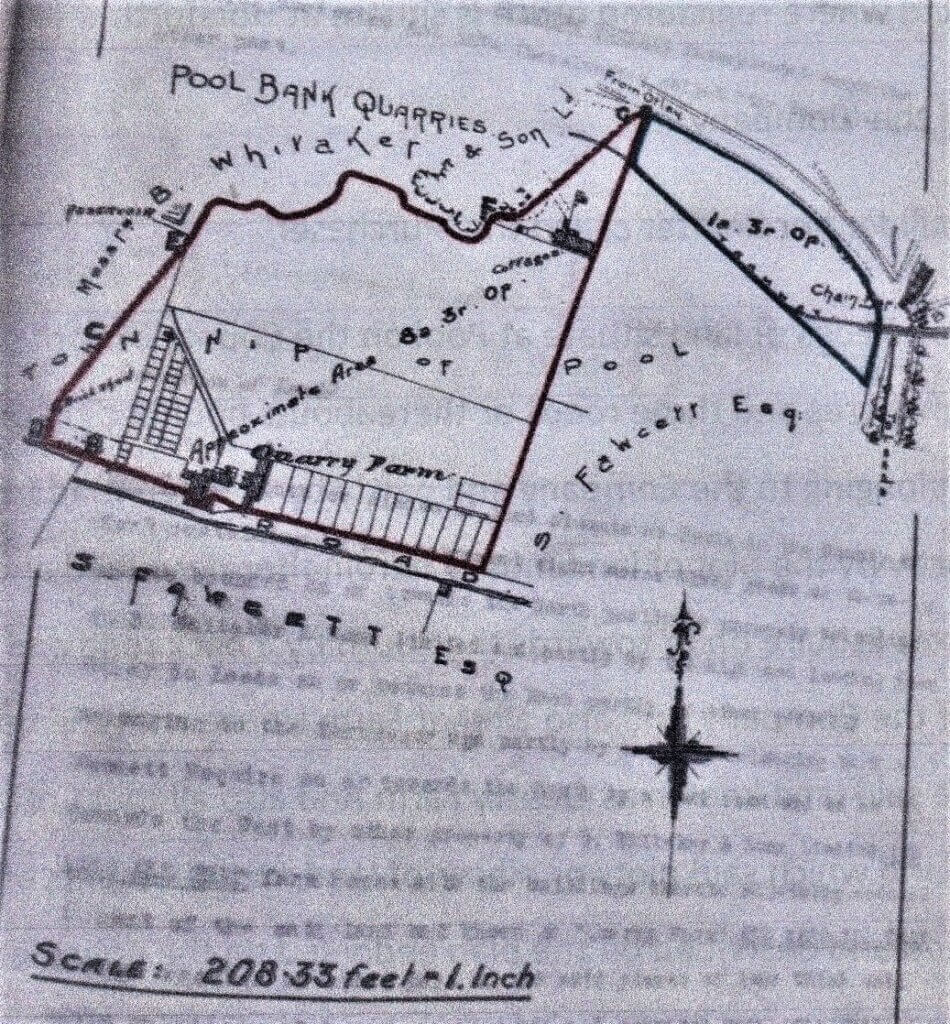
The quarry re-opened under the name, B. Whitaker & Son (1923) Ltd.remaining in operation between both World Wars. After finally closing, in May 1941 the A660 road was closed for four hours whilst the bridge over the road, known as “the slide”, was dismantled for scrap. This was used to help in the Second World War effort.
The Disused Quarries find other Uses
After the closure of the quarry and brick works the area was used in various ways during WW2. Broken bricks from the brick works, which had been disposed of in a pit, were removed and used as hardcore for the base of the Avro factory being built at Yeadon. The sides of the quarry were some 300 ft. high and Mrs. Doreen Singleton, whose father worked at the brick works, recalls Canadian soldiers from Farnley Camp trained there . They used the quarry face for climbing and absailing.
Extracts from “Home Guard in Pool” by Kendal Newby tell us:-
“I also recall being taken up Pool Bank to the old quarry. In the quarry a barricade of tin sheets had to be erected and set up with the officers in charge. We stood behind the tin sheets, then in our turn, we went up to the officer in charge. He gave us our instructions. We were there to learn how to throw hand grenades.
They were Mills hand grenades, so we went one by one up to the tin shields where we were shown the grenades, which are pear shaped with a lever held down by a pin, which when pulled out, released the pressure on the lever, so when you threw the grenade the lever came off and you had just five or six seconds to duck before the grenade went off. I can’t remember how far mine went but shouts of “Duck” rang out as the grenade went off. It was all taken very seriously.” The slogan was “Look, chuck, duck!”.
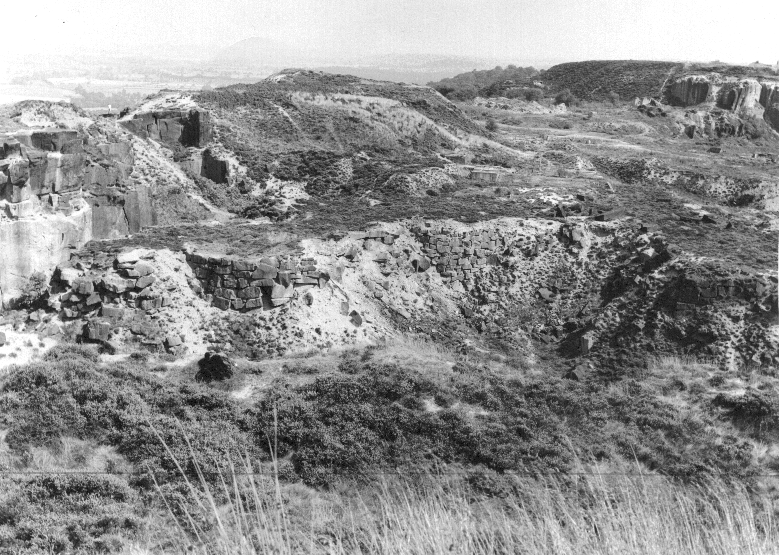
The future infill of the Pool Bank Quarry site south of the A660 by Leeds Corporation was first mentioned in the minutes of the Pool Bank Residents Association in 1957. It was later completely filled with household waste and has now returned to be part of Pool Bank.
Many fossilised parts of trees can be found amongst the spoil heaps in the northern quarry

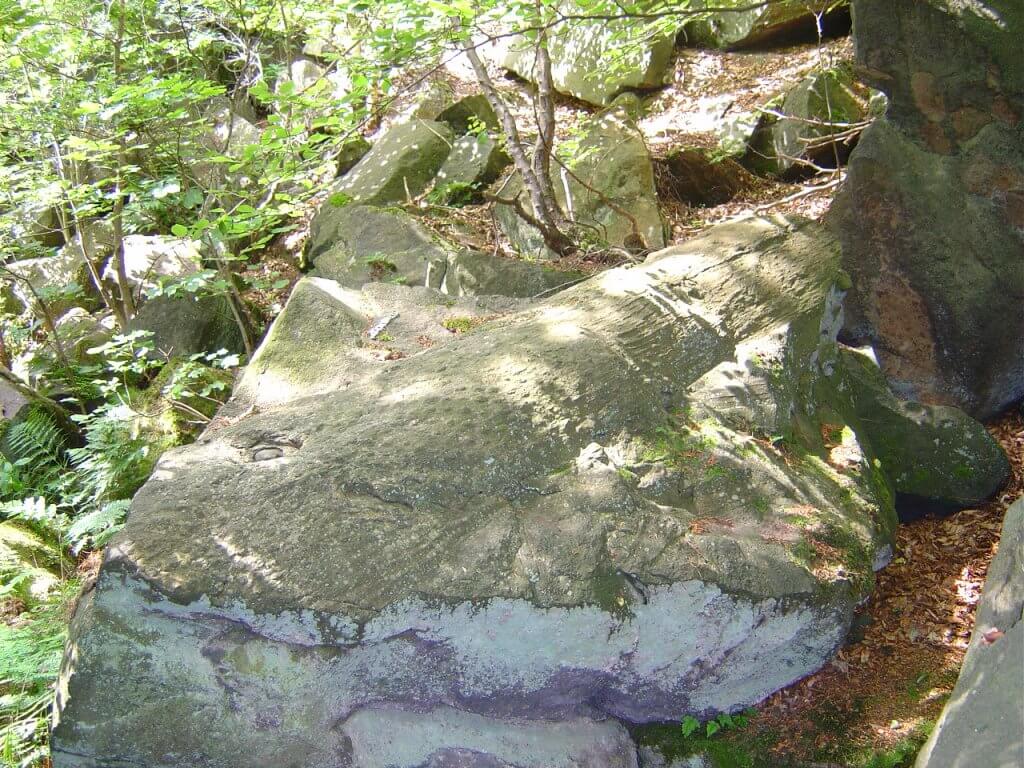

The remains of lower Old Pool Bank quarry workings make an interesting and picturesque woodland walk with wonderful views over Wharfedale from the elevated area named “Spion Kop”, no doubt named by quarry workers during the Boar War. There is a fine fossilized tree trunk, a fossilized root called a “stigmari” and many more small examples of branches of a tree, thought to be a Lepidodendron or Scale Tree. They are fossilised remains of an ancient forest approximately 280 to 300 million years old. The trees resembled gigantic Christmas trees. These can be found amongst the spoil heaps just south of Far Row cottages. During a survey made by the architectural historian, Peter Thornborrow in 2005, a suggestion was made that because of the many fossils and remains of the lower quarry, it could be designated a Site of Special Scientific Interest. Of the central photo, more of a broken off piece of this tree fossil can be found lying underneath.
THE POOL QUARRY RAILWAY by John Whitaker 1976
“The first reference to a railway up Pool Bank from the station of Pool-in-Wharfedale is in an Agreement dated 26th March 1879 between the North Eastern and the quarry owning firm of Whitaker & Co. This was for the erection of a loading stage and crane at Pool to serve the quarry railway. The railway completed in 1880, connected a siding in the (railway) yard on the down side with Pool Bank Quarry at the top of the hill on the south side of the Leeds-Otley road (A660). The difference in elevation of some 300ft necessitated the construction of an incline some 650 yards in length and a further half mile of comparatively level track at the top, crossing the main road on its way into the quarry.
The incline was a conventional affair, with a three rail section above a passing loop at the half-way point and the usual two-rail section below it down to the lower terminus. From the outset the incline was gravity worked. Few large engineering works were required, the line simply climbing at an angle on a shelf in the hillside, but a small under bridge was provided about two-thirds of the way up to cross a public footpath. The incline top was at the north end of a row of cottages known as Far Row and the brake drum was close by the end house.
Here the level section commenced with a short rock cutting but this was the sole major feature on this stretch which pursued a comparatively easy course to the Toll House on the Otley Road. This road was crossed on the level and at such an angle that a turnplate was needed at the south side, after which the railway ran parallel with the road until it climbed into the quarry itself.
The section from Far Row to the quarry was horse worked. At Pool, where the NER provided a siding exclusively for the quarry traffic, a dressing shed was built, in addition to the loading stage and crane mentioned in the Agreement.
In about 1890 Whitakers decided to improve the railway and considerable alterations were carried out. The upper half of the incline was realigned to a new summit, this time at the south end of Far Row, a short rock cutting being necessary some 100 yards short of the incline top. The underbridge mentioned above was enlarged to suit the new course. From Far Row to the quarry a completely new alignment was built, approximately parallel with the old but slightly higher up the hillside and climbing towards the main road. The major difference came with the crossing of the Otley road and here a wrought iron girder bridge was provided. This bridge believed to have been bought for the purpose was of 60ft span and weighted some 20 tons. It was supported by substantial stone abutments and a central pier. Beyond the bridge a virtually level stretch led into the quarry complex. The new line, and almost certainly the old, was to a gauge, unusual for England, of 3ft. 6ins.
It is not known if Whitakers carried out these improvements with the express purpose of facilitating locomotive working but certainly by about 1895 a steam locomotive was at work on the top section. Of this engine little is known for certain but it is described as being an 0-4-OT in green and black livery and was thought to b new from the Leeds firm of Hudswell, Clarke. Unfortunately no trace of such an engine can be found in R.N.Redman’s exhaustive history of that company’s products.
However, after some twelve years or so the boiler tubes were giving trouble and it was replaced in 1910 by an 0-4-OST. This was called LEA and carried a maroon livery, fully lined out in black. It is believed it came second-hand from Lankshire. It arrived one day at Pool station on a low wagon, was unloaded and then pinch-barred up the incline…. No easy task with a ruling gradient of 1 in 6!
On the top section the layout of the quarry machinery required that the locomotives should work with the chimney towards Far Row. Of course LEA was the wrong way round and had to be turned. The exertions over, the boiler was filled from barrels brought on drays from the quarry and the engine was successfully steamed. It was stabled in a small shed in the quarry.
Wagons were normally worked down the incline one at a time, but occasionally two or even three were sent down. A good day meant some twenty trips, but about ten was more usual. Telephone communication was provided between the brakesman and the loading stage at incline foot. The brake drum was counted horizontally again hard by the cottages and a stay block was situated just short of the summit. Traffic mainly consisted of stone which was finally dressed, by hand, in the small yard at Pool, but bricks were carried too from a brick works built by Whitakers in the quarry. LEA’s load from the quarry to Far Row was usually restricted to two or three wagons but there was a great deal of internal traffic in the shape of spoil from the quarry to be tipped near Far Row, so LEA was kept busy.
The quarry itself was said to be at its peak in the early years of this century and it was very well equipped. Three 60ft derricks of 8, 12, and 15 ton capacity, two universal cranes each of 15 tons and an overhead travelling crane of 20 tons capacity were provided. In addition to stone, working machinery including three planning machines and five saw frames, a 22 chamber brick kiln was in use, the clay coming from the same quarry. Over 100 men were employed in the early 1900’s but the outbreak of WW1 brought about a mass cancellation of orders. The quarry struggled on for a while but finally closed in 1915. The machinery, railway and LEA all went for scrap, dismantling being completed in 1917. The bridge however survived, only to be claimed as salvaged in WW2. It was removed in May 1941, in a four hour operation, during which the road was closed.
Mr. Joe Roundhill, who provided much information for this article, survived until December 1974, outlasting his engine by nearly sixty years!
Today a great deal remains to be seen of the course of the line. The incline survives virtually intact and can be walked despite the brambles, for most of its length. At Pool itself, however nothing remains. The station and yard are now a small housing development and the incline ends abruptly in a potato patch. The site of the passing point is still clearly visible and the abutments of the small underbridge survive, though deteriorating fast. The formation of the original incline can be followed, though this has suffered from land-slips and the rock cutting of the new route is well preserved. At Far Row nothing remains of the brake-drum, but the site of the top block can still be found a little way down the bank. The remains of the sidings for spoil tipping can be followed with ease.
From Far Row to the Otley road the course of the line can be followed without difficulty whilst the abutments of the girder bridge are intact and the foundations of the central pillar are to be seen at the roadside. Beyond the bridge, however, the course of the line has been landscaped into a private garden and there is little to be seen. The quarry itself has suffered the usual fate of such things and is now almost filled by tipping.“
Taken from the original typewritten transcript given to Kenneth Horn, High Ridings, Park Mount, Old Pool Bank in 1976. It has been reproduced in the M.E.R.A. Express of May 1976.
TOOLS USED as described in an interview with Ernest Longfield in 1981 who was an employee in 1924 of B. Whitaker & Son (1923) Ltd.- by kind permission of Otley Museum O/P/dc/4,
Quirk A narrow chisel about ¼” wide. So sharpened when you made a groove it cleared itself. Narrow at the back. Very fine tool for getting into fine rebates.
Chisels(2 types) Hammer headed are punches, pitching, nickers and Lewis tools.
Mallet headed are bolsters with 2” to 3” cutting edge, 1”, ½”, ¼” chisels, quirds and claw tools.
Also set squares, sinking squares, compasses, straight edges, hammer and mallet bevel.
Picks 18” long, with a point on either end. The operator was called a “Scrappler” a semi-skilled workman who swing on the quarry face to get a large piece of rock, done in lines to look like corduroy trousers. Would swing hour after hour to get into uniform block shape.
Templates Very thin zinc Masons templates. They had bed moulds, face moulds, reverse moulds used to finish the quarry stone.
Lewis chisel Makes a 4” deep Lewis hole.
Lewis A lifting device with a ring, a straight leg and wedge shape leg.
Paddies, hooks, slings, wedges, frame saw, planing machine, Lewises, chains, dogs, hand jacks, hand wedges
Ogeee moulds, fillets, return ends, mitres, block and spacing. Used by masons at Pool Bank.
Bottomer A little pick which bottoms out a hole to put wedges in to be lifted onto a Derrick crane
Posts The depth of the rock.
Workmen
Getter Made great big races and wedge holes. The races ran across the rock face with special picks, working on planks like scaffolding.
Scrappler Semi-skilled worker, used 18” long picks to get large pieces of rock from the rock face to look like corduroy trousers. Constantly swinging pick for our after hour.
Apprentice Mason Earned 2/6d per week in 1924.
Mason Skilled worker, earned 12/6d per week in 1924. Was not laid off in bad weather.
Plant
Quarry Plant consisted of 4 stone planing machines, 2 frame saws, a compressed air driver and all driven by Crossley diesel engine. A large steam driven crane which ran on rails and could serve the machinery. On the quarry hill was a large Derrick crane with a large jib.
LOWER QUARRY NATURE SURVEY OF 2016
During 2016, at the request of Pool Parish Council, the lower quarry area was surveyed, on a voluntary basis, by Keith Wilson MSc. MICFOR.(retired)
“Too steep and rocky for agricultural use other than light grazing, it is likely to have had some woodland cover since the last Ice Age.
It is important to conserve and enhance Pool Bank wood for its landscape, wildlife, quiet recreational and environmental importance. It provides shelter and shade for adjacent roads, fields and houses; absorbs carbon dioxide and air borne pollution; and slows run off to lessen flooding. Mostly broad leaved in character, the woodland corridor extends from Otley Chevin / Caley Craggs to Pool Village with links via Old Pool Bank, Avenue des Hirondelles and the old railway line.
Birds. Common songbirds share the woodland with specialists such as nuthatch, great spotted woodpecker, jay, tawny owl and sparrow hawk. Common buzzard and red kite frequent the area. Roe deer are present, as are red fox, badger, brown hare, hedgehog, rabbit, grey squirrel and several species of bat. Polecat ferret casualties have been found in the area.
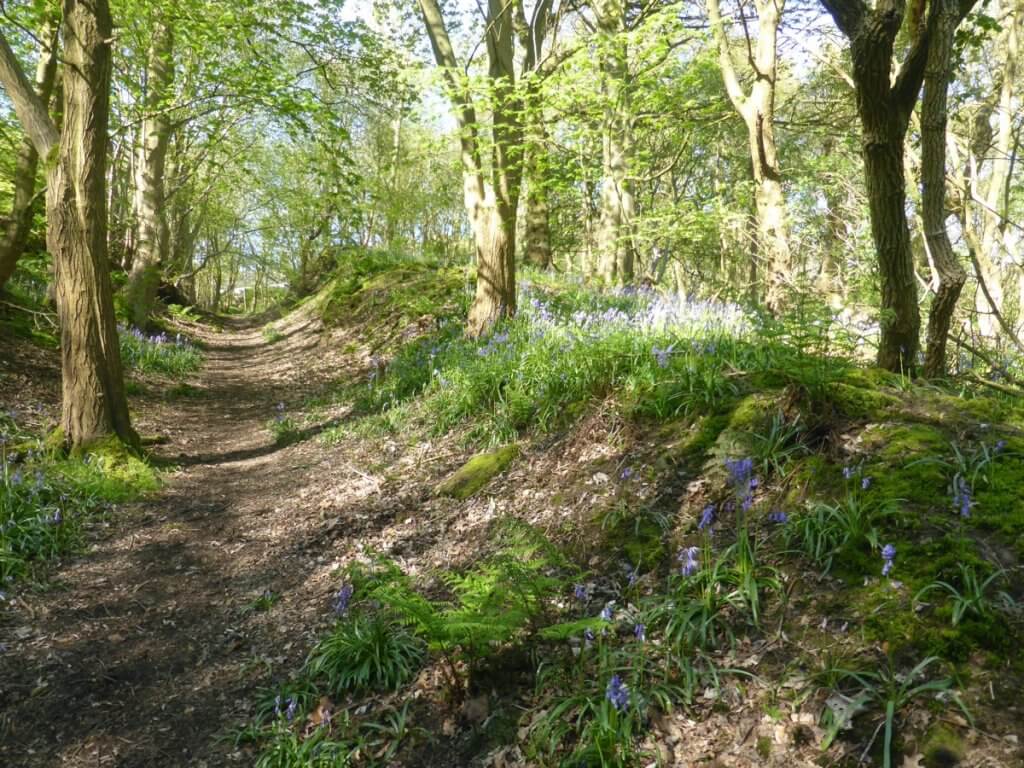
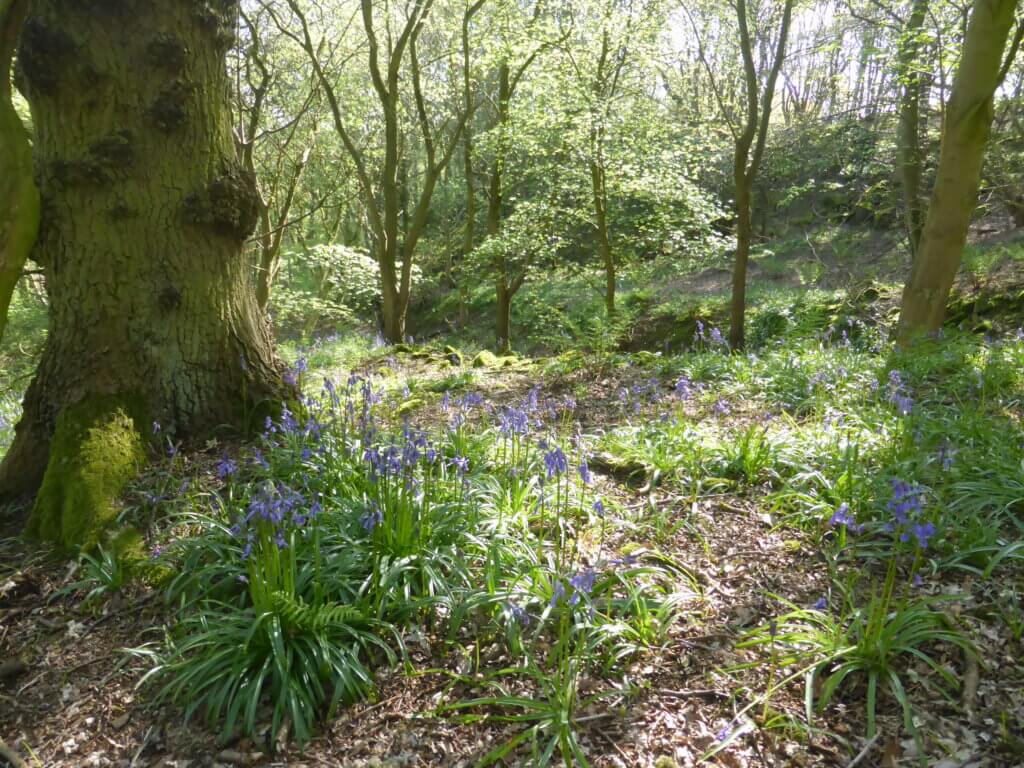
Flowers. Pool Bank has a good, if limited, show of spring wild flowers . Lesser celandine are followed by bluebells and wood sorrel (mainly on the bridleway banks ) indicate that the woodland is old.
(Britain has half of the world’s bluebell population making our woods internationally important.)
In the lower more lime rich areas wild garlic and dog’s mercury are present. Later flowers include red campion and foxglove . Multi stemmed ferns and mosses grow in the more shaded areas. Single stemmed bracken is present next to the lower, more open areas, as is Himalayan balsam.
Trees Only a few specimen trees of 150-200 years of age survive in and around the wood. In addition to native oak birch, rowan and wych elm trees (typical of acidic Pennine sandstone slopes, non-native sycamore and beech are present.”
In September 2009 the majority of the village of Pool-in-Wharfedale, including the site of the old Pool Bank quarry was officially designated a Conservation Area by Leeds City Council.