

Dyneley Arms Inn . The boundaries of Pool-in-Wharfedale changed c.2010, bringing in this public house, named after the Dyneley family who moved to Bramhope Hall in the 16th century. Shown on a map of 1847. Publican 1890 Ernest Movley.

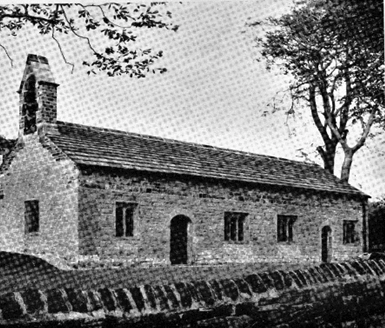
The name Dyneley Arms was given as reference to Robert Dyneley (1609 – 89) who lived at Bramhope Hall, Bramhope. The land had been purchased by his great-grandfather from the Earl of Cumberland and following the dissolution of Kirstall Abbey, which had held the manor for centuries. He built the Puritan Chapel, at Bramhope around 1649. The baptisms were recorded from 1677 to 1881. The grassy area to the right, marks the resting place of many of the Dyneley’s. This can be visited.
6th Aug. 1880. “ A Drunken Typo. William Joseph Slack was brought up in front of Otley Police for driving 25 geese whilst drunk, owned by the landlord of the Dyneley Arms. “It transpired that the defendant who is very comfortably circumstanced, has for sometime past been addicted to the habits of intemperance and that his friends have done all in their power to wean him from his ruinous course, but has had no effect. Believing therefore that imprisonment in default of payment of the fine would have a salutary effect, they declined to pay the penalty of 5/- (25p.) and expenses. The defendant was therefore sentenced to 14 days imprisonment.”

c.1910 . Drover, “Beakey” Holmes passes the Half Moon on his way to market.

Advert of 1910
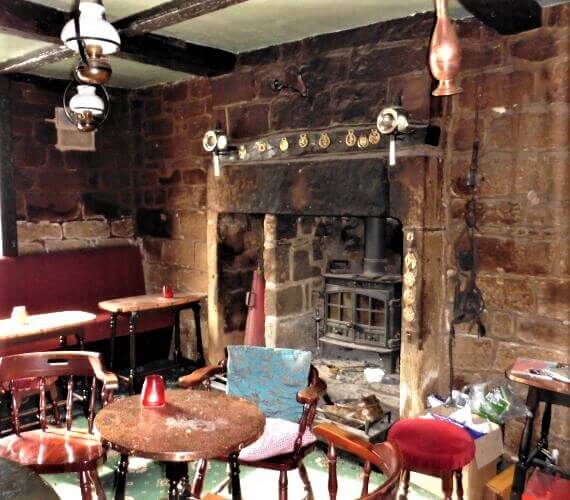
HALF MOON INN appears to be shown on a map of 1756. It has a mullion window at ground level at entrance to the cellar as has Pool Farm cottage which is dated 1725. “The stone fireplace c.1740 helps to date this old Inn.” (P.Thornborrow).
The Half Moon Inn is probably the oldest Inn in this Domesday village and is situated in its’ centre. It can be seen from the photo above, that over the last century little change has taken place along Main Street. The Inn lies opposite a track which led to the medieval Caley Hall, demolished some fifty years ago. In 1550 the Hall was a hunting lodge for the Gascoignes, later owned by the Fawkes of Farnley Hall whose ancestor was the infamous Guy Fawkes.
Over the centuries, the Inn has had a chequered history. After being hosts to meetings of the trustees of the Turnpike Road from Dudley Hill to Killinghall in years around 1817, the vicar of St. Wilfrid’s church in 1894 bought the Inn, adjoining cottages and the land around it, after apparently complaining the noise from visitors arriving at the Inn in horse drawn waggonettes, were interrupting his services. Removing the alcohol licence, he renamed it The Riverside Temperance Hotel. Since then it has been known as the Riverside Hotel, the Half Moon Temperance Hotel and the Half Moon Café. In 1948 it supplied food for many passing cyclists, providing hot luncheons, afternoon teas, wedding, birthday and bridge parties. A full ham salad tea could be bought for 2/3d. (12p) It
The Inn was initially a small farm of 6 acres, had by the mid 1800’s increased to 22 acres. Alcohol was sold from the one roomed farm. Although enlarged over the centuries the original character has been retained. The building is marked on a map of 1756 and so far, records of licensees have been traced back almost three hundred years. The old stone fireplace to the left of the entrance has been dated between 1725 and 1740. The Inn, which employed an ostler, lies on the medieval route connecting Skipton with Tadcaster. In 1816 a coach named the Royal Pilot stopped in Pool. This daily service ran between York and Liverpool taking eighteen hours to complete.
In 1817 and 1818 meetings of the trustees of the Turnpike Road from Dudley Hill to Killinghall were held “at the house of Mr. Samuel Stead, the Half Moon Inn”. At the meeting of 1818 it was proposed that a Side Bar Gate or Chain would be placed at the end of Leathley-Bridge across the road leading towards Otley. Although built in 1754, Pool bridge had been widened in 1815.
In 1822 the Inn was owned by John Milthorp, farmer, maltster and Pool paper mill owner. (Low Mill). It, together with two closes of land called the Low Pastures, containing six acres or thereabouts in the occupation of Samuel Stead, were sold by auction by John Milthorp, held on 4th July 1823 and which stated Joseph Stead & Co. was a butcher. A “pining house” (place where beasts were placed for a day or so before slaughter) was situated at the rear of the Half Moon, demolished c. 1990. Also included in the sale by John Milthorp in 1823 was the White Hart Inn. In 1864 the Half Moon had an ostler in Francis Yates. John Milthorp lived at Pool House in 1822 (see Pool House “Houses pre 1850”)
By 1869 the Half Moon Inn had increased its land as it is recorded that it was available to rent, “including 22 1/2 acres of excellent land, farming stock and produce at a fair valuation. Rent very reasonable.”
In 1847, during Pool Feast, a riot took place in both the Half Moon Inn and the White Hart, caused by railway navvies, (see “Living” “Events” of the Past)
The story told is that The Rev. A. E. Meredith, vicar of Pool from 1884-1898, objected to noise coming from the Half Moon. In 1894 he did in fact buy the Inn, some of the adjoining cottages and the land around it, renaming it the Half Moon Temperance Hotel, which became later known as The Riverside Hotel. (There was old sign “Temperance Hotel” still at top of cellar in 2004).
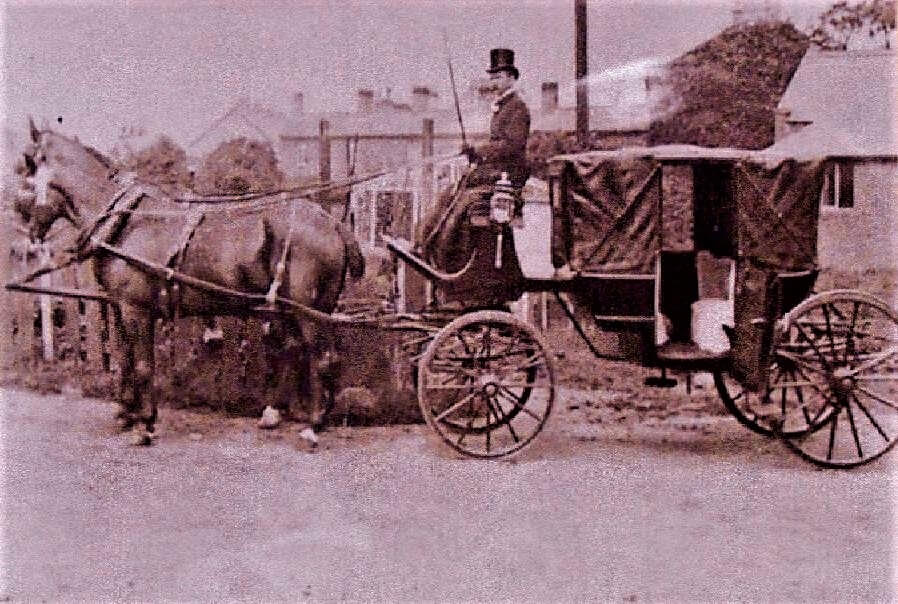
Mr. Reginald Fairburn, (see above) who, as a boy, had previously worked at Arthington Mill, later ran the Corn Mill on Mill Lane in Pool, was the keeper of the hotel in the early 1900’s. He and his wife, Fanny also had a tea room there and provided bed and breakfast. It was about this time that Holmes Whiteley described “a confectionery business was started and real good eats they were”. Although having an injured leg – he had a bad accident with a horse and cart at the stone quarry round about 1911 when the wheels ran over him and he broke 5 ribs, pierced a lung and broke a leg, and he was left with only one lung. (Ashley Howard relative) In spite of this Reginald Fairburn built a bowling green and pavilion, which backed on to Mill Lane, alongside the Church Room, taking two years to build. Advert above of March 1910 reads “R. Fairburn, Half Moon Temperance Hotel. Large or small parties catered for. Field for bowls, cricket etc. etc. Cabs, Landaus and Waggonettes for hire. Hearse and Mourning carriages. General carting agent. All orders promptly executed.”
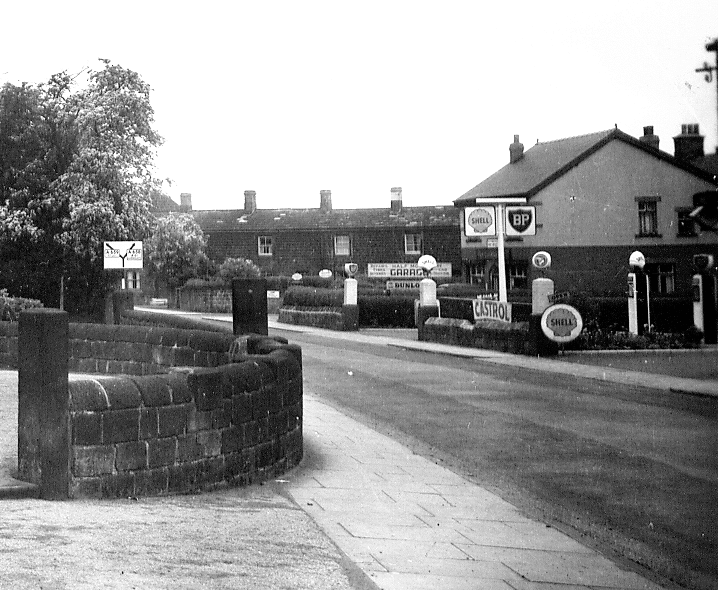
In 1923 the Inn and adjoining houses were bought by the Foster’s who owned the North View Stores. opposite the White Hart. Run by brothers Sam and Ronny Foster they built the Half Moon Petrol Station on the land. (now a car showroom 2017). Advert of 1929 states, “Foster’s, Cash Stores, Main Street, Pool, Grocers, Newsagents and Tobacconists” also “When visiting our village fill up here with petrol of 1st grade for your journey.” They now owed two stores and petrol stations known as “Top Fosters” and “Bottom Fosters”
The “Hotel” was known as the Half Moon Café in 1948, selling hot luncheon and afternoon teas, “Now open for Wedding, Birthday or Bridge Parties”. After WW2 the bottom half was used as a café by Mrs. Wood. A full ham salad tea could be bought for 2/3d. (12p) which was popular with cyclists who parked round the back.
When Dr. John Metcalfe first arrived in Pool in 1955 to hold his surgery, it was still a temperance hotel. The waiting room was under the stairs! With the surgery being in a tiny room upstairs. When Dr. Metcalfe arrived the rent for holding the surgery was 12/6d per week. (John Metcalfe). Pool practice had become part of the Bridge Street practice, Otley c.1912 with Dr. Hermon Wolfe as practitioner, retiring in 1953. It moved to the Church Room on Mill Lane, later to Methodist School Room on Main Street in 1980. The surgery closed and moved to Bridge St., Otley on 28.4.1994, leaving the village without a surgery.
In March 1964 the Riverside Hotel applied for, and was granted, a licence to sell alcohol so once again became a public house run by Jim Williams, reverting to its original name of The Half Moon Inn.
Some local lads nicknamed it the “MINI”, (the 1960’s era had miniskirts and Mini cars) as it was considered not to be a full pub. It had only one room with a bar in which to drink, which was down the step at the bottom. It is still known as “The Mini” by the locals. The rest of the downstairs was lived in by the landlord and with the doctors’ surgery waiting room under the stairs, (see John Metcalfe’s description in “Public Services”) a kitchen and a lounge. It was also nicknamed “Pocklington’s Palace” when run by Mrs. Pocklington. It was converted into the large pub of today in the mid 1970’s.
In the year 2020 the Inn and surrounds were sold, the interior of the inn was then stripped by the owner. The Inn being an important part of the village as shown in Pool-in-Wharfedale Conservation area, is to remain as originally built.

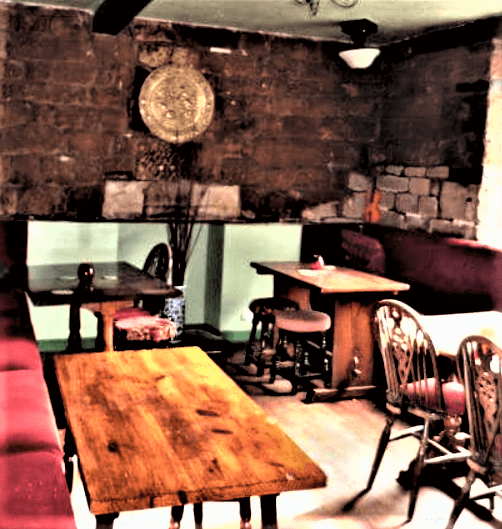
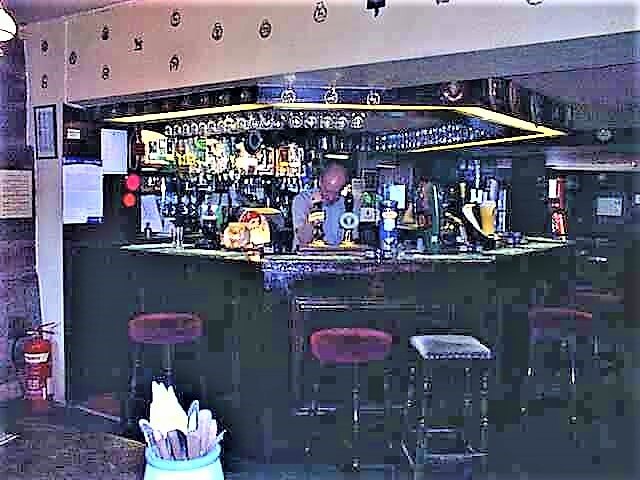
Jim Irvine shown behind the bar here, both he and his wife Vicky raised money to provide lighting for St. Wilfrid’s church opposite and donated money for one of the flower gardens in the War Memorial gardens.
Ghost stories abound in the village. Several previous publicans here have experienced strange “happenings”; pressure on the cellar beer pumps suddenly reduced; T.V. turning off; shower coming on and the burglar alarm suddenly ringing, drinking glasses swept to the floor.These seem to be apparent when alterations are taking place! A man was often seen sitting in the small room, never bought a drink and soon disappeared.
Newspaper cutting of “Riotous Days” The riot was in both the Half Moon and the White Hart during Pool Feast in August 1847. (see “Events “of the Past)
Innkeepers: In 1817 (Turnpike Road mention of meeting to be held) Samuel Stead was victualler; 1830 Francis Stead; 1849 John Baldwin; 1851 (census) Thomas Calvert (died 1851 age 51) & wife Elizabeth; 1861 William Simpson (1808-1863) 1864 Ostler Francis Yates; 1881 Thomas Snowden & wife Sarah (census) 1881 John Baldwin McKenzie and 1883 William Brown. William Brown married Charlotte Ann McKenzie at St. Wilfrid’s Church on 18th Sept. 1882, his address at this time was “Bank Pool”. The Brown’s had a son Alec, born in 1884 and daughter 1886, both born in the pub. and christened in Pool Church. After leaving the Half Moon Mr. Brown worked at Pool Paper Mill. (Information from granddaughter Majorie -2002.). It has also been occupied by William & Ellen Shaw 1891. (census) F. G. Barkby- confectioner (1860-1900), Fairburn (c.1909) G. & F.Swales . Mrs. Pocklingson (c.1960) : Jim & Vicki Irvine (c. 2002 – 2012 ): Wharfe Bank Brewery 2012; Frederick Bell 2012-2015, after which various attempts were being made to re-open. This wonderful old inn, full of history was sold in August 2020, with an asking price of £250,000.00d.
Leeds Mercury “21st June, 1817. Turnpike Road. From Dudley Hill to Killinghall and the Southwest corner of Harrogate enclosures. Notice is hereby given that the next meeting of the trustees of the said Turnpike Road will be held at the House of Mr. Samuel Stead, the Half Moon Inn, in Pool on Friday the eleventh day of July next ad Eleven oclock in the Fornoon. Samuel Hailstone, Clerk to the Trustees. Bradford 20th June 1817
Leeds Mercury 18th July 1818 Dudley Hill & Killinghall Turnpike Road. The next meeting of the trustees of the said turnpike road will be held at the house of Mr. Samual Stead, the Half Moon Inn in Pool on Monday the 10th August next at which meeting it will be proposed that a Side Bar Gate or Chain shall be placed at the end of Leathley-Bridge across the road leading towards Otley, also that a Side Bar Gate or Chain shall be placed across the road leading from Dudley Hill toward Harrogate at the Four Lane Ends, near Old Bramhope in order that the tolls and duties authorised by the said Act of Parliament relating to such aforesaid Turnpike Road, may be taken and collected at such Side Bars, Gates or Chains, respectively. By Order Samuel Hailstone, Clerk to the said Trustees, Bradford July 1st 1818.”
Leeds Mercury July 10, 1847 ANCIENT ORDER OF ROMANS. On Monday last, the 14th annual congress of the above Order was held at the house of Mr. Thomas Calvert, the Half Moon Inn, Poole, near Otley
Leeds Mercury 21st July 1864 Stealing Ferrets at Pool, Near Otley. On Tuesday, three men named respectively Walter Marston, currier, Francis Ward and John Smith, laborers, all of Otley were brought before Mr. Billam and Mr. Dawson at the Police office in that town for examination of the charge of stealing on the 17th July last, four ferrets the property of Francis Yates, ostler at the Half Moon Inn, Pool.The prosecutor had five ferrets in the chamber of an outhouse and in the afternoon of that day in question he took the prisoners to look at them. The prisoners inquired if the ferrets were on sale, upon which the prosecutor said he had already disposed of them. About seven o’clock the same evening the prosecutor fed the ferrets and locked the door. Three hours later he found the door open and three of the ferrets taken away. Having got the assistance of two other men, they proceeded towards Otley and at about a mile on the road they found the prisoners sat by the wayside and the ferrets in a sack near them. Ward and Smith who said they had nothing to do with the robbery, were apprehended at the time by Police Constable Chadwick; Marston ran away but was taken custody at Otley, the same night. The prisoners were committed for three months each with hard labour.
From The Leeds Intelligencer- Sept. 1862. Pool, Near Otley – Fatal Accident to a Butter Factor.
The lamentable and fatal event occurred near Pool at the close of last week. About ten o’clock on Thursday night Mr. Francis Kendall of Weeton near Harewood, butter factor and fruit dealer, was on his way home from Bradford market accompanied by his son, who is 14 years of age and having with him a light wagon drawn by one horse. Two men who had been waiting form him by the roadside for the purpose, called out asking to be allowed to ride in the wagon. Kendall not knowing the parties, and supposing they entertained some mischievous designs towards him, increased his pace and, the road on which he was travelling at length becoming very steep and dangerous, he leapt from the wagon to stop the horse, but in doing so he fell to the ground and one of the wheels passed over his body.
His son did not succeed in bringing the vehicle to a stand until he arrived at the village of Pool. Assistance being obtained, the poor sufferer was ultimately found on his hands and knees near the place where the catastrophe happened and he was immediately conveyed to the Half Moon Inn, Pool where notwithstanding every attention, he expired in great agony about noon on the following Friday.
The deceased, who was a local Wesleyan preacher, was a very steady and industrious man. He was 40 years of age and leaves a widow and six children to mourn his untimely end.
Leeds Mercury 12th Jan 1876
Distressing Suicide at Pool, near Otley. An inquest was held at the Half Moon Inn, Pool, yesterday before Mr. T. P. Brown, Deputy Coroner for the district, on the body of Mary Lavinia Herman, aged 26, the wife of Modest Herman, a fitter. From the evidence it appeared that the deceased had been very despondent for many months past and at five o’clock on Sunday evening the 2nd inst. fell ill, necessitating the doctor’s being sent for. Mr. Ritchie surgeon of Otley, sent his assistant who attended her on Sunday night. On the following day Mr. Ritchie himself visited her and she then complained of a burning sensation in the pit of the stomach and occasional sickness, adding that she had purchased a pot of “phosphate paste” (commonly used for killing rats) a portion of which she had taken on the previous Friday and the remainder on Saturday. The symptoms confirmed this statement and Mr. Ritchie believed “she was killed” by taking the deadly mixture. The poor woman died on Friday last. A verdict in accordance with the medical testimony was returned.
Extracts from the Wharfedale and Airedale Observer, incorporating the Otley & Ilkley Guardian.
28th Oct. 1881. Leathley Cricket Club. The annual supper in celebration of the close of the season took place at the Half Moon Inn on Saturday last. Members and friends partook of an excellent spread provided by Mr. & Mrs. McKenzie. The tables were afterwards cleared away and a well attended meeting was held. Great pride is due to Mr. John Watson who has shown some good cricket with both bat and ball. After the meeting members and friends sang several glees and songs and a hearty vote of thanks was accorded to Mr.& Mrs. McKenzie for their excellent catering.
Aug. 4th.1882 “The annual Feast (Pool) was celebrated during the early part of this week. Shooting galleries and the other country fair concomitants have been pretty busy. But the greatest feature this year was the presence of a number of ponies and donkeys which were put into requisition by the children. During Monday and Tuesday the animals were worked very hard.
On Monday a good number of people assembled in the Half Moon grounds to witness a number of sports which created considerable interest. The first race was a 200 yds. Handicap, the prize being a copper kettle, which was won by a very promising pedestrian named James Fox”. “The second race, 100 yds. Handicap – prize a silk handkerchief – after a re-run because of a three -way tie, was won by John Bland by a foot.”
2nd Feb. 1883. “The floods in Pool and district seem to have been fatal to many hundreds of rabbits and also to several otters. One of these latter animals sought refuge on Monday, in an orchard at the rear of the Half Moon Inn and was captured by Mr. Brown the landlord. It is living and weighs from 10 to 12 lbs.”
Arthington. “The land from Pool to Arthington Viaduct was one sheet of water and the Corn Mill was flooded.”
Below the Half Moon Inn as described by Architectural Historian Peter H. Thornborrow, in 2005, when providing his assessment of the village in preparation for the Conservation of the village adopted in 2009 by Leeds City Council
“The inn adds vitality to the street scene with a neat painted green-backed sign and in addition a hanging sign and two flag-poles proudly displaying the Cross of St George and the Yorkist Rose, its frontage floodlit at night. Opposite to it the war memorial is shortly to be floodlit; the church is already floodlit and adds much to the street scene here at the heart of the village at night. The terraced rows retain their ashlar stone shouldered stacks with flat corniced caps. Inside the inn is a fine exposed wide stone fireplace with curved corners to its flat lintel that is suggestive of an early-to-mid 18th century date for building of c.1740.”

FOX AND HOUNDS is on the map of 1847 – a beer house (only licensed to sell beer not wines or spirits) This stood at the corner of Chapel Row and St. Wilfrid’s Terrace, dated mid 1700’s by Peter Thornborrow Architectural Historian. On the corner of the building were steps for mounting your horse and at one time the inn employed an ostler, Ridealgh.
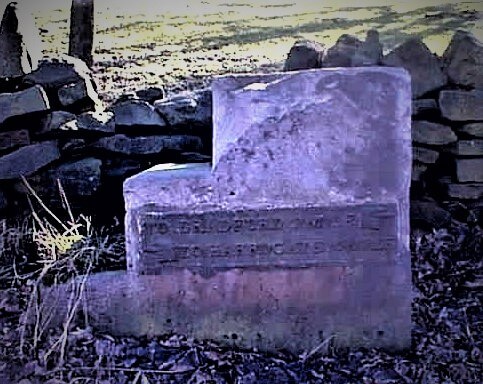
A similar mounting stone, complete with brass direction plate is to south of the Dyneley traffic lights which was part of the route from Bradford to Killinghall when a “Ride & Tie” system operated i.e. two men would set out, one riding, one walking for a mile, then change places. (Perhaps the man riding the horse would pop into the Fox Hounds for a beer, whilst waiting for his partner arriving on foot!) It maybe this mounting stone which is approx a mile from the Dyneley stone, was part of this system. A further mounting stone can be seen, about a mile further on the main road to Bradford when approaching the Leeds/Bradford airport.
There was a well still in the cellar, which the present owners have recently filled it. (2001). It is now a private house. There are two cellars, each vaulted. The cellars of the adjacent cottages on St. Wilfrid’s Terrace were also vaulted and ran into the Fox & Hounds. The first two were shown to be there in a sale of property- Atkinson, Dacre. 1973. I am told this suggests they were all built at the same time as the Fox and Hounds and were most likely the stables which were attached to this coaching house. I have also been told that the cellars went under the road to emerge at the Manor House. An arch, which was filled in recently, goes to the centre of the main road.
In 1894 the Rev. A.E.Meridith, then vicar of St. Wilfrid’s, leased the pub. from Michel Nicholson Milthorp Snowdon (Plainville/Park House/Monkmans, now demolished is The Hollies) acting as executors for Michael Nicholson, to be used as a Parish Room. It has never reverted to a public house.
Kendal Newby can remember after a day’s visit to Leeds by train, his father would call there for a drink before returning home to Leathley.
Innkeepers In 1841 & 1851 census *Mary Greaves was the beerseller with son George, ostler. In 1849 it was owned by the Greaves family and occupied by John Shires, Wm. Shires in 1861 who was also a butcher in 1861. Jabez Greaves and George Crawshaw (there on 1881 census, with wife Cecelia) were the last two publicans.
* In Sept.1888 Mary Greaves, along with her sister and brother came into an inheritance on the death of their father Charles Greaves.(deeds) The Greaves family were related to Rhodes of Creskeld Hall and Bramhope Hall. There gravestone in St. Swilfrid’s church shows they were buried alongside members of Caley Hall. Mary Greaves also built Farfield House on Arthington Lane c. 1849. A map shows George owned 1-3 & 6 Park Buildings
Extracts from Wharfedale Observer:-
13th June 1883. “Accident to Boy”. On Wednesday night of last week an accident befel John Robert Ridealgh, a youth in the casual employ of Mr. George Crawshaw of the Fox and Hounds in Pool, when taking a horse to grass in a field near High Mill. It appears the lad was in the act of reaching up to take the blinders off the animal (which is remarkably docile) when it accidentally placed its foot upon his ankle and broke his leg near the calf. He was immediately taken to his home in the village and the limb was attended to by Mr. G.H.L.Rickard. He was afterwards removed to the Leeds Infirmary and we are glad to learn he is improving rapidly.” (Details of Rickard in “Families”)
14th Sept. 1883 Otley Police Court. “Furious Driving at Pool “John Nundell of the Wharfedale Hotel Arthington was charged with furiously driving on the highway at Arthington on the 24th ult. And also being drunk whilst he was engaged. James Myers, farmer and Matthew Oldstones proved the first charge and several witnesses were called to prove that the defendant was drunk. This charge however fell through. For the furious driving charge the defendant was fined 20 shillings and costs. (This would be either on a horse or driving a horse and trap.)


WHITE HART was originally a 10 acre farm with large outbuildings and stabling for about 12 horses with a granary above. In 1871 employed an ostler. (photo of 1900 above, the man in the background is thought to be Stephen Kaye, founder of Kaye’s wood yard which stood opposite, before the building of Hall Farm and before moving to Arthington Lane in 1902) on land now the Beeches, a small housing estate c. 2001
The auction of Pool House and other properties in the village, including the Half Moon and the White Hart Inn, owned by John Milthorp, was held on 4th July 1823. Included in the sale was a quantity of malt, malt kiln, brewing vessels, 2 wagons and 3 carts. This suggests he brewed and supplied ale for both his inns. Pool Farm Cottage, behind Stocks Hill, was the malting house as the occupier in 1730, John Fourniss, is described as a maltster .(brewer). The White Hart Inn included 2 closes of land, Ellershaw Close and The Croft, garden and buildings measuring approx. 10 acres, whilst in the occupation of Richard Bickerdike. The house and properties were sold to Mrs Ann Nowell Stott of Mancheser who died in 1839
John Milthorp (1768-1847) and father, William also uncle John (1725-1778) owned several farms in Pool, Arthington and Leathley, i.e. the White Hart and Half Moon, Pool. The Low mill paper mill had originally been a farm owned by the Milthorps and Maudes. The Land Tax Returns of 1781 show Edmund Maud and William Milthorp Snr. owned the Low Mill, paper mill. Records in Otley church registers show Low Mill was washed away by a flood in 1673. It was a fulling mill. Another Milthorp farm was roughly in the area behind Weideman Whiteley paper mill. Award map for OPB 1774
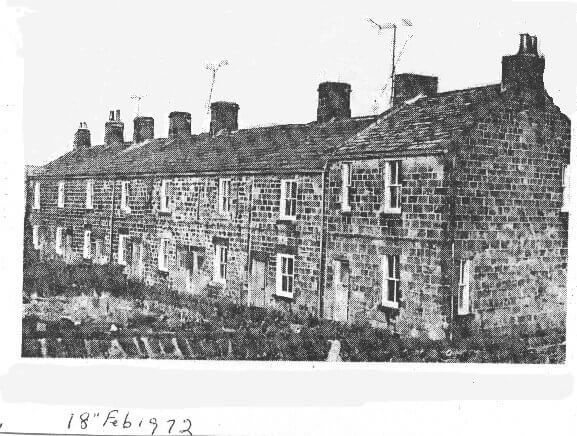
To the west of the White Hart there was an old mistal which was owned by Michael Nicholson, this was added around 1818 to the row of cottages known as “Fatticake Row” or Old Post Office Row, demolished 1972. The house to the right was added later c.1906, by Kaye’s. The row lined Main Street, west of the pub where Wharfedale Court is now built. It was nicknamed “Fatticake Row” after William Ridealgh got the reputation of making special “oven cakes” from his home, which were considered rather fatty.
1861 March 1st. The first meeting of the Wharfedale Board of Guardians was held in the White Hart. Matthew Whitaker Thompson was elected first Chairman appointed by the Poor Law Board for Law Union, with J.D. Holdforth of Caley Hall and F. H. Fawkes of Farnley Hall amongst the guardians. Mr. John Milthorp was elected vice-chairman. The Yorkshire Banking Company were appointed to act as treasurers to the Union.
In 1874 the first meeting of the Wharfedale Union, following the original Poor Law Act of 1601, was held here with Matthew Whitaker Thompson appointed Chairman of the Board of Guardians. (Little Town of Otley) The headquarters was in Otley formed in 1861. The workhouse was at Newall part of the former Otley Hospital.
The death is recorded on 8th April 1839 “On Tuesday, at Poole near Otley. Mrs. Nowell Stott relict of the late Nowell Stott Esq. of Manchester.” It remained in the family until 1922 when it was bought by Tower Brewery, Tadcaster.
“White Hart Inn Farm” was owned by Miss Susannah Stott who died on 11th April 1873 and inherited by her cousin Miss Susannah Greene Stott who lived at Pool House and died in 1883. In 1922 the “White Hart Inn Farm” was being rented from Pool House, (often referred to as the “Mansion House”, under the ownership of the Stanhopes, (again obtained through inheritance) “with buildings, garden and orchard containing in all about half an acre” to the publican of the time, Daniel Byford as tenant, at and annual rent of £80.” (shown in deeds and map.) The map of the “White Hart Inn Farm” dated 1922 in the Stott deeds, above, has a pencil date of 1857.
The Tythe map of 1849 confirms that Miss Stott was the owner of Pool House, with William Ockerby farming the land. Miss Stott appears to have let Pool House to several people, including William Austin who died there in 1871 (gravestone).
The 1841 census shows Eliza Beanland as innkeeper. The 1849 tythe map shows Joseph Hearfield as occupier of what is now the White Hart whilst the 1851 census shows William Ockerby as inn keeper at White Hart Inn.
During the laying of the foundation stone for Arthington Viaduct (then known as Wharfdale Viaduct) in 1846, a large flag waving procession, headed by a band left the White Hart (Mrs. Beanland vitualler) to be met at Arthington by another procession from Bramhope. After the laying of the three and half ton foundation stone on the Castley side of the viaduct, the procession returned to the White Hart where the navvies were given food and twelve large barrels of “Fine English ale”, by the contractor James Bray. (see Arthington Viaduct).

The White Hart “August 1904“
The interesting photo below c.1900, shows one of the large stable/granary at the east side, alongside the Bar House on Arthington Lane. Around 1915 Mic McGinty, an Irish tramp, would often sleep there en-route to Wetherby. His “home” was the workhouse in Otley, he would be given a cup of tea and a sandwich by the Daveys’ who lived in Park Buildings or from the Midgleys’ who lived next to the “middle shop”, now the pharmacy.

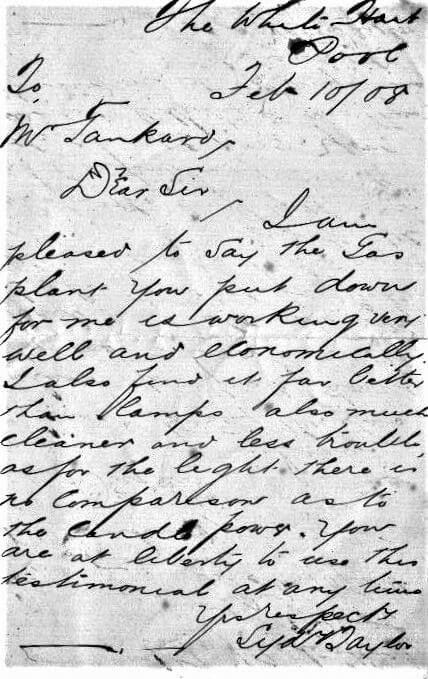
In 1908 G.A. Tankard of Pool installed a Sunlight Acetylene Generator. A letter of thanks from Syd. Taylor of the White Hart to Mr Tankard reads, “I am pleased to say the Gas plant you put down for me is working very well and economically. I also find it far better than lamps also much cleaner and less trouble. As for the light, there is no comparison as to the candle power.”

Interesting photo of White Hart near Stocks Hill, showing a stone column, at junction of New Pool Bank and Arthington Lane, this was demolished c.1900 to make way for vehicles to pass by. (A similar stone column is near the bus stop outside Pool House. Is this the same one?) The extreme east end of the pub was added in 1998. Part of the inn was rebuilt after a kitchen fire at Christmas 2016.
There are two photos showing charabancs outside the White Hart leaving on “Men Only ” trips in 1921 and 1924. These trips continue today (2011) but recently from the Half Moon Inn. On this trip to Filey, below, it was necessary for the occupants, when reaching Filey, to alight as it was not thought the brakes were good enough to stop the charabanc when going down the hill into the town.

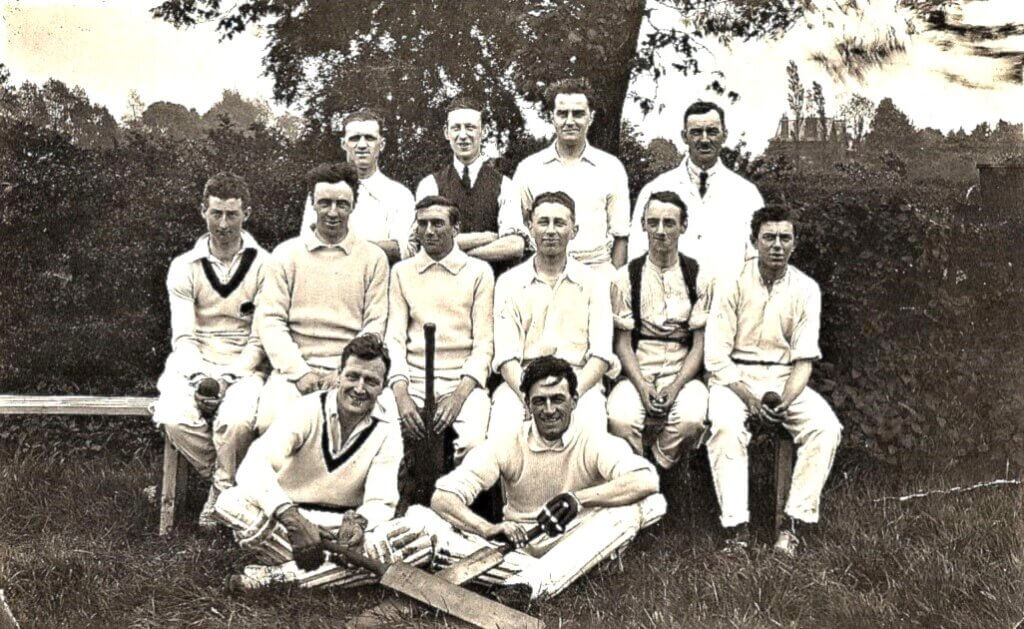
Cricket team 1925 behind the White Hart.
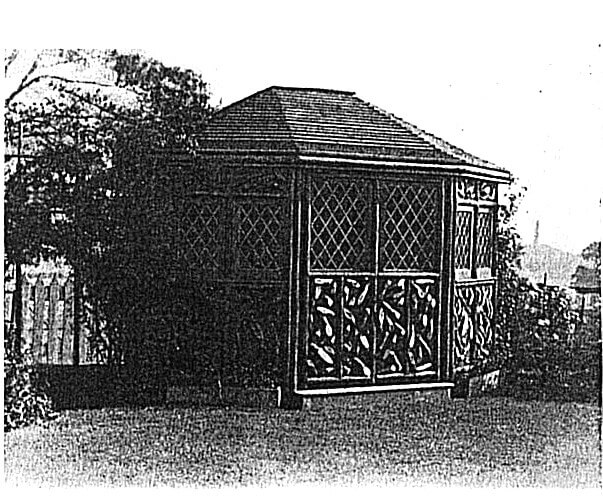
Until 1939 the cricket field was at the back of the pub., now Millcroft estate, which served the teams’ teas from an ornate summer house, made from wood set at various angles and with stained glass windows, possibly made by Kayes woodyard on Arthington Lane. There was a lovely garden at the back, whilst the front had two small garden areas either side of the entrance, surrounded by wooden railings where nasturtiums grew, “they looked lovely although they didn’t smell very nice but better than that awful beer.” (Molly Tindall) and “but they were eaten bare by caterpillars” (Roland Tankard). The small front garden area can still be recognized by the flag stones in the pavement.
For many years during the mid 1900’s Pool Angling Club used an upstairs room as their club room, the walls of which were covered in glass cases displaying stuffed fish and birds. The Pool branch of the Royal British Legion held their monthly meeting here.
In 1937 for the Coronation celebrations the village organised a procession which went passed the mill and turned at the White Hart to return to a field west of the mill.
“Around 1924/5 Tower Ales, a Tadcaster Brewery, sold light and dark beer “very good”. Around 1930 John Abrahams ran a taxi service and he garaged his taxi in the outhouses.” During WW2 in case of invasion, plans for sewage, burials and a mortuary were made for the White Hart, St. Wilfrid’s Church and Methodist School Room. A Nissen hut was erected to the west side in the car park. This was used by the Home Guard. At the end of the war, after an exhibition of photos. taken after the liberation of the Belsen Concentration Camp, grown men were seen leaning on the wall in tears. The hut was then advertised for sale and in November 1945 Old Pool Bank village considered buying it and transporting it to be used as their village hall, this did not materialize.
Inn keepers: Richard Bikerdyke 1821(Bains Directory) Richard Bickerdyke 1759 died 1829, age 70, wife Mary died 1818 aged 64: Eliza Beanland (“Innkeeper” 1841 census); Miss Susannah Stott (owner living at Pool House): William Ockerby 1847 & 1851 (census) ; Joseph Hearfield 1849, Andrew Proctor 1861: B. Mallinson 1865; John E. Buckley from 1865 (on 1871 census employing an ostler): Thomas Lodge 1874-1894,(where he died, married Clara Denton, Eva & Harry Denton’s, great great grandmother:) James Botterill Hardaker, from 1896 and his daughter Mrs Taylor: Syd Taylor 1908; Daniel Byford 1916.; Harold Byford c. 1926: A. Slesser from 1928. In 1922 the property was bought from John Milthorp’s executors, by either John Smith’s Tadcaster Brewery Co or Tower Brewery.: Mr Albert Cannon, carried on by his daughter Audrey Canon. Albert Cannon was at the Wharfedale Hotel before coming to the White Hart; 1960’s Dick & Ann Wilson; 1970’s Wilf & Dee Scott. Presented The Wilf Scott trophy, a silver trophy to Muker Show.
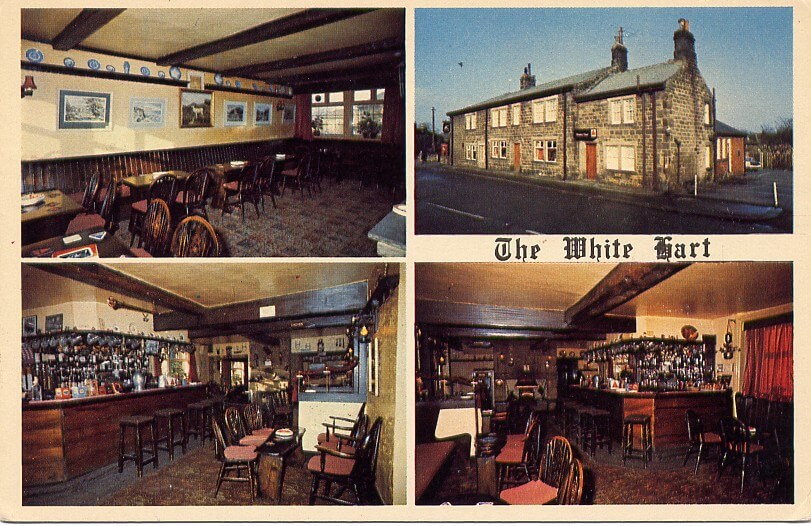
1891 census shows Richard Myers was the domestic servant and ostler when Thomas Lodge was innkeeper with Harry Denton son-in-law, shuttlemaker living there with his wife Clara & their daughter Ada Mary barmaid, and Sarah Ann as cook, also grandson Harold.
Leeds Mercury 14th June 1823 (This was included in the sale by John Milthorp of Pool House)
THE WHITE HART PUBLIC HOUSE, situate in Pool aforesaid in the Occupation of Richard Bickerdike, with outbuildings and Appurtenances thereunto belonging, together with two closes of land therewith occupied and containing in like measure the several quantities hereinafter mentioned or thereabouts that is to say
The Croft including garden and buildings 4 3 1 acres
Ellershaw Close 5 2 37 acres
Total 10 1 38 acres
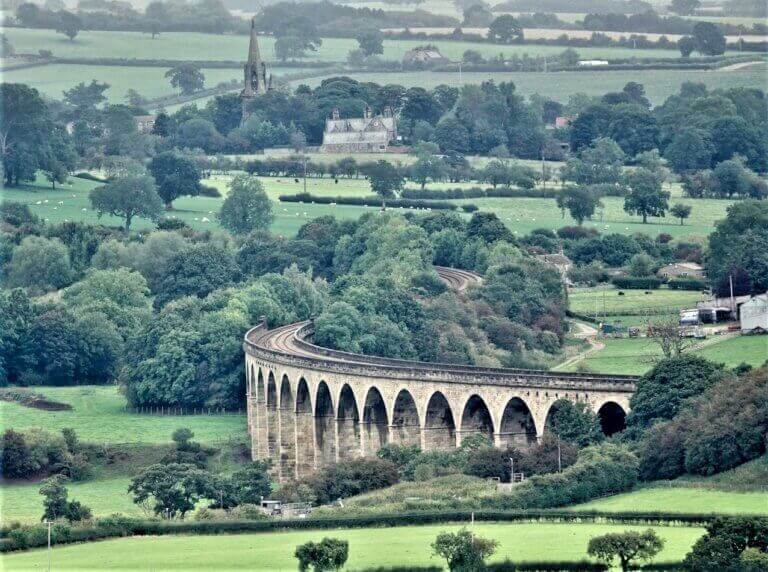
Arthington railway viaduct today.
1847 Pool Navvy Riot – Halifax Guardian in 1847.
“Pool Feast was this year signalised by a disturbance of rather alarming character.
The neighbourhood, it appears, is inundated with navvies employed on the Leeds and Thirsk railway, now in course of construction, and a young man named William Mounsey of Otley went with his dulcimer to the Half Moon Inn where a number of these semi-barbarians were assembled for the purpose of having a dance.
Mounsey played for while, but not receiving adequate remuneration for his services, left the house and went to the White Hart Inn. There, meeting with a fiddler, they played to a select party of villagers, among whom were Messrs Thomas Bray and Milthorp.
At a late hour, the house was attacked by a number of navvies who had come to demand back their musician and a scuffle ensued, several of the dancing party being severely treated. Mr. Bray escaped under a bed but, being discovered, was dragged forth in a brutal manner.
The constable, with the assistance of several of the dancers, attempted to clear the house. This was effected, but not before several of them had suffered rough treatment, Mr. Milthorp narrowly escaping strangulation.
Whilst this was going on, Mr. Ackerby, the landlord, rather injudiciously fired some small shot out of the window, hitting but not injuring some of the riotous gang. First throwing a stone through a panel of the door, the rioters broke it open with a crowbar and, after breaking doors and windows in all directions, ransacked the house in search of the landlord, whom they threatened to murder. Mr. Ackerby retreated into the spirit vault, where he was locked in by his servant. The rioters, baffled in their search, went into the dairy and cellar, where they amused themselves by dashing bowls of milk, bread, meat, etc. upon the floor, and trampling them.
Mr. Akerby’s servant, fearing for this master’s confinement and rushing from the house, he buried himself in a stack of hay, not far distant.
The landlady had a narrow escape. One of the villains attempted to plunge a knife into her breast, but the deadly weapon slipped on one side, passing through the sleeve of her dress.
The report adds, “we are glad to find that four of the villains were secured. They were brought up at Otley the following day, heavily ironed and being taken before F. Bilham, Esq. On the charge of riot and assault, were by him committed to take their trial at the next Wakefield sessions. Seven of the gang made their escape and have not yet been apprehended.”
“July 1857 workmen employed at an Airedale foundry held their anniversary at the White Hart Inn, where sixty two sat down to an excellent dinner. “The remainder of the day was spent in exhilarating field amusements, enlivened by the Poole brass band.”
Leeds Mercury 5th October 1858. ANCIENT ORDER OF ROMANS FRIENDLY SOCIETY. The officers and members of No.31 Senate of the above order, celebrated their eighteenth anniversary yesterday (Monday) at the White Hart Inn, Poole, near Otley. The members walked in procession, accompanied by the Poole Brass Band to the church, where an excellent discourse was preached by the Rev. W. J. Ridsdale, M.A. At the close of the sermon the members dined together in the Lodge Room. From the report of the secretary it appears that the Senate is in a very prosperous condition and is doing a great amount of good in the neighborhood.

Advert: “29th April 1865. Leeds Mercury. White Hart Inn, Pool, Wharfedale three minutes’ walk from the Station. Bottled and Draught Ales and Stout. Refreshments on the shortest notice. Choice Wines, Trout fishing in the River Wharfe adjoining. Well aired Beds. B. Mallinson, Proprietor.”
York Herald 2nd Oct. 1847 Conviction – A man who gave the name of John Thompson, was charged before F. H. Fawkes, Esq., at Farnley Hall, on Monday last with stealing potatoes, the property of Mr. W. Ockerby, of the White Hart Inn, Pool near Otley – For some time past Mr. Ockerby’s field has been entered and potatoes taken away; however on Saturday night last he watched and caught the prisoner, who was ordered to pay 20s. or stand committed to Wakefield for a month.
Leeds Mercury 19th April 1851`County Court – On Monday last, a Court for the Otley district was held in the Court-house, Otley before John Hamerton, Esq., deputy judge. The cause list was one of the smallest ever known at Otley. A jury cause, Pullein v. Ockerby, excited some interest. The plaintiff is a farmer at Pool, near Otley and the defendant is an innkeeper at the same place. A few weeks ago the cattle of the plaintiff strayed upon the land of the defendant when the latter, it was stated, used dogs to get them out. The stock appeared to have been so roughly used, that two of the beasts, as was alleged by the plaintiff soon after picked their calves and a third was injured. The plaintiff claimed for the damage sustained by him as the move mentioned £13.10s. Mr. Barrett appeared for the plaintiff and Mr. Bond of Leeds, was for the defendant. The jury returned a verdict for the plaintiff, damaged £6. (Pulleins were Lords of the Manor with Ockerby being the landlord of the White Hart Inn Farm)
Three extracts from “Timble Man” by Ronald Harker. –Hendon Publishing. (“Timble Man” was John Dickinson born in 1844 at Timble who for years walked to Pool to register births and deaths, calling in at the White Hart.)
1878 Wed. July 3rd. “Down to Pool. A fair day. Got four three penny whiskys and several bitter ales. Registered four births and one death. One of the births occurred at Caley Lodge on the road and the mother was removed to the workhouse where she arrived when I was there. “
1878 “Off to Pool by 7. Called on Homeses at Swinsty “ A wet walk to Pool. Sat two hours at the White Hart. Got three whiskeys hot”.
1898 Sept.15th Weighed seven hams and took them in trap for the landlord of the White Hart at Pool, price 9½d. per lb
Leeds Mercury 19th Sept. 1877 On SALE, a stack of well-won HAY about 148 yards. Price either by stack, measurement or weight at a very reasonable rate. Address Mr. Lodge, Poole, near Otley (White Hart Inn)
Extracts from the Wharfedale Observer:
1882 Oct. 6th Anniversary of the Wharfedale Sick Benefit Society held its 5th annual meeting at the White Hart Inn. Members met in the Lodge Room and then walked in procession to a service held in the church by Rev. R.P.D. Bainbridge. On returning and after the election of offices and other minor business, they returned to the Lodge room for a substantial meal provided by Mr. and Mrs. Lodge and the singing of glees, duets and songs, etc. “The catering was all that could be desired”.
13th June 1883. Pool “Miraculous Escape”. “Whilst a party of excursionists 15 or 16 in number from Leeds were proceeding round the sharp curve on the Pool Road, nearly opposite the White Hart Hotel, Pool on Sunday last, a waggonette in which they were riding was capsized by the sudden turn and the occupants precipitated into the middle of the road. Beyond the fright and a few bruises the party escaped unhurt but had to return home by train.”