1086 DOMESDAY BOOK “Pouele” is mentioned in the Domesday book being taxed on 6 Carucates of land making its farmland the same size as Otley and Guiseley.
1279 CORN MILL was built The mills (plural) of Pool are mentioned in an inquisition taken at York in June 1279 (see Corn Mill)
1267 EXECUTION “In 1267 there was an indictment presented by the inhabitants of Pool, Otley. Bramhope and Arthington to the effects that one Ralph Brun had committed many robberies and fled. He was apprehended and executed by the said townships at the Otley gallows and his land, said to be worth 24s.4d. and chattels, worth 14s. were forfeited.” (H.Speight)
1539 MUSTER ROLLS for the township of Otley (Otley Museum)

1584 POOLE FEUD c. 1564. Anne Goldsborough was a small child when her father William died. Her uncle Richard Goldsborough had quietly claimed nearly the whole of the family property after the death of his brother William. When Anne married Edmond Kighley of Newhall, Otley, (Thomas Kighley of Newhall, had married a daughter of John Vavasour of Weston, living in 1505), a litigatation followed when she claimed her rights to the manors of “Goldsburgh, Kryskelde and Powle, etc.” The dispute was bitter and protracted between her and her uncle.
In 1584 Creskeld Park was broken into, some closes at Pool stripped of growing woods, etc. (to the value of £30) and other violences perpetrated for which Richard Goldsborough claimed 100 marks damages from Edmund Kighley, who is described in the bill as “of Kriskeld gentleman”, and several others.
Eventually in 1586 Kighley and his wife obtained judgment in their favour so far as the Goldsborough property was concerned and they let the hall and estate to one Raynold Jake, but very soon afterwards Richard Goldsborough, aided by diverse others, entered the premises and ejected Jake and his family. Not only did they do this but they also “did utterlie deface and pull downe to the ground the foresaid capital messuage called Gouldisborough Hall, and all the barnes, stables, dovecotes, brewhouses and kilns, and one new building called Aldborough Parlour, and all the edyfices and buyldinges thereunto belonging,” etc. leaving not a stone standing. The company next were proceeding to pull down the park palings when an affray ensued, in which Kighley’s park–keeper, one Thomas Waid was struck with a dagger, receiving a wound which resulted in his death.
Edmond appears to have left Newhall to live in Pool where he died in 1602. (Most information from Harry Speights “Lower Wharfedale”1902 and Huntingdon Archives )
1660 Otley grave records “Here resteth the body of Elizabeth Battye, wife of James Battye of Pooile, who departed this life the 3rd day of April 1660” – Thomas Shaw “Wharfedale.” 1830
1673 THE GREAT FLOOD of 1673. The Mills of Pool were washed away by the Great Flood. The event recorded in Otley church register book states on “Memorandum, Sept.11th 1673. This summer is remarkable for the abundant and continual rain therein. On the 11th of this month there was a wonderful inundation of water in the Northern parts. The river Wharfe was never known to be so big within memory of man by a full yard in height, running in a direct line to *Hall Hill Well. It overturned Kettlewell Bridge, Burnsey Bridge, Barden Bridge, Bolton Bridge, Ilkley Bridge and Otley Bridge and the greater part of the Water-mills. It also clearly swept away Pool Low Fulling Mills, and carried them whole, like to a ship to the sea. It left neither corn nor cattle on the coast thereof.” (“Guide to Otley and District” by Charles Walker c.1920)
“There are several other records concerning this great flood. The mills at Pool, at that time, were principally constructed of wood, which caused them to float” Shaw “Wharfedale “- 1830
(*Hall-Hill-Well, a spring immediately below the Roman Catholic Church, Otley, running west of Bridge Street)
1673 BOUNDARIES OF THE MANOR OF POOL DEFINED for Everyld Thornhill, Lady of the Manor of Kirskell & Poole in the County of York are drawn up.
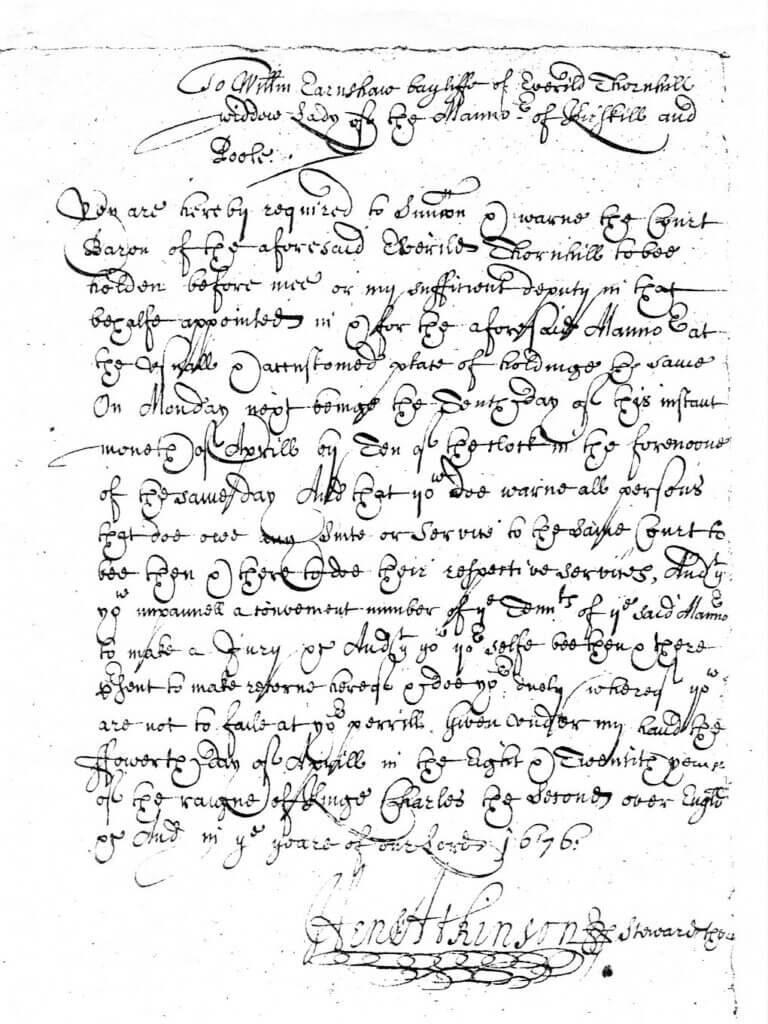
William Earnshaw. Bayliffe of Everild Thrornhill of the Manor of Kirskell &Poole1676
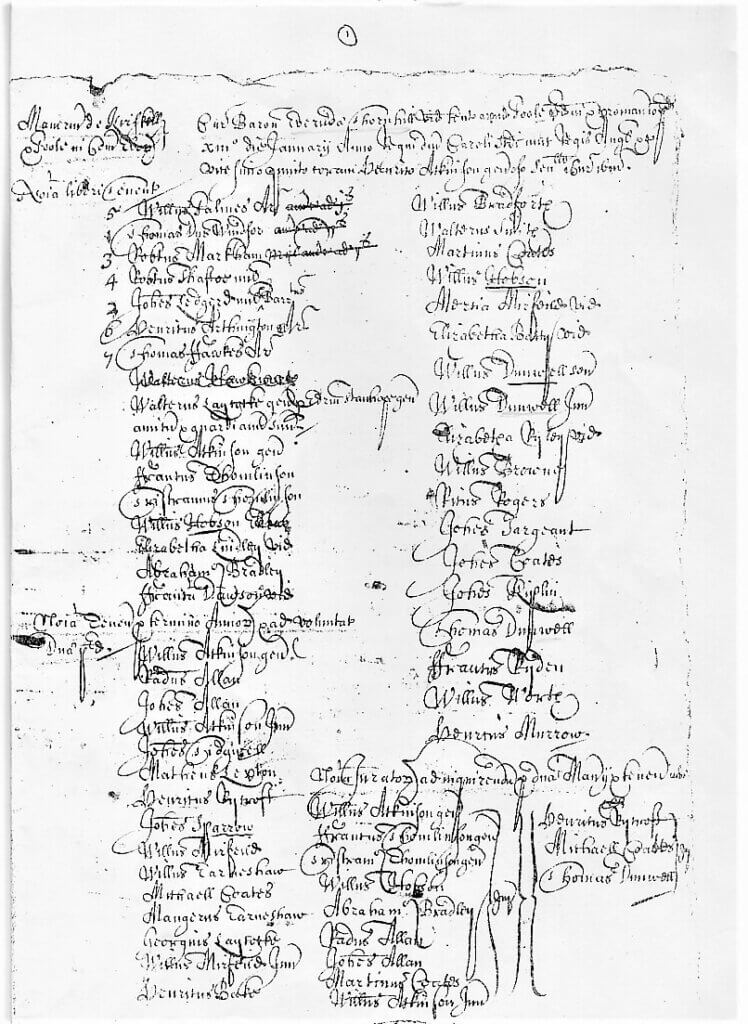
Attendees of the Court January 1673
Jurors for the lady of the manor aforesaid <held at Poole aforesaid in the aforesaid county of York on 13th day of January 1673> (at the court of the aforesaid manor then and there held) & then and there adjourned until the 26th day of the same month (of January), present on their oath aforesaid in manner and form following, that is to say:
First: <they say> they present on (their) oath <of them> aforesaid that Thomas Lord Windsor (1s.), Robert Markham knight and baronet (1s.), John Ledgard knight and baronet (1s.), Robert Shaftoe knight <and baronet> (1s.), William Palmes esquire (1s.), Henry Arthington esquire (1s.), Thomas Fawkes esquire (1s.), Walter Laycocke gentleman (1s.), Edward Stanhope gentleman (1s.), Elizabeth Lindley widow (4d.), Frances Dawson widow (6d.), John Tidgwell (4d.), Matthew Lepton (4d.), Mauger Earneshaw (4d.), William Mirfeild junior (4d.), Walter Smith (4d.), William Dunwell junior (4d.), Elizabeth Ryley widow (4d.), John Kiplin (4d.), Francis Ryden (4d.), William Worth (4d.) and Henry Murrow (4d.) are free tenants of this manor and owe suit to the court (aforesaid ……), and <made> at this day made default of doing their suit, therefore each of them are in <?default> mercy as appears above their heads. According to the judgement <?aforesaid> (of them as appears by) <…> and … <…..> …… …… <……> exhibited.
The boundaries are described below;-
Item: the jurors aforesaid on their oath <aforesaid> (aforesaid) say and present that the boundaries (and limits) (<…..>) ?of the aforesaid manor <beginning ……. from the north corner from the north corner next to the west …….> (that is to say the limits thereof begin in the north corner next to the west of the same manor, in English ‘the north west corner of the manor’ from a certain place there called le Lock Yate near the river of Wharfe (in) a straight <course> (line) to a certain <…….> (……) of ?common land called le <C> ?Caleyht close (as far as) to the <water> west corner of one place called Caley Spring and thence ?along/upwards (as far as) to the boundary stone near Caley Cragg and <from there> (thence as far as) to <the western spring> (the head of a certain spring ) called the Westerne <mad> Mayden Well and thus ?along/upwards (as far as) to a certain stone called the Preist Stone and thence (as far as) to a certain <well> (pit) called the Wolfe Pitt. And thus (thence as far as) to a certain stone called the Bishopps Head and (thus by and through) <……> a certain way called Yorke Gate <going across>, (and thence as far as to) <… in> a certain place called Careleton Slacke where the separate wastes of the manors of Otley, Poole and Carleton <run together> come together. And thus downwards <…> (<in the aforesaid place called>) the aforesaid place called Carleton Slack to a stone pillar placed next to the south part <of one> of a certain double ditch where the aforesaid wastes of Poole and Carleton run together with the wastes of Bramhope. And thus by and through the aforesaid ditch <…> (the boundary (thence) goes) near <a stone> a certain stone called Goldbrough stone standing on <…> the north side of the aforesaid ditch on the <…> summit of a certain hill called Blackehill which <?belongs …> (is parcel of the waste and common) of Poole. And thence downwards crossing a certain road called Bradforde gate <to a place> (downwards to a certain place) there called Arrowsike alias Arrowshowe and <……> (thus) continuing keeping the aforesaid ditch directly behind the aforesaid hill on the east (part thereof) as far as the (western) wood of Bramhope near to a certain place called Duckitt lane end and <..> from there turning ?up/towards the north by the aforesaid ditch as far as a certain close of land called Scatchards croft and <in> (then) East near a certain house called Atkinson house in Kirskill where the aforesaid double ditch <at…… adheres> (adjoins) upon Micklebecke and from there as far as the east part of a certain road called Poole Lane and then downwards to a certain place called Lancarre and (thus downwards) to the stream running in a certain place called Calfemyers and <at> (from there following) the stream (aforesaid) as far as the west part of a certain close of land called Castley Inge Holme where the aforesaid separate lands of Kirskill and Poole run together. And thus by the stream aforesaid (as far) as the middle (in English ‘the Midle Stream’) of the aforesaid river of Wharfe thus <at> through the middle of (that) river as far as a certain close of land called Dead Waters, parcel of one close of land called Poole holme and from there on the west between two closes of land called le Inge and Neitherfeild of Leathley on the north part and the aforesaid close of land called Poole holme on the south part and thus by the (aforesaid) river of Wharfe next to the aforesaid place called <place> Locke Yate where the aforesaid limits (as is aforementioned) began. (Translated from Latin)
Once the boundaries were established the Lady of the Manor Everyld Thornhill, issued fines to various people for not obeying the rules of the Manor. Below is a sample:
Item the aforesaid jurors on their oath present Ralph Allan, another tenant of the aforesaid manor because he ground all his grain and malt which he spends and consumes in his house at a mill outside the £0 10s. 0d. aforesaid manor and not at the mill of the lady of the manor aforesaid against the custom of the same manor. Therefore he [is] in mercy:
Item they present on their oath aforesaid (that) William Mirfeild of Poole dug out stones upon the common (waste) of Poole aforesaid without the license of the lady [the lady] of the aforesaid manor £0 15s. 0d. and the free tenants of the same or any of them and that he carried off and led away the same stones (<out of the manor aforesaid as far as>) to Leathley and there <constructed> (built) a house outside the manor of Kirskill and Poole. Therefore [he is] in mercy:
(Manor of Pool 1673 “Manor Court Boundaries”)
1717-1798 Pulleyn- Vavasour Feud as described by Thomas Maude
“In another of his notes Mr. Maude relates the following, as a beacon to any who may be under the same circumstances. He alludes to two of his neighbours of fortune, the Vavasours and the Pulleyns, respective owners of the opposite banks of the Wharfe.
“Stirred up by the insidious whispers of party, (for she is ever prone to talk) they were perpetually directing works to throw the water in right angles upon each other’s banks, by means of moles and jetties of masonry: but after long contention, finding that fluids were not compressible by their attempts, and that floods would occupy space and were not to be so controlled with works, which they dignified with the military names of Dunkirk, Bergen, etc. etc.; also feeling the folly in their pockets, they contented themselves at last with providing the water an easy passage, instead of a rough one, by lining their banks with stones loosely tumbled in, then properly sloped and swerded; the result of which now proves the wisdom of their proceedings. Their hostilities ceased, but their dislike continued until fate joined them to the great majority”
1727 POOLE FEAST known to take place in 1749 in Poole Doles though it is likely to have been before 1727 when Poole Doles was first established by a farmer named Laycock, joined in 1728 by Mr. Hobson and in 1749 by John Dixon. The Feast was held on the last Saturday-Tuesday before Bank Holiday around the 29 July. The stalls and side-shows stretched from Stocks Hill, at the bottom of Pool Bank, to the Half Moon Inn and the White Hart, which was the “village green”. Games were played down Mill Lane, The Pool Feast is mentioned in a newspaper article of 1847. The paper describes the scene of a fracas between the railway navvies and the publicans of the Half Moon and White Hart Inns. (for full story see below “Pool Navvie Riot” and Poole Doles)
The Curate is entitled to the annual sum of five shillings a year payable by the Church warden for preaching a sermon at Tollerton on Poole Feast Sunday.” (Vicar Mercers Notes)
Extracts from Wharfedale Observer.
30th July 1880 The Feast at Pool. Bad weather – few people. There was a nut and spice stall and shooting gallery.
Aug. 4th 1882 “The annual Feast (Pool) was celebrated during the early part of this week. Shooting galleries and the other country fair concomitants have been pretty busy. But the greatest feature this year was the presence of a number of ponies and donkeys which were put into requisition by the children. During Monday and Tuesday the animals were worked very hard.
On Monday a good number of people assembled in the Half Moon grounds to witness a number of sports which created considerable interest. The first race was a 200 yds. Handicap, the prize being a copper kettle, which was won by a very promising pedestrian named James Fox” “The second race, 100 yds. Handicap – prize a silk handkerchief – after a re-run because of a three way tie, was won by John Bland by a foot”.
In Otley Parish Register 1718 Peter Bland was described as a labourer as is William Bland in 1733.
The feast was still being carried on in 1911. Miss Alice Davey’s friend was born on that day 1911. Her friend’s mother (Mrs. Midgley) began labour and her father had to walk to Bramhope to fetch Mrs. Robinson, the midwife. It would seem to have been carried on until the first World War in 1914. At the suggestion of Pat Lazenby, it was decided to re-introduce Pool Feast in 2002 but was again discontinued in 2016.
1727 POOLE DOLES was charity begun in 1727 to be “distributed at Poole Feast, among poor persons of the chapelry”. Pool Feast was held on the last week-end July/first week-end in August. The money was donated from the income from three pieces of land which by 1749 were owned by Laycock, Hobson and Dixon, the total at that time was £5.6.8d. Sometimes it was shared amongst as many as sixteen people. For a short time there was a donation of calico and flour (maslin) but this was discontinued in 1863.
In Nov.1964 Charity distributed by Pool Parish Coucil to 6 persons for Christmas of £1.10.0d. each. Namely Mrs. Laking, Jane Whiteley Memorial Homes. Miss Hammond, 13 Wharfe Cres. Mrs. Foster, Old Post Office Row. Mrs. Stead, Lindley, Quarry Farm Road, Mrs. Brown, 3 Bar House Row. Miss M. Gains, 22 Wharfe Cres.
The charity was finally wound up in 1997 and the remaining accumulated money given to the Jane Whiteley Homes. This amounted to £81 which had accumulated at 62pence per year over 34 years since the last distribution
The name William Hobson appears on the Boundaries of Manor of Kirskill and Poole of 1674. Walter Laycocke of Poole is described as a yeoman in 1584 in the Huntington Archives . John Dixon’s death is recorded in the Church grave records in 1749, (His gravestone was removed in 1956) it could therefore be that he donated his dole money in his will.
For more information see “Spaces, https://www.poolinwharfedalehistory.co.uk/13-poole-doles-poole-feast/
1753 POOL TOLL BAR RIOTS In 1753 the need to build turnpikes became necessary to improve the local roads. A large number of local landowners and gentry including Lascelles, Thomas Arthington and members of the Fawkes family together with Charles Sheffield, who owned Weardley and Cookridge, became turnpike trustees. They obtained an Act of Parliament which enabled them to repair the road, erect toll-bars and levy tolls to maintain the roads. The act described the existing roads in Pool as, “ruinous and bad.. that the winter season it is impossible for wagons or other wheeled carriages to pass along the same and very dangerous for travellers”
A surveyor, John Gibson, prepared a rough plan dated 12th Feb. 1753 and work began. But ordinary people were opposed to the turnpike and on 23rd June 1753 an angry mob of 200 pulled down the toll-bar at Pool, just 19 days after it had been built. The mob marched along the road to attack Harewood bridge turnpike, but were met by the mounted trustees of the turnpike who were meeting at Arthington Hall and were dispersed with difficulty. The following day the mob gathered again and fought a pitched battle against Edwin Lascelles and his armed retainers near the Harewood Bridge toll-bar before being beaten off. (Otley Museum.TP/dc/3 1750-1890)See also “Turnpike & Toll Bars” under “Living”
1793 DROWNING Three workmen were repairing a cotton mill on the Wharfe at Otley and were swept away whilst standing on a platform. All three were drowned, two were found immediately, the third Wm. Standeven, was discovered 14 years later, on May 1807, a completely skeletonised body, lodged between two stones in Pool Walk Mill dam. He was discovered whilst searches were being made for William Lamb, who was thought to have drowned on his way home to Stainburn, after drinking,. Lamb had, three weeks earlier, been whipped in Otley Market Place for theft. His body was found near Harewood Bridge (HS)
1817, 1819 and 1821 meetings of the trustees of the TURNPIKE ROAD from Dudley Hill to Killinghall were held at the House of Mr. Samuel Stead, the Half Moon Inn. At the meeting of 1819 it was proposed that a Side Bar Gate or Chain would be placed at the end of Leathley-Bridge across the road leading towards Otley in order to collect Tolls or Duties.
1833 27 July CRICKET “Return match between Rawden and Pool Cricket Club” at Rawden . Rawden winning by 50 runs Pool chasing Rawden’s 136.
1846. DEATH BY DROWNING Leeds Mercury 31st Jan. – About four o’clock on Friday afternoon, the 23rd inst. Wm. Dawson, the eldest son of Mr. Thomas Dawson of Pool Crookes, near Otley, farmer lost his life in the following manner. He had gone to the mill at Arthington, occupied by Messrs. Wade and Sons and while waiting for some corn being finished grinding, two excavators connected with the Leeds and Thirsk railway, called fromthe North side of the Wharfe for the boat to fetch them over. Although the river was much swollen, Dawson got into the boat and put off, unknown to the owners, and when about half way over, the stream carried the boat on the dam stones, where it upset and he was precipitated into the water. He was carried by the stream on to a piece of ground about twenty yards from the dam stones, where he regained his feet, and stood with the water reaching only to his waist, when, unfortunately the boat drifted towards him; he endeavoured to get into it but failed, fell again into the stream and rose only once afterwards. The deceased was 21 years of age and greatly respected. The body has not yet been recovered
Bradford Observer Jan 31st 1846 Fatal Accident – A man drowned in the River Wharfe – On Friday last betweixt three and four 0’clock in the afternoon, Wm Dawson, twenty-one years of age, second son of Mr Thomas Dawson, Farmer of Pool near Otley, was hurried into a world unknown. He had gone to Arthington corn-mill upon business at which place a boat is kept, partly for the purpose of conveying people across the Wharfe. While there two men on the opposite side called out to be fetched over and no one hearing them but young Dawson, he leaped into the boat and set off for them with all speed, but the water being very high, it had the mastery over him. He was driven over the damstones and plunged into the abyss below, from which however, he rose and stood upon his feet, but was soon pushed down by the boat and has not been seen since, though daily search has been made for him and 5/-offered to anyone who finds him. The unfortunate young man’s elder brother was killed some years ago near Harewood, by the upsetting of the coach in which he was returning from the boarding school
Bradford Observer 19th Feb. 1846 The Lost Found – Wm. Dawson, the son of Mr. Thomas Dawson, of Pool Crookes, near Otley who was drowned in the river Wharfe on the 23rd January was found by an old man last Saturday, in the Harewood Dam, having been driven down the river between three and four miles from where the fatal accident happened.
*On July 1816 The Atkinson farm was let to Dawson at £70 per annum. (Don Cole)
1846 WHARFEDALE VIADUCT (See “Arthington Viaduct”) https://www.poolinwharfedalehistory.co.uk/4-arthington-viaduct/
1847 POOL NAVVIE RIOT in White Hart and Half Moon during Poole Feast 1847 when a group of navvies working on the Leeds and Thirsk railway came into the Half Moon Inn to dance whilst William Mounsey was playing on his dulcimer but when he did not receive enough money for his efforts he left to play at the White Hart where he met a fiddler. The navvies followed and a scuffle ensued. Shots were fired, a crow bar and knife were used and the place ransacked. “Four of the villains were heavily ironed and taken before the Courts in Wakefield.”
The full account below was published in the Halifax Guardian in 1847.
“Pool Feast was this year signalised by a disturbance of rather alarming character.
The neighbourhood, it appears, is inundated with navvies employed on the Leeds and Thirsk railway, now in course of construction, and a young man named William Mounsey of Otley went with his dulcimer to the Half Moon Inn where a number of these semi-barbarians were assembled for the purpose of having a dance.
Mounsey played for while, but not receiving adequate remuneration for his services, left the house and went to the White Hart Inn. There, meeting with a fiddler, they played to a select party of villagers, among whom were Messrs Thomas Bray and Milthorp.
At a late hour, the house was attacked by a number of navvies who had come to demand back their musician and a scuffle ensued, several of the dancing party being severely treated. Mr. Bray escaped under a bed but, being discovered, was dragged forth in a brutal manner.
The constable, with the assistance of several of the dancers, attempted to clear the house. This was effected, but not before several of them had suffered rough treatment, Mr. Milthorp narrowly escaping strangulation.
Whilst this was going on, Mr. Ackerby, the landlord, rather injudiciously fired some small shot out of the window, hitting but not injuring some of the riotous gang. First throwing a stone through a panel of the door, the rioters broke it open with a crowbar and, after breaking doors and windows in all directions, ransacked the house in search of the landlord, whom they threatened to murder. Mr. Ackerby retreated into the spirit vault, where he was locked in by his servant. The rioters, baffled in their search, went into the dairy and cellar, where they amused themselves by dashing bowls of milk, bread, meat, etc. upon the floor, and trampling them.
Mr. Akerby’s servant, fearing for this master’s confinement and rushing from the house, he buried himself in a stack of hay, not far distant.
The landlady had a narrow escape. One of the villains attempted to plunge a knife into her breast, but the deadly weapon slipped on one side, passing through the sleeve of her dress.
The report adds, “we are glad to find that four of the villains were secured. They were brought up at Otley the following day, heavily ironed and being taken before F. Bilham, Esq. On the charge of riot and assault, were by him committed to take their trial at the next Wakefield sessions. Seven of the gang made their escape and have not yet been apprehended.”
Taken from a news cutting of Nov. 1845 relating to workers on the railway and viaduct “We found that many of these men abstained from the use of strong liquors and that the persons who pursue this temperate course go through their work well, enjoy as good health and have more the appearance of long life than those who spend a considerable part of their wages in beer and spirits. The wages of workmen employed in this kind of labour vary from 20s. to 24s. a week and the persons employed as miners will earn 6s. a day.”
1858 FIRST PARAFFIN LAMP Mrs.Gall (resident of Chapel Row & Jane Whiteley Homes) visited Leeds in 1858 when Queen Victoria opened the Town Hall. She walked from Pool to Woodhouse Moor and joined a crowd of children who cheered the Queen as she drove across the Moor. Mrs. Gall told our reporter “In those days Leeds seemed a long way off and a visit was regarded as a rare treat. Farmers went on horseback to Leeds and Otley for the roads were so bad that carts were often bogged in winter.
I was born in 1849, the year when Bramhope tunnel was opened. At that time farm houses round about were lighted by tallow candles and I remember the extraordinary interest when the first paraffin lamp arrived in the village. Everyone went to see it. Within a few months almost everyone had one and we thought that long winter evenings had been made really enjoyable.”
1860 c.DENTON SHUTTLE WORKS Established. Yorkshire Observer 15th July 1930. “ A stout rope swings from the roof. With this you help yourself up the steps leading through a square gap in the floor. Cobwebs drape across your shoulders as, with a final heave, on the rope “banister” you pull yourself through the floor into the workshop of Pool’s shuttlemaker.
Trades not what it used to be … that accounts for the cobwebs which your shoulders caught on the way up and the cobwebs which veil the shafting, the pulleys and the leather driving belts. Yet there are still days when Mr. Harry Denton, the 70 year old village shutttlemaker comes here and plies his old craft when he is not busy being a postman and if trade brightens there will still be days when the throb of the tine engine will tell of more shuttles being fashioned on the lathe or cutter.
Mr. Denton took me into his workshop. It looked just the same he told me, as when his father, Mr. Thomas Denton made shuttles here too, for the Denton family have made shuttles for over one hundred years in Pool.
A Week’s Production. Shuttles lay finished on the bench, stained a golden brown. Shuttles lay completed but unstained, showing the white of the crab-apple wood from which they are made. Thrown under the rough trestle bearing a lathe, were oblong chunks of the same white wood. Some had been hollowed out, others rounded at the ends It is years ago now that drill and gouge worked these iron-hard blocks until when a flaw was revealed in the wood and they were thrown away on this wood heap.
All this tells of the days when this one-man shuttle factory worked hard. “Working full-timeit was possible to turn out 21 shuttles a week” said Mr. Denton, as he fished a huge shuttle, fitted with four wheels, from a joiner’s chest. “They varied in the price they brought, from 1s.3d to 5s.6d. No there’s not many of these now and doesn’t want to be either” he said holding up the shuttle with runners underneath. Mr. Denton turned to his sawdust-coated lathe top – a crude enough machine with a wooden tailpiece and headstock and treadle for power. “I remember bringing that into the shop 55 years ago or more. It did take some getting in and not half”. Remembering those steep steps with their rope, I could quite believe it. Fifty-five years ago! In those days, at the top of the steps stood in all its newness, the biggest belt leading through the floor to the engine in the basement slapped healthily as it went round the pulleys.”
1861 BOARD OF GUARDIANS the first meeting was held of the appointed by the Poor Law Board for Law Union, was held in the “White Hart, Poole” (Leeds Mercury) with J.D. Holdforth of Caley Hall and F. H. Fawkes of Farnley Hall amongst the guardians. Mr. John Milthorp was elected vice-chairman. The Yorkshire Banking Company were appointed to act as treasurers to the Union. Michael Nicholson was also a member.
1865 CRICKET 23 Sept. Pool cricket club v. Leeds Caledonians played at Royal Park Leeds. “The result a decided victory for the Poole eleven” (Leeds Mercury)
1874 WHARFEDALE UNION. The first meeting of the Wharfedale Union was held in the White Hart Hotel in 1874, the headquarters being in Otley established in 1861. Matthew Whitaker Thompson was appointed Chairman of the Board of Guardians. The union was an outcome of the Poor Law Act of 1861. Many reference are made to how poor the people of Pool were.
In Ronald Harkers “Timble Man”, the record of a diary written by John Dickinson, he says,
“Wednesday Jan 5, 1881. Off to Pool by 8. The people down at Pool are chiefly poor working people who are dependent on the paper mill and stone quarry and those trades are very bad just now.”
Holmes Whiteley, born in 1888 recalls, “These quarrymen had to work hard, it was a rough job both in the quarry and the brick yard. They were paid a little more than most other trades but the extra was more than offset by them having to stand down during frosty weather. One winter they were off work, owing to frost for thirteen weeks. It was then a gentleman from Park House provided many of them with soup.” Park House has had other names. Plainville, Pool Court Restaurant, Monkmans, demolished in 2002.Poole Doles was a charity begun in 1727 to be “distributed at Poole feast, among poor persons of the chapelry”.
1882 RENT DAYS were held in Pool at the White Hart. The custom in the area was for local tenant-farmers to gather every half year to pay their rents at the same time enjoy a meal usually at the landowner’s expense.
14TH Feb. 1882 A petition was signed by numerous influential people of Pool and forwarded to the Home Secretary to overlook the matter of Mr. Thompson, a respectable farmer, who was found drunk and disorderly after a Rent Dinner, and who was sentenced to “Wakefield House of Correction for one month with hard labor” He denied being disorderly. The case was later dropped. Wharfedale Observer
1896. April 24 “Parish Council Election. The first general annual meeting of the Parish Council was held on Friday evening last. The Rev. A. E. Meredith (the late Chairman) was appointed the Chairman and Mr. M. Barret, Vice Chairman of the year. Messrs. John Pullein and Herbert Pepper were appointed overseers of the poor.” (Wharfedale Observer.)

The village has always been popular with cyclists escaping from nearby Leeds and Bradford to enjoy our fresh country air. At the turn of the last century many tea rooms flourished in front rooms, shops, inns, farms and even a blacksmith’s shop where as many as a hundred bikes could be seen parked outside.
The 1930’s Old Pool Bank was a popular road used for cycle racing. Annually on Sunday, hundreds of cyclists came from miles around to race from the bottom to the top, many not making it, “It took a lot of puff, as anyone who knows the Old Bank will realise”. The fastest received a trophy. Hundreds of spectators arrived, some on bikes, some on tandems. An ice cream seller could be seen, in his white jacket and trousers, pedaling his three-wheeler bike which had an ice cream box fitted to the front, with the lettering, “Stop Me and Buy One”. (Kendal Newby)
“Cote de Old Pool Bank” was the name given by the Tour de France on one of their routes in the early 2000’s

1899 QUARRY DEATH Extract from Daily News 7th April 1899 “Pool Boy’s Terrible End in the Machinery. Horace Waugh, a bright, laughing schoolboy, living at the pretty little village of Pool the 12 year old son of a stone mason, named Emmanuel Waugh, was yesterday afternoon the victim of a sad accident. Waugh is employed at Messrs. Whitaker’s yard, immediately opposite Pool station, where he has charge of a stone-planing machine, which is worked by a portable engine. Yesterday afternoon the lad went to the yard to see his father shortly before five o’clock. Soon after he arrived, his father left the shed for a moment and almost directly afterwards heard a terrible scream and a cry of “Dada Dada”
He rushed to the engine and knocked off the belting, bringing the machinery to a standstill in an instant, but it was too late to save the boy. A youth named John Henry Bland, who was working close by, had run to the machine as soon as he heard the cries and when the terrified father reached it the found Bland extricating the mutilated form of his little son from the great cog wheel which had ruthlessly crushed him. A young man named William Emmett ran quickly up to Bryn Afton, the residence of Mr. Whitehead which immediately overlooks the station and the scene of the accident, and from there Dr.Bennett of Otley, was telephoned. On learning what had occurred, the two Misses Whitehead went down to see what aid they could render. There this terrible spectacle met their gaze. The poor lad had been most frightfully mutilated, every one of his limbs being fractures and the bone of one of his legs being forced through his trousers. In addition he had received a severe scalp wound and is face was also injured, while his left hand was crushed to pulp..
A messenger who went to Arthington Station to obtain help of the ambulance corps was fortunate enough to meet a porter going from his work, who has been through a course of ambulance instruction, and he, with the help of Miss Gertrude Whitehead, who, he says, behaved in the bravest possible manner under circumstances when most women would have been quite unnerved, did all they could to mitigate the victim’s suffering. Miss Whitehead, senior, found that no one had been to inform the boy’s mother, and as no one had dared to accept the errand , she took upon herself the painful task of breaking the news to Mrs. Waugh and so far as was possible, comforting her in her trouble.
The Arthington Station Master with two porters, came upon a pilot engine with ambulance appliances with which little Waugh’s injuries were properly bandaged.”” The boy was then removed to the station and attended to in the waiting-room until the arrival of the 6.30 train, in which he was conveyed to Leeds where he was taken to the Infirmary. His injuries, however, were of such a nature that he could not be expected to recover and he died about 7 this morning.” “He was conscious for a long time after the accident and was able to talk to those around him and bore the pain almost without a complaint.” Miss Whitehead who lived at Bryn Afton, (now called Bank House) had seen him only a few minutes earlier going down the bogey line, laughing.
1903 DISASTER DAY 24th April 1903. A newspaper cutting reports:
“POOL. A Chapter of Accidents:- An accident happened about 3.00. p.m. on Friday afternoon last to Arthur Kaye, while following his occupation as joiner at the works of his father, Mr. Stephen Kaye, Pool. The unfortunate young fellow was engaged planing a piece of wood at the wood planing machine, when the plane caught a knot in the wood, causing it to spring out, the result being that his right hand was caught and severely injured. Dr. Drury of Otley, who examined the injuries, ordered the man’s removal to the Leeds Infirmary. He was accordingly accompanied to the Leeds institution, and it was found necessary to amputate the two first fingers of the right hand.
A short time prior to the above occurrence Bryan Taylor, employed by Mr. Hanley, blacksmith, Pool, had his shoulder put out and his chest severely crushed while shoeing a vicious horse.
The same day, George Wood employed at the sewage works was accidentally struck by a fellow workman on the back of the hand with a pick-axe, causing a wound which had to be sewn up and Mr. Bootham who is assistant engineer at the same works, sustained a rather nasty sprain to his ankle.
With such a chapter as this it would almost suggest itself to the more superstitious that some evil genies must be been abroad in Pool on this particular day. Fortunately all those injured are progressing favorably towards recovery.”
1908 MURDER OF MRS. TODD ON POOL BANK. “May 8th Many children attending funeral of Mrs. Todd, mother of Anne, John, and Arthur, who was found murdered and mutilated on Pool Bank on Tuesday afternoon.” (Pool School log book)
James Jefferson appeared at Otley Police Court on remand to answer the charge of wilful murder of Elizabeth Todd wife of John Thomas Todd, shoemaker Pool Bank. On May 5th Police Sergeant Cooke, who hastened to the scene of the tragedy in response to a telephone message said, he took the prisoner into custody and charged him with the murder of the woman, to which Jefferson replied: “I don’t know what made me do it. I don’t know the woman. I met her on the road. She turned back once and then came on again. I robber her, cut her head off and threw her over a wall”. He was committed for trial at the next Leeds Assizes sentenced to death for murder was after an appeal to spend the rest of his life in an asylum..
In May a fund was opened for the relief of the children of Mrs. Todd who was murdered on the high road on May 5th was closed with a balance available of £60 which the committee decided to invest in the names of the trustees for the benefit of the children when they became of age, or earlier should circumstances warrant it.
A unique set of real photo post cards could be had from Messrs. William Walker & Sons Otley which were in great demand: l Funeral procession in Pool Road. 2 Cortege and Carriages in Pool Road. 3 Victim’s three children and Mr. Todd proceeding to the graveside. Prisoner leaving police station in custody of officers. 5 placing wreaths on coffin outside Todd’s house. 6. Home of Mrs Todd at Pool Bank. 7. The Clergy heading procession to graveside. 8. Scene at the graveside. 9. Another view of funeral procession. 10. Todd’s three children. 11. Scene of the tragedy. 12. Another scene of tragedy. (Wharfedale Observer)


(Otley Museum)
1910 Aug.FOOTBALL The local lads of Pool approached The Rev. J. Sheldon-Jones, Vicar of St. Wilfrid’s with a view to forming an association football club under the name of Pool Church Lads AFC to which he agreed and was soon underway playing in a field north of the bridge for many years.
1911 A SCAVENGER was first classed as an occupation in 1911. Pool Parish Council was already employing a local man whose job was not to be envied. Every six months he was to empty all earth closets (loos), dust bins and ash pits whilst clearing away rubbish. Payment for this was £38 a year. Over the years many complaints were made for not satisfactorily completing the work. Excuses were given – “snow prevented emptying earth closets at Old Pool Bank”. In an effort to improve the service in 1925 a new contract was produced by the P.P.Council. Now, in addition to the contractor providing a man, his own horse and cart, he was to provide the necessary appliances and tools for monthly cleaning and emptying of bins, ash pits and earth closets, also find his own waste tip. His pay was £95 per year.
One Pool village waste tip in the early 1930’s was alongside the old corn mill at the end of Mill Lane, previously a hollow known as the Yellands. Many complaints were made of this tip when an infestation of rats was thought to be the cause of much illness in the village. At least one cottage was still using an earth closet in 1947.
1929 SEAPLANE/AIRPORT AT POOL A news item in the Wharfedale Observer of 1929 gives an account of a suggestion from the Chairman of the Yorkshire Aeroplane Club to build an airport “beyond Pool Bridge where, east and west, there is a expanse of territory sufficiently large for the purpose both from the point of landing and navigation” This to be an airport for inland and seaplane purposes. It was said at the meeting that this was an interesting speculation that Leeds, Bradford and Harrogate should combine on a site where land could be flooded and a seaplane station erected but thought it was “in the land of dreams and a more immediate prospect was for a municipal airport, where Leeds may join with Bradford in some site between the two cities”.
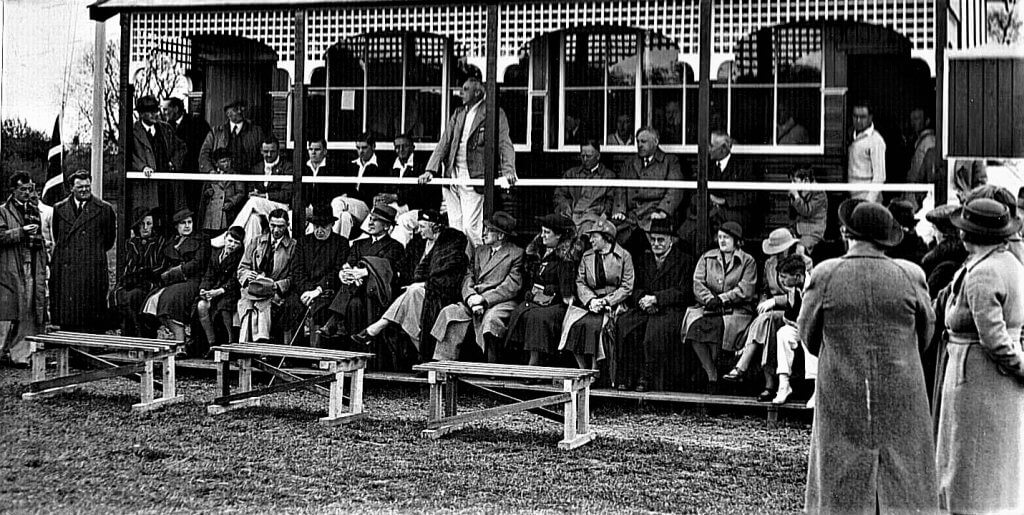
1939 CRICKET GROUND In 1937 land, Sym Ings, was purchased by the Whiteley family, Pool paper mill owners. It became necessary for the cricket club to move from their ground behind the White Hart, this in readiness for the building of the Millcroft estate. Things were to move fast for the cricket club. On 29.4.1938 the move began to transfer from their pitch to the present field. With the ground now prepared, and the pavilion transferred, the opening match against Arthington, in which Arthington won, was held on 5th May 1939. The Whiteley family have always encouraged, supported and played cricket in the village, one member playing for Yorkshire.
One organisation in the village that showed no ill-feeling amongst its members was the cricket club. Cricket is such a leveller. No matter who you are or your creed you are likely to get a duck!
Holmes Whiteley c. 1950

After WW2 Whiteley’s paper mill built a sports club alongside the mill on Otley/Pool Road which had a cricket pitch . It was a very successful club, winning many trophies. The ground, by 2004, became overgrown and is now used a the village junior football teams
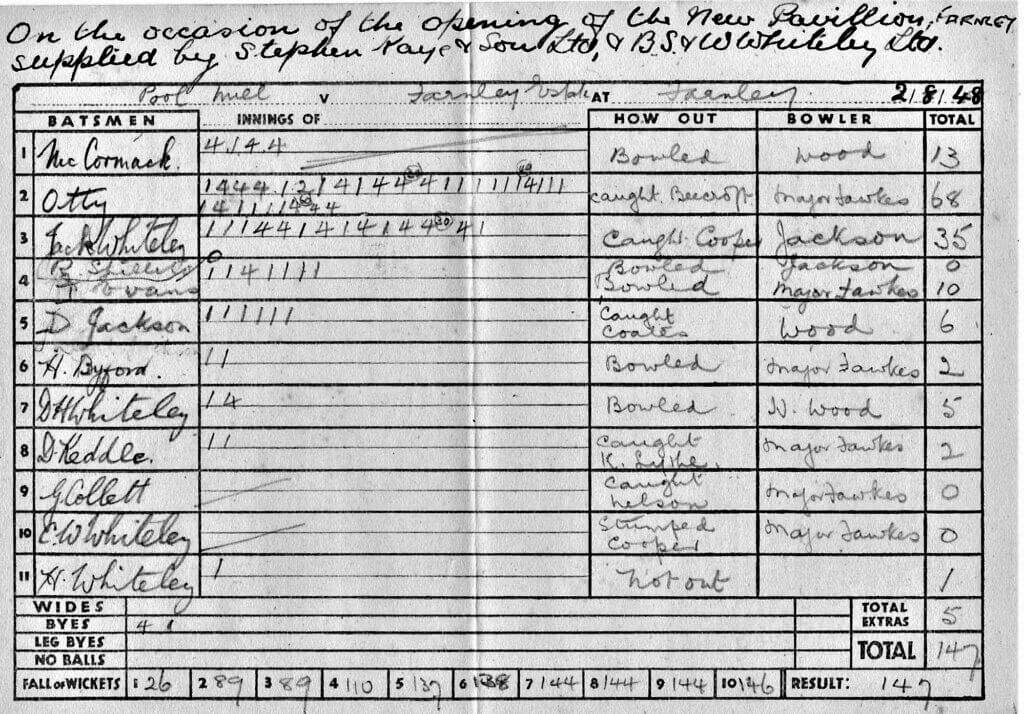
Memories of early Pool village cricket:
We would play cricket across Main Street using the church gateposts as wickets. We only had three bats between the whole team. Showers were a bucket of cold water from the river. (Freddie Midgley b.1916)
When I came home from the war I didn’t have any cricket boots, so painted my old wartime boots white. Unfortunately when it rained they turned black again. (Billy Webster) Many member of the cricket team did the same thing (Mic Cryer)
The first recorded match at Pool
Leeds Mercury 27th July 1833 Cricket –
On Thursday last the return match between the Rawden and Pool Cricket Clubs came off at Rawden and was decided as follows:-
Rawden, first innings, 76; second 60, total, 136
Pool, first innings, 49; second 37, total 86. Rawden won by 50 runs.
Leeds Mercury 23rd Sept.1865 Cricket – (The Pool railway opened
at Pool on 1st Feb 1865)
Poole(near Otley) v. Leeds Caledonians. This match was played on Wednesday last on the ground at the Royal Park Leeds. The result was a decided victory of the Poole eleven.
Score:
POOLE
First Innings Second Innings
J. Bramley run out 0 b. Hardaker 1
J. Ridealgh b. Harpham 3 st. Bulwar 0
J. Pullein c. Hardaker b. Gerrard 29 b.Swaine 8
C. Robinson b Harpham 14 c Hardaker b Swaine 2
R. Ridealgh c. Benton bGerrard 0 lbw Hardaker 2
F. Newsam b. Gerrard 0 c.Hardaker b Swaine 2
J. A. Yeadon b. Swaine 0 not out 3
J. Wade c. Long b. Gerrard 10 c Benton b Swaine 1
A. Ridealgh b. Gerrard 8 run out 1
W. Mason not out 4 c Gerrard b Hardaker 15
J.B. Shann b. Swaine 10 c and b Swaine 0
Byes etc. 17 Byes etc. 16
96 51
LEEDS CALEDONIANS
B. Anderson b. J. Ridealgh 6 c A Ridealgh b Pullein 0
G. Cooke b. Pullein 0 b Robinson 0
Benton lbw b Pullein 1 b Robinson c. Pullein 12
Wm Swaine b. Ridealgh 3 st. R.Ridealgh b.Robinson 0
J Hudson b Pullein 0 b Pullein 6
E. Gerrard c Robinson b Ridealgh2 c & b Pullein 1
J Long lbw, b Ridealgh 4 b Pullein 5
R. Hardaker not out 21 b Pullein 0
A. Harpham c Wade b Ridealgh 0 c R. Ridealgh b Robinson 0
J. Smith b. Pullein 6 c & b. Pullein 0
G.H. Bailey b. Pullein 1 not out 3
Byes etc. 7 Byes etc. 0
51 27
Key to Pool players in 1865 match
1. John or James Bramley, 1829 living at North View Stores, (now cottages opposite White Hart) a tailor on the census in 1841
2. J. A. & R. Ridealgh were brothers & sons of William and Tabatha living on Chapel Row. Members of the Ridealgh family still reside in Pool.
3. Census of 1871 shows Catherine & Thomas Newsam, land agent and surveyor living at the Manor House. Their youngest daughter Sarah Jane married Matthias Shann in 1869. He made blue sugar paper (used as bags for storing sugar) at Low Mill (paper) in 1861.
4. J. Pullein a member of the Lords of the Manor of Pool, farmers with 180 acres 1861
5. J. A. Yeadon lived at Pool Hall, farmer with 42 acres.
6. J. Wade, family worked the mill at Arthington
7. W. Mason, a woollen spinner at High Mill – 1851 census.
8. J.B. Shann, apprentice paper maker, at Low Mill.
—————
Leeds Mercury Thursday August 30, 1866
Finsbury (Leeds) v. Poole (near Otley) on Saturday on
the ground of the latter. Score: Finsbury 38 Poole 40
—————-
Wharfedale Observer. 11th May. 1883.
Pool v. Weston. The opening match of the Pool Cricket club was played on Saturday last at Pool and resulted in a decided victory for the home club.
Playing for Pool were:
Wm. Brown, Wm. Yates, I. Bland, C. Lodge, I. Pullein.
S. Crabtree, M. Oates, R. Ridealgh, J. G. Thompson,
J.W. Harper, W. Law.
————–
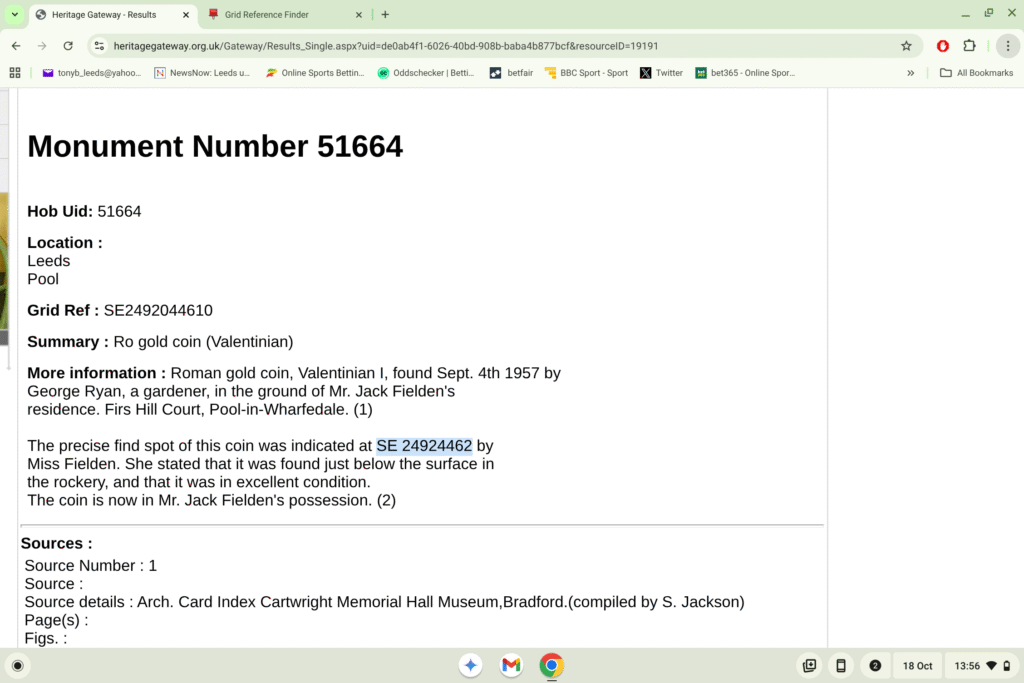
A Roman Coin, Valentinian I previously recorded as having been found in a garden at Old Pool Bank has been found as recorded above.
2026 West Yorkshire Archives of this web site stated “What a fantastic website! It’s a wonderful resource for local history.”