THE CHAPEL OF EASE FOR POOL-IN-WHARFEDALE
A Chapel of Ease was a place of worship provided for the ease and comfort of those people who lived a distance away from a church. In the case of Pool worshippers would have had to travel on foot or horseback to the mother church of Otley Parish Church.
Records suggest that the village has had a place of worship from at least 1538 – almost five hundred years – with a curate recorded from 1553. The original dedication was to St. Swithin. (Derek Dalton). Mention of the Pool Chapel of Ease is made in the will of William Vavasour in 1642. At sometime a Chapel of Ease was built on the land which is now occupied by St. Wilfrid’s Church. The Chapel was partly demolished and rebuilt at the cost of £330 in 1839, remaining a Chapel of Ease until 1879 when Pool was constituted a separate Parish becoming the St. Wilfrid’s Church we see today.
In 1793 whilst still a Chapel of Ease, a chalice, paten and flagon were presented by the Township of Pool. The chalice is two handled and it is said that there is only one similar chalice in England which is at the Parish Church, Bridlington.
Little is known of the features of our Chapel of Ease but a letter sent to the Wharfedale Observer on 27th April. 1883, written by Col. G. Rhodes who had lived in Pool, gives us an insight into the building and the village in the mid 19th century.
” The present church (St. Wilfrid’s) was erected about 40 years ago at the site of the old chapel. A Chapel of Ease to its mother church of Otley.
I can still remember that tiny chapel, with its uncomfortable square pews, lined for the most part with red and green cloth and which from dampness or want of fresh air, emitted a clothy odour.
In those early days of coach and waggon locomitive the Royal Mail Cart used to pass daily from the hamlet of Pool as far as Otley, returning to Wetherby in time for the Royal Mail Coach on its way to London. For about 43 years the Rev. W. J. Ridsdale held the cure or was the incumbent of Pool.
As well as I can remember the square pews and other sittings have been lately removed out of the present Pool church originally belonging to the Chapel of Ease. Most of the inhabitants of this hamlet numbering 100 to 150 souls occupied regular chapel sittings, of which for the most part they were the owners. The said original Chapel having been erected by themselves.” The box pews were about four feet high and had doors.
In his book “Wharfedale”, Thomas Shaw wrote in 1830, “The chapel is plain and neat; it is in the gift of the Vicar of Otley, being a chapel of ease, value about ninety pounds a year.”
It is also written that the Chapel of Ease had a belfry. It was suggested by architectural historian Peter Thornborrow during his survey in 2005 that the lower section of the present tower may have been part of the original Chapel of Ease as the outline of two windows could be seen on the west wall. The nearby Parish church at Brafferton near Boroughbridge had been enlarged some eight years prior to Pool, when its chancel and tower were also retained.
Below are some events which took place during the life of the Chapel of Ease
1538 The will of William Smythe of Pool, made in 1538, proves that the original dedication was to St. Swithin. (Derek Dalton). It is probably about this date that the Chapel of Ease was built.
1553 Richard Oldrede, Curate.
1558 Rev. Sir John Baynes described in the Testamenta Leodensia as Priest of Pool
1635 James Illingworth, Curate
1640-1658 The Chapel of Ease made an attempt to break away from the mother church at Otley, but this was refused. Shown in a Parliamentary Survey of this date.
1642 The will of Wm. Vavasour dated 3rd Sept. 1642 refers to five chapels within the parish of Otley one of which was “Poole”.
1650 Valued in the Parliamentary return at £71.17s.
1651 The Chapel of Ease is mentioned in the Otley Parish registers.
1661 Isabella daughter of Thomas and Isabella was baptised in October at “Powle Chappell.”.
1675-6 John Thomlinson is mentioned in the Fleetham Charity as Curate of Pool. He was licensed to the curacy of Pool. (H. Speight)

1727 Farmer Laycock donates £1 annually from three of his fields to the Charity, Poole Doles, which is attached to the Chapelry of Pool. In 1728 he is joined by Hobson and in 1749 by John Dixon, a total annual contribution of £l.13.0d. (£1.65p) was made. To this is added Pool’s portion of a grant given by Queen Elizabeth the First, of 7s. or 7/6d. (37p.) a year. (This was taken from the total grant given to the poor of Otley Parish of £5.6s.8d.).
Further details of the Poole Doles can be found on https://www.poolinwharfedalehistory.co.uk/13-poole-doles-poole-feast/
1749 The Chapel is augmented by £200 and 1752 by another £200.
1754 The Curate is entitled to the annual sum of five shillings a year payable by the Church warden for preaching a sermon at Tollerton on Poole Feast Sunday.
1765 Christopher Alcock, Curate.
1765-8 John Thomlinson “curate of Poole”. (F .Morrell)
1770-8 William Smith “incumbent of Poole”.
1778-89 Roger Wilson LL.B “minister of Pool” living at Grove House, Bondgate Otley.
c.1790 Succeeded by another William Smith living at Rottten Row, (now Mercury Row) Otley. “Curate of Otley and incumbent of Poole”.
1793 Chalice, Paten and flagon presented by the Township of Pool. These were replaced in 1924 by a gift from the Mothers’ Union.
1806 Rev. William Smith is Curate. Died 15 Nov.1834.
1834 Rev. William John Ridsdale, aged 30, presented to the perpetual curacy of Pool, near Otley. Patron, the Rev. Ayscough Fawkes, Vicar of Otley. Incumbent for Pool’s Chapel of Ease remaining in charge for 45 years. As with all the incumbents he was in the service of the Parish Church of Otley until the Constitution of the Parish of Pool in 1879 when it became St. Wilfrid’s church.
1838 The Chapel of Ease is partly demolished.
1839 The Chapel of Ease in Pool is partly rebuilt at a cost of £330. The tower was added
1840 The new Chapel of Ease is officially dedicated on 14..6.1840.
1851 Survey of the Chapel. (see later)
1872 Pool Church of England school is built, sometimes referred to as Pool National School.
1878 Wed. July 3rd. “Down to Pool. A fair day. Got four three penny whiskys and several bitter ales. Registered four births and one death. One of the births occurred at Caley Lodge on the road and the mother was removed to the workhouse where she arrived when I was there.” from “Timble Man” by Ronald Harker. –Hendon Publishing.
1879.26.6 Constitution of the Parish of Pool. Reginald P. Daniell-Bainbridge MA. is appointed the first vicar of St. Wilfrid’s Church.
1880 The Chapel of Ease is dedicated so becoming St. Wilfrid’s Church.
Pool’s curates lived in Otley travelling to Pool each Sunday to take the daily service.
During 45 years of dedicated service the Rev. William John Ridsdale was to see many changes, the most important of which was the part demolition and rebuilding of the Chapel of Ease. Although there had been several small schools in the village, it was not until 1872 that the first school for all village children was opened. This was the Church of England school which was on Main Street. The curate cared much for the welfare of the children and could be seen making regular visits to the school along with his daughter Miss Mary Dorothy Ridsdale, who would help the children with their reading. On Nov. 24th 1873 The Rev. J. W. Ridsdale called and left one pound one shilling at Pool School to be placed in the Yorkshire Penny Bank for the Pool Clothing Club.
An illustration of his love of the village is given by the Rev. G. H. Mercer in his book written in 1929. “From his home, Chevin Grange at the foot of the Chevin, each Sunday he would ride to Pool on his white pony to take either Matins or an afternoon service, alternating between Pool and Bramhope. With him he always carried a milk can of hot soup to distribute to the poor of the village.”

In 1879 after 45 years of service to both church and village, William John Ridsdale retired. He died in Knaresborough on 25th March 1885 at the age of 81 and is buried in Pool churchyard. The headstone, for William John Ridsdale, his wife Isabella, daughter Mary Dorothy and sons Francis Thomas and William Everard, can be found against the west wall of the churchyard. Its unusual shape seems to mirror the porch entrance to the church.

Leeds Mercury 5th October 1858.
“ANCIENT ORDER OF ROMANS FRIENDLY SOCIETY. The officers and members of No.31 Senate of the above order, celebrated their eighteenth anniversary yesterday (Monday) at the White Hart Inn, Poole, near Otley. The members walked in procession, accompanied by the Poole Brass Band to the church, where an excellent discourse was preached by the Rev. W. J. Ridsdale, M.A. At the close of the sermon the members dined together in the Lodge Room. From the report of the secretary it appears that the Senate is in a very prosperous condition and is doing a great amount of good in the neighbourhood.”
The New Chapel of Ease

This old photograph, taken around 1880, shows the Chapel of Ease built in 1839 and before becoming St. Wilfrid’s church at the Constitution of the Parish of Pool on the 26th June 1879. No apse is shown here, this was added in 1890-1.
As the village was expanding rapidly due to the prosperity of the two Pool mills, High Mill (or Walk Mill) and Low Mill, and Pool Bank Quarry, the population increasing from 182 in 1801 to 363 in 1841, the need to rebuild and enlarge the Chapel of Ease would have become evident.
An important source of income for the church at that time was pew rental, therefore by doubling the number of new sittings it would enhance the income.
At the base of the tower is preserved this important historical board recording,

“This Church was rebuilt and enlarged in the Year 1840, by which means 100 additional Sittings were obtained and in consequence of a Grant from the Incorporated Society for promoting the enlargement building and repairing of Churches and Chapels, so of that number are hereby declared to be free and unappropriated for ever in addition to the 100 appropriated Sittings formerly provided. William John Ridsdale, Minister. Samuel Burnley, Church warden.
In 1851 a further survey of the Chapel took place:
Free sittings 80. Other sittings 120. Pew rent £1.00.
On 30.3.1851 there was no morning service. The afternoon there were 84 attendees. Evening, no service.
The average attendees for the preceding six months from 30.3.1851 were:
Morning service: 90. Afternoon: 90. Evening: no service.
Sunday school, morning 50. Signed by W. J. Ridsdale.
(Otley Museum.O/p/ce/1).
A few artefacts were transferred from the Chapel of Ease to the present St. Wilfrid’s Church, including the Chalice, Paten and Flagon of 1793.
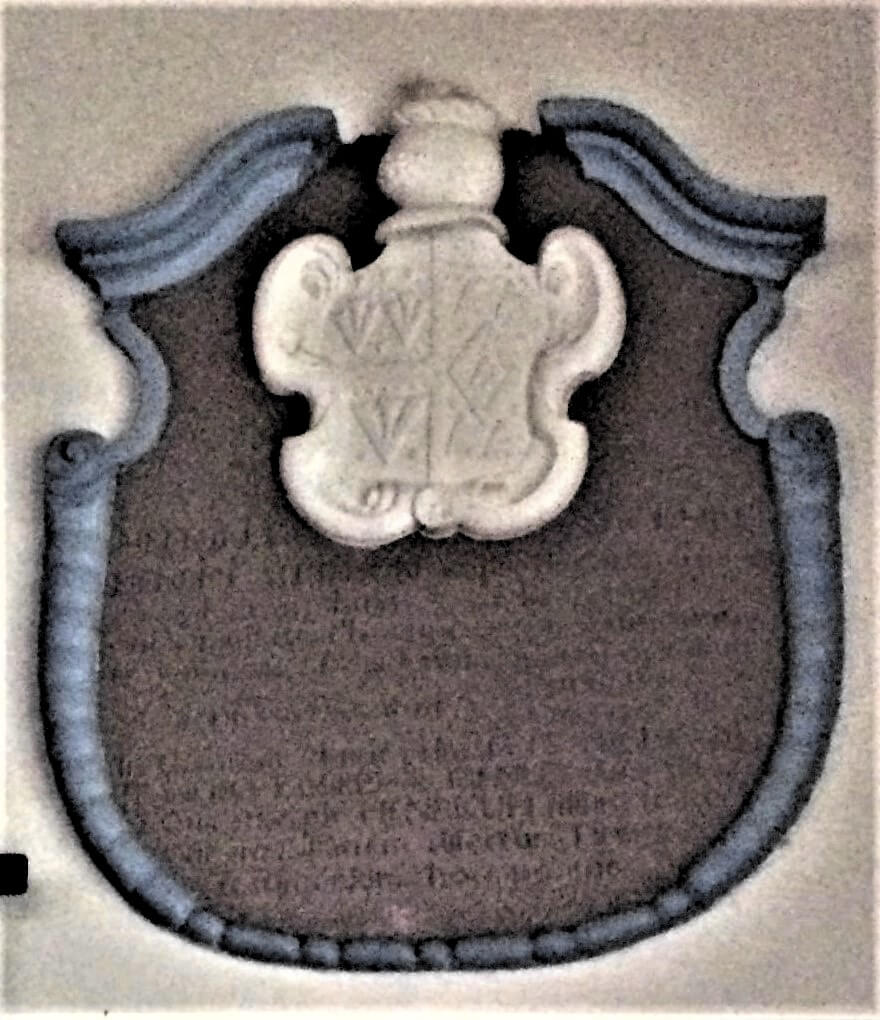
On the east wall, adjacent to the hymn board, is a wall monument dated 1743, a memorial to Henry Atkinson of Caley Hall, raised by his wife Francis Fawkes of Farnley Hall. This features an heraldic shield forming a conjoined achievement of arms set within a shaped cartouche with an open-pedimen. The coat of arms on the plaque show; on the left, the coat of arms of Henry Atkinson’s father and the right, the coat of arms of his mother. (Peter Thornborrow, Architectural historian).During the early 2020’s when the floorboards below this cartouche near the lecturn, needed to be replaced. It was then the grave of Henry Atkinson was discovered.
In the churchyard are a number of older head stones placed around it’s boundary, many date from before the building of the new Chapel of Ease. In 1956 many of the headstones, mainly from around 1700 and 1800, were re-sited to make a grass area which would be easier to maintain. Again c. 1970 some were re-sited.
Other items remain from the days when the Church was still a Chapel of Ease. The chancel floor has a brass plate inscribed: John Pullein April 5 1842, Ann Pullein March 17 1851; Fanny Pullein March 29 1856; John Pullein March 12 1866. These were family members of the Lord of the Manor of Pool.
There is a plaque high on the north wall in memory of Maryann Whitworth Curry who had died in 1840 aged only 13 weeks. Her parents Joseph and Sarah were running a school for seventeen boys in the Manor House in 1841. After moving to Dewsbury, in 1846 he wrote the book entitled, “Curry’s Chronological and Geographical Family Guide to Holy Scriptures”
It would appear that the three stained glass windows, now in the apse, were originally in the Chapel of Ease.
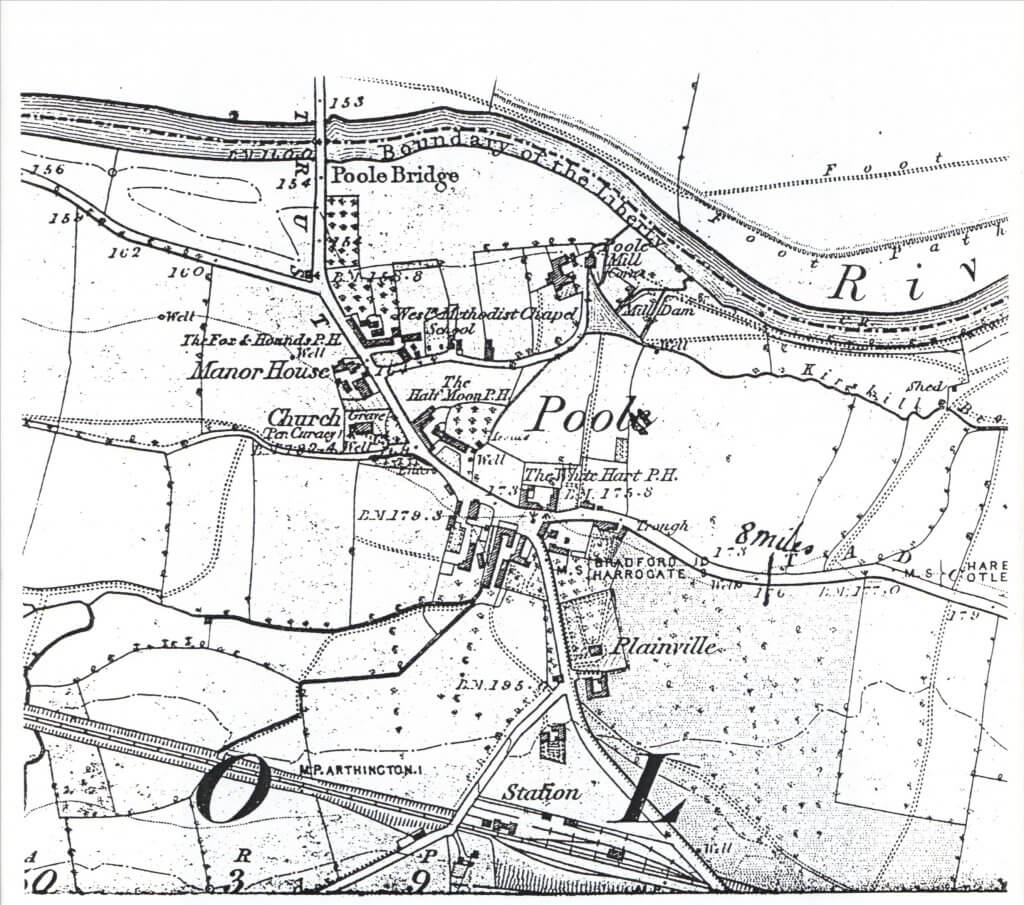
The Village in 1847
PARISH CHURCH OF ST WILFRID’S, POOL-IN-WHARFEDALE

St. Wilfrid was born in Northumbria. He became bishop of York in AD 665, after defending the Roman cause at the Synod of Whitby and built Ripon Cathedral in AD 672. (At the Synod it was decided that Britain should follow the custom of Rome, not the native Celtic Christian Church.). According to research carried out by Derek Dalton the will of William Smythe of Pool, made in 1538, proves that the original dedication was to St. Swithin.
The vicars of St. Wilfrid’s Church:-
1834 William John Ridsdale, Perpetual Curate. (added to the Board in 2004)
1879 Reginald Percy Daniell-Bainbridge M.A.
1884 Arthur Evan Meredith M.A.
1898 Herbert Arthur Woodhouse.
1910 John Sheldon Jones. M.A.
1920 Henry Maddrell. M.A.
1928 Geoffrey Hamish Mercer. M.A.
1938 James Ernest Leach.
1942 Percy Clegg.
1951 Thomas Alun Williams. B.A. B.D.
1954 Frank Geoffrey Southworth.
1965 Archibald William Franklin. B.D. A.K.C.
1978 Leslie Wilson Kitchen. M.A.
1986 Denys Ralph Hart de la Hoyde. M.A.
1998 Frank Snow. Priest in Charge.
2002 John Edmund Bassett. Hon. Curate. (House for Duty Priest and in Lower Wharfedale Benefice.)
2010 Rector Rev. Stuart Lewis
2010 Reverend Rachel Wilson working as an Associate Priest in the Benefice of Lower Wharfedale. Working part time in this role as well as continuing her role as part time Chaplain to the Deaf in Ripon and Leeds.

S. Wilfrid’s, Pool.
Easter, 1911
Hours of Holy Communion
Easter Day 7.0, 8.0, 11.15 (choral) a.m.
Easter Monday 11.0 a.m.
Easter Tuesday 11.0 a.m.
Low Sunday 8, 11.15 a.m.
May it be our Easter Prayer that He may evermore abide in us and we in Him.
Wishing you a Holy and Happy Easter.
Your faithful Friend and Vicar,
J. SHELDON JONES
VICARAGES

After becoming a Church in 1879 a vicarage was built to house the first vicar of Pool, the Rev. R. P. Daniell-Bainbridge M.A. (Diocesan Inspector of Schools) Originally named The Stonehouse on Arthington Lane, on land purchased in 1886 it was built in 1887 at a cost of £1,915 remaining the vicarage until 1923. On his resignation of the incumbency in 1884, was presented with “A handsome writing table, beautifully illuminated address and a marble clock” at a tea where nearly 150 persons were present, “the schoolroom was full to overflowing.”

Although built in 1908 Riversdale, now called Surrey Lodge, also on Arthington Lane, it was in 1923 that it became the vicarage remaining so until 1979. Recently extended.

From 1979 the vicarage was in grounds of Pool Hall, Old Pool Bank. (bottom)
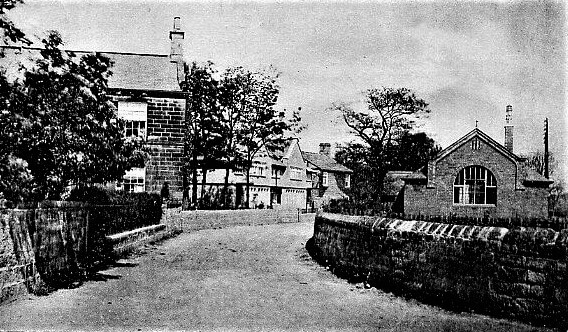
CHURCH ROOMS on Mill Lane built by St. Wilfrid’s church in 1897, plans by Marshall of Otley at an estimated cost of £250, built to celebrate the year of Queen Victoria’s Diamond Jubilee. The land together with the Half Moon and cottages around, had been purchased by the vicar Rev. A. E. Meredith c.1894. The Church Rooms were built “To contain two class rooms available on both Sundays and weekdays for the use of Bible classes, Confirmation classes, mothers’ meetings, Church lectures, Young men’s bible classes, Temperance Society, Band of Hope and other purposes connected to the Church.” The opening was attended by a fairly large gathering. which included Mrs. Pullein wife of the Bishop of Richmond. (The Pulleins were Lords of the Manor of Pool at the time. Many Pullein gravestones lie under the carpet in the church chancel.)
The Building

An extract of the book “Upper Wharfedale” by Harry Speight, published in 1900, describes St. Wilfrid’s and churchyard.
“Its walls and the surrounding graveyard are a picture of luxuriant rusticity, clothed and covered with trailing ivy and roses, tall climbing fuchsias, ferns, and a variety of other sweet emblems of mortality. there are also some particularly fine weeping ash-trees in the burial-yard”
The building we see to-day built in 1839, dedicated on 14th June 1840, was originally a Chapel of Ease. After Queen Victoria signed the Order in Council, Pool became a Parish so that in 1879 the Chapel of Ease became St. Wilfrid’s Church which was dedicated in 1880. It can be seen in the section headed, “The Chapel of Ease for Pool-in-Wharfedale” that the present St. Wilfrid’s Church stands on the site of an earlier building. Details of the building’s structure, given by Peter Thornborrow, Architectural Historian in 2005 can be found at the end of this section.

Dedication stone for the apse

As mentioned, this early photograph of around 1885 shows the Church did not have the apse we see today. This was added in 1891 a dedication stone was placed on its’ outside. The apse was built in memory of Frances Meredith, mother of Rev. A. E. Meredith, vicar of Pool, whose memorial plaque on the inside of the apse shows it was erected by “those who loved her”. In 1890, whilst vicar of St. Wilfrid’s Church, the Rev. Meredith converted the Fox & Hounds, a beer house on Chapel Row, into a Parish Reading Room. In 1894, apparently after complaining that noise from the nearby Half Moon Inn was disturbing his church services, he bought the Inn and some adjoining cottages together with land around it. He then changed its use, and name to The Riverside Temperance Hotel. In 1895, at the marriage of the Rev. Meredith, the children from Pool School were given a half day holiday to see the wedding. After the ceremony he gave a tea to the children. In 1910 he left Pool to become vicar at Bawtry, Nr. Doncaster.

This photograph of the interior taken in 1906, shows a lamp and candle lit Church with ornate painting around the windows. Electricity was installed in both the Church and the school in 1926. An orange molding runs round the walls. The inscription over the entrance to the sanctuary reads “With Angels and Archangels and with all the company of Heaven we laud and Magnify Thy Glorious Name.” A cloth curtain covers the lower half of the apse.
Mrs. Swallow also gave the land in front of the Church to the village for the War Memorial to be erected. This land in 1756, had held three cottages, owned by the Lord of Manor, Thomas Thornhill. In 1902 when Emily Swallow purchased the land from Hannah Pullein, a member of the family of the Lord of the Manor of Pool, it was described as a building site of 693 square yards with 139 feet of frontage to the highway. It was bought by her for 2/6d. per square yard. On giving the land to the village she made a condition that, “if at any future time this close of land should cease to be used for the purpose for which it would be given it should become the property of the Church and join up to the present church yard.” Mrs. Emily Swallow unveiled the War Memorial in 1923.

Beneath the carpet on the aisle are several gravestones commemorating the death of various members of the Pullein family, (Lords of the Manor).see above mentioned in Chapel of Ease. “The opening of the Church Rooms on Mill Lane in 1897 was attended by a fairly large gathering, which included Mrs. Pullein wife of the Bishop of Richmond.”
A large offertory was made and many items were given to the church in February of 1880, some of which are mentioned in the narrative below. Other donors included the Rev. T. Sheepshank, the Misses Fawkes and the Vicar.
Lighting “RAIL 527/35 is the minute book for 1880-81. Minute 21011 of 23 October 1880 reads “Application having been made on behalf of *Mrs Wood (Caley Hall) for a supply of gas from the company’s works at Arthington to the church at Pool, resolved that a supply be granted at 5s 0d per thousand cubic feet, the company being put to no expense for pipes, etc. Mr H Copperthwaite [the NER Engineer at York] to make the necessary arrangements.” RAIL records by kind permission of (Neil Mackay,Chair, North Eastern Railway Association). The husband of Mrs. Wood of Caley Hall, George Wood Esq. M.A. Oxon, of the Inner Temple, J.P, died in 1879 age 54. (buried at St. Wilfrids church) had been a director of the Lancashire & Yorkshire Railway, In 1880 Mrs. Wood gave the alter table and pulpit to the church. They both took a “keen interest” in Pool C of E school. After her husband’s death she continued supporting the school, making weekly visits, providing prizes, reading and dictation lessons, a school lending library, sourcing a play ground for children (at risk of being injured by passing carts), visits to Caley Hall, etc. (School Log book) more details below 1880

The church contains many beautiful stained glass windows. The outstanding feature being the three windows in the apse, the centre one is of the school of William Morris below
As we enter the Church, immediately to the left of the door is the impressive window in memory of Charles Lawson who died in 1936, erected by his wife and children.
“Putting on the whole armour of God”.

Passing down the nave the two windows to the immediate right are in memory of John Fieldhouse who lived at Pool Hall and died in 1893. “Woman why weepest thou. He is not here He is risen”.
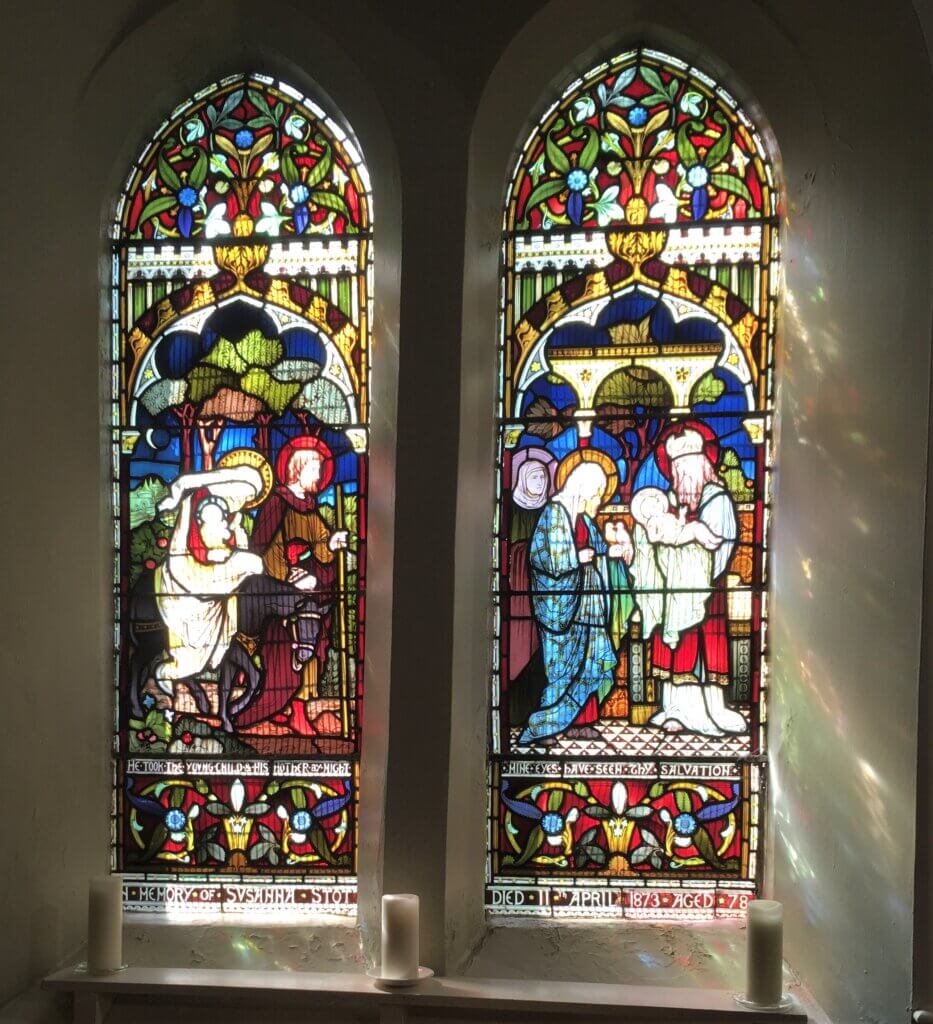
Two of the four windows in memory of Miss Susannah Stott
The next four windows are in memory of Miss Susannah Stott of Pool House who died in 1873. Her beautiful grave stone lies, now hidden by ivy, propped up against the north wall of the churchyard. Making her will 1825 she began The Susannah Stott Charity. Initially the sum of £400 being for the benefit of the Medical Dispensary, the Lying-in-Charity, the Charity for the Aged and Infirm and the Female School of Industry. When the Female School of Industry closed down in 1890 its share went to the Orphan Girls’ Home and in 1927 this part of the charity was transferred to the Waifs and Strays, which later became known as the Church of England Children’s Society At the present time the Church of England Children’s Society receives £25 annually and the Diocesan Board for Social Welfare £12.50. (Bradford Historical & Antiquary Society) On her death her cousin, Miss Greene-Stott lived at Pool House owning much land and property in the village.
Following the refurbishment of the Church in 1880 interesting events took place. This is recorded in a series of articles in the Wharfedale & Airedale Observer of that time. One heading declares, “There has been of late some little unpleasantness in church matters.”
Miss Greene-Stott, who had a large number of household staff, claimed at a Vestry meeting in 1883 that she should have exclusive use of her pew and that “the whole of the pew to belong to her and her house in perpetuity and on-one else should use it”. In response the Rev. R. P. Daneill-Bainbridge, not accepting this stated, “no-one could for one moment tolerate her conduct in turning people away from the pew.” A petition, previously given to the Bishop at his presence at the memorial and signed by upwards of sixty parishioners, stated that she should not retain the right. As a way of objecting, “her” pew was deliberately occupied by a number of quarry men from Pool Bank Quarries.
It would seem that the saga continued as this article was in the Wharfedale Observer of 12th October, 1883. “Vile Outrage was perpetrated in this village on Tuesday evening. Some miscreant, at present unknown, has poisoned twenty seven ducks and seven fowls belonging to Miss Stott. Why this lady has been subjected to this annoyance it is difficult to state. But every right minded person cannot but look upon it with some abhorrence.”
It is understood Miss Greene-Stott was not granted permission for a personal pew and left St. Wilfrid’s Church to worship at St. Peter’s Church at Arthington.

“When I was in service all the staff were required to stand outside the Church whilst our employers from the “big” houses in the village took their places. Some houses would have as many as eleven or twelve servants. We were then allowed to file in to join them. After the service we had to run home to prepare Sunday lunch for the house whilst the gentry stood chatting outside the Church.” (Resident of the 1920’s)

As we return down the nave we see on our right alongside the pulpit, the two windows, “Blessed are the pure in heart for they shall see God” and “Suffer the little children to come unto Me and forbid them not ”. These were unveiled on 11th Aug 1918 in memory of John Cunliffe Johnstone of The Tower, Arthington Lane, who was killed in France during WW1. His wish was that one day he would be ordained and the windows were fittingly placed near the spot where he had often read the lesson.
On January 17th 1912 Pool School closed for the dedication of the next two windows, by the Bishop of Knaresborough in memory of the late Alfred Whitehead who had lived at Bryn Afon (now Bank House) Old Pool Bank. He had been a valued benefactor of the school. Amongst his gifts was a much needed lamp during the winter of 1901. The school log records “Have a good light from a new lamp given by Mr. Alfred Whitehead to the school”. At his death in 1910, the school children were given a half day holiday to attend his funeral.
“Simon son of Jonas lovest thou Me” and “Feed My sheep”

The beautifully sculptured font showing the four Evangelists was presented in 1880 by William Huddleston who was a sculptor and who, it is understood from his descendant Joan Buckle, may well have been designed and made by him.

The present choir stalls were erected in 1927, the ends carved by J. Harold Snowdon, who lived at Plainville/Park House, later Monkman’s Bistro.(demolished in 2002) He was a descendant of William Milthorp who with Francis Maude of Leathley, began Pool paper mill (now Weidmann Whiteley) c. 1750. John Milthorp, his son, married Elizabeth Nicholson in 1802. It was her brother, Michael, who bought the paper mill from John Milthorp in 1809, thus joining the two mill owning families. After leaving Pool House in 1822, they lived at the now demolished Plainville on Pool Bank New Road. The family vault is now in St. Wilfrid’s church yard. Two family plaques are on the north wall: Michael Nicholson Milthorp Snowdon who died at Plainville in 1918 and Mary Elizabeth Snowdon to whom “On November 16th 1926, “Jesus said to her, “Mary.”
Two memorials are placed under the hymn board to some of the men who were killed in both World Wars, “We will remember them”. Cyril Bernadine Holroyd who was killed during WW1 was from Otley and a member of the Denton family, with Acting Sergeant Major Harold Ellis Denton D.C.M. from Pool.

The “book cupboard”, (cupboards, notice board and bookshelves) at the rear of the Church were made and donated by “Vinny” Parker who spent many years serving the Church, being a People’s Church Warden for over thirty years. During his working life he was a skilled joiner and cabinet maker at Stephen Kaye & Son, saw mill, on Arthington Lane where he became manager. He made the wooden cross and candlesticks used at mid-week Communion. He became a sympathetic undertaker when Stephen Kaye & Son opened a Chapel of Rest on 12th September 1975 within Kaye’s woodworking business on Arthington Lane, which was dedicated by the Vicar of Pool, Rev. A. Franklin. The cupboard is inscribed, “In memory of Alice Parker 1905-1986 and Herbert Vincent Parker 1911 – 2002.”
In 1983 a new Incumbents’ Board was dedicated. It was made by Desmond Ellis from grained elm in a new “White letterset” technique. The cost of materials was £64 met by the Church Council.
Mention is made of the Atkinson monument of 1743, on the east wall, is in the section “The Chapel of Ease for Pool-in-Wharfedale”.

Lectern in 1990. A gift in 1970 by Rev. Geoffrey Mercer, vicar of Pool 1928-38, in memory of his wife Elsie.

The Processional Cross. In 1970 this was presented by The Rev. G. H. Mercer who had left Pool for Oulton in 1938.

The Pulpit and Altar Table were a gift from Mrs. Wood of Caley Hall in 1880. The present altar frontal and pulpit fall were donated in 2006.
The rearedos, carved by “Mouseman” Thompson of Kilburn, was a gift from Mr.Frank Harold Bride in memory of his wife, Annie who died on 19th November 1934.
The clock has seen a number of changes since it was installed in 1840, a gift from Mr. Austen who was living at Pool House in 1871. For a number of years it must have been causing problems as during 1929 it was repaired and painted and in 1938 a proposal was made for it to be replaced. It was not until 1956 that the old Bailey hand-wound clock was removed and a new electric clock installed. The cost was met by generous donations on Gift Day.
Early Memorable Events
In 1793 whilst still a Chapel of Ease, a chalice, paten and flagon were presented by the Township of Pool. The chalice is two handled and it is said that there is only one similar chalice in England which is at the Parish Church, Bridlington. These were used at Holy Communion during the 50th year celebrations on the 26th June 1929. The ones used to-day were given by the Mothers’ Union in 1924.
In 1870 A scheme for the new Pool National School, (National Society for Promoting the Education of the Poor in the Principles of the Established Church) was to be built on “Water Croft”. Cost of building the school was £400. The school was opened in 1872 on land, Water Croft, obtained in 1870 from Wm. Milthorp and executors of Michael Nicholson, Pool Mill owners. It was built on land conveyed to the Minister and Church Wardens for that purpose.
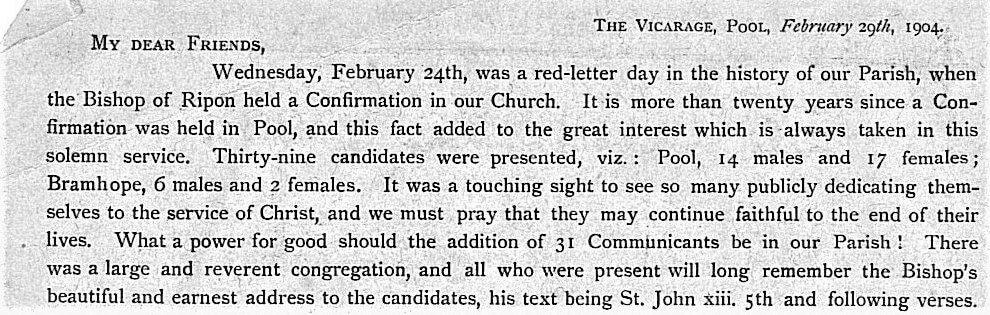
The first confirmation to ever take place at St. Wilfrid’s Church was held on the 21st March 1881. The Service was taken by the Bishop of Ripon and the organist was H. Woffindale**.
The number of communicants were: Pool 21: Arthington 14: Leathley 15: Stainburn 14 and Bramhope 3, making a total of 67.
On this day all choir boys were given leave from Pool School to take part in the Confirmation Service. (School Log).
**Henry M. Woffindale was organist for forty years. Two of Henry and Amelia’s sons Hubert Noel and Edward, lost their lives in World War 1.
When the first vicar the Rev. R. P. Daniell-Bainbridge arrived in 1879 he was welcomed by the school. At the same time, whilst examining the children’s Religious Knowledge he reports, “The selection and singing of the hymns are very good. A little more modulation and sweetness would make this exercise excellent.”

One of his daughters would often take the girls for sewing classes.
She and her sister donated the Church cross. The sisters lived adjacent to their father’s vicarage at Laurel Bank and Beech Bank, Arthington Lane.
Taken from the school Log Book 1876. Interesting to note it was expected that children under the age of 7 to be capable of hemming, seaming, felling and fixing a hem. Also to have made a garment such as a child’s pinafore. They should also produce a strip of plain knitting.
Interesting articles appear in old editions of the Wharfedale & Airedale Observer and other records giving an insight into the activities of the early life of St. Wilfrid’s Church.
27th September 1880. Mrs. Wood (of Caley Hall) kindly commenced a lending library for the school. The books were lent free of charge on Friday afternoons. A week later Mrs. Wood extended the use of the library to any villager. In 1881 after the headmaster commented that children were being repeatedly warned to keep out of way of carts, etc. she organised a playing field for the school, and provided cricket, lawn tennis and croquet sets. (School Log Book)
Mrs. Wood also gave the altar table and pulpit to the Church.
Balance Sheet of 1890 The Revs. Bainbridge & Meredith head the list of ”Receipts”.

Feb 17th 1882 “At a concert at St. Wilfrid’s schoolroom on Saturday evening in aid of the reading room, Mr. Thompson in opening the proceedings, pointed out the advantage and amusement the young men in the village would derive from joining the reading room. A very pleasing entertainment was then gone through. Several glees, etc. being rendered in a most creditable manner by a glee party from Yeadon assisted by a few Pool friends. Mr. W. Brown of Pool, who possesses a capital tenor voice, sang “I Waited by the Beech Tree” “Mr. Albert Denton of Pool gave two pianoforte solos in a finished style and was loudly applauded.”
28th September 1891. “A library belonging to the Sunday School has been opened for use of the Day School too. No charge to be made for books of which there are 160 at the present time.” School Log
10th June 1881. Whitsuntide Festivities. “The church Sunday School. On Monday the Sunday School in this period held their annual gathering. The scholars ninety in number, met at the schoolroom at half past one and were marched to the school where a short service was held. After service they marched to the principal houses in the village and sang their hymns. A good tea was partaken of and the children enjoyed it very much. A field was provided for the children to play in but the grass being very wet, an adjournment was made to the schoolroom where they were served with buns and oranges. The little ones heartily cheered the ladies and gentlemen who had so kindly provided for them.” (According to Margaret Hammond, nee Oates, even in the 1930’s village children were expected to step aside, sometimes off the pavement, to allow the gentry to pass
The St. Wilfrid’s school room was used for other events:
5th Feb 1886. “Cricket Club Concert. The committee of the Pool Cricket Club gave their annual concert in the St. Wilfrid’s schoolroom on Saturday evening and we are glad to have to announce that it was the best concert which has ever been given in the village. The committee has gone to great expense in procuring the services of well-known artists and they were determined that the inhabitants should have a special treat.” The item continues with a long list of entertainment which took place.
5th March 1886 An advert reads, “Under the auspices of the Church of England Temperance Society, the dramatic members of the Otley Temperance Society will give a drama entitled “The Bottle”, to be followed by a farce in the School Room, Pool on Shrove Tuesday next.”
29th October 1886. Harvest Festival. “Although the services were a great pleasure to those who took part in them, though to enjoy was somewhat lessened by the fact that so much grain in the parish was still lying out in the fields, with little prospect of being well and safely gathered in.”
26th January 1894. “Annual Parish Gathering took place on Monday last in the church schoolroom. The proceedings began with tea to a large gathering of about one hundred persons sitting down and after tea an entertainment was held presided over by the Vicar. The room was well filled, with Mr Nicholson, the well known humorist from Leeds, delighting the audience during the greater part of the evening.” Various other entertainment was mentioned.
The Vicar went on to say “Where there is no School Board and no school pence to pay, it is incumbent on all to subscribe to the maintenance of the school, where children are receiving an education both in secular and religious subjects. A School Board means in many cases a heavy rate and the neglect of the moral and religious training which is so essential a part of the education. A hearty vote of thanks was awarded to all who had helped make the evening a success.”
20th December 1889. “A most successful concert was given on Wednesday evening by the children of the National Day School under the supervision of Mr. Brunt and Miss Gell. These included, “school songs, recitations and musical drill including piano scales and a musical cantata and dancing. The vicar, during the interval spoke of the efficiency of the school which has earned during the past year, a good report from H.M. Inspector and also from the Diocesan Inspector in Religious Knowledge. He also congratulated the master and assistant mistress on the success of their work. The room was crowded to excess and everyone went away delighted with the entertainment.”(Pool School Log Book)
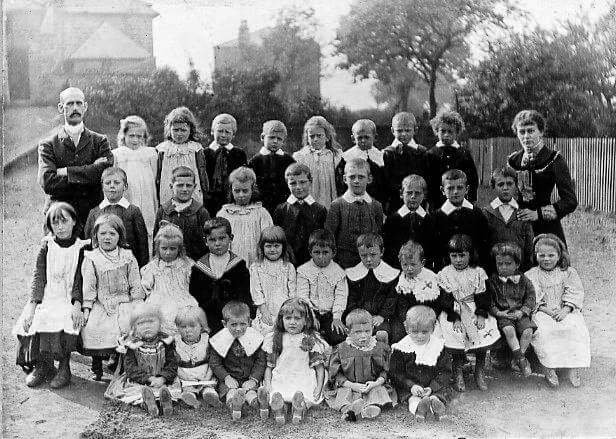
In 1896 Walter Wigglesworth took up the post as headmaster where he remained until 1923. His wife, Anna Mary, remained teaching at the school until 1936, giving over thirty eight years of service. His assistant until 1902 was Clara Ridealgh.
11th December 1896. Church Sunday school annual distribution of prizes, “the number of scholars at present in the books is 71.”

The above was taken from the inside cover of “The Three Cornered House” by Evelyn Everett-Green. It was presented to Sylvia Woffindale whose family lived in the village. Her father Henry, played the organ at St. Wilfrid’s, for many years.
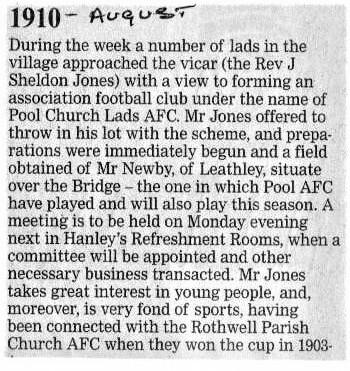
In 1910 The Rev. J. Sheldon Jones was approached by a number of village lads with a view to forming an association football club under the name of Pool Church Lads AFC to which he agreed. “Mr Jones takes great interest in young people and is very fond of sports having been connected with Rothwell Parish Church AFC.”
Later Event
Jubilee celebrations were held in June 1929 marking the 50th anniversary of the Constitution of St. Wilfrid’s Church. A series of special services were held over the week-end with various guest preachers. A garden party was held in the vicarage grounds organised by the Mothers’ Union. Before the Sunday evening service, given by the Rev. C. C.. Marshall, Vicar of St. Chad’s, Far Headingley, there was a procession of the choir, Sunday School children, scouts and guides, St. Wilfrid’s Fellowship and members of the congregation who walked from the school to the Church.
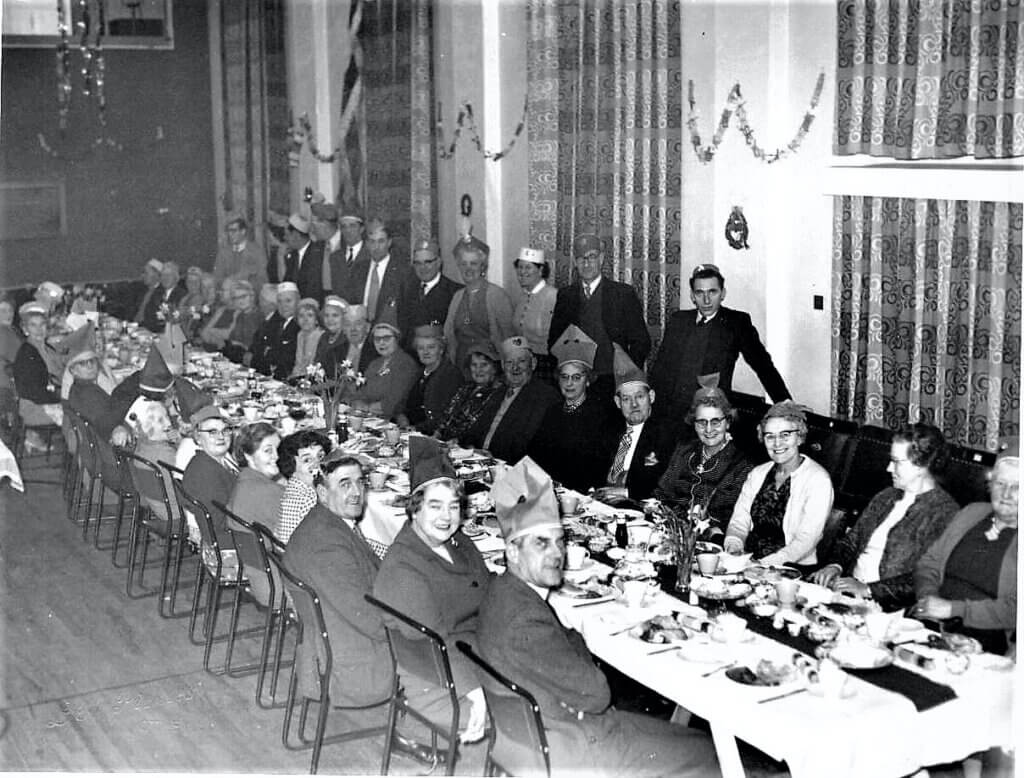
At the suggestion of Rev. Southworth, in the early 50’s Good Companions was formed for retired people of Pool. Meetings were held on Thursdays, in the old Church Room when a shilling was charged for tea. Games of whist and dominoes were enjoyed. Every Christmas lady helpers gave a dinner with turnkey, crackers, paper hats,etc. The Rev. Franklin joined them for tea when he became vicar. When the Companions closed, with the money left over, a small stand was suitably engraved. This stands at the church entrance, used for church literature.
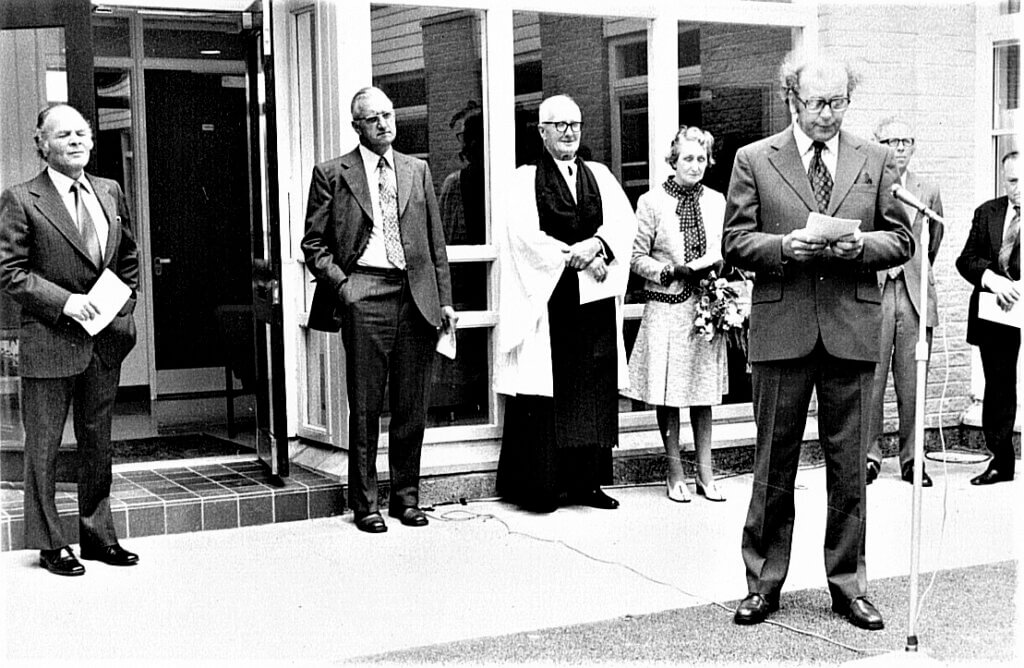
In 1974 the building of the new combined First and Middle Church of England School on Arthington Lane was completed and officially opened in July 1975.

Again in 1979 centenary celebrations took place when the new vicarage in Pool Hall grounds, was blessed by the Rt. Rev. Ralph Emmerson, Bishop of Knaresborough and the Vicar of Otley, Canon D. M. Kendrick. B. A. Over the centenary week-end a display on Christianity and the Church was given by the children of Pool school. There was also a choral, organ and orchestral concert given by St. Wilfrid’s. Derek Dalton compiled a special history of the church, a leaflet which was soon to be published. Also during this year the special honour was bestowed on Mr. Thomas J. C. Lodge who was appointed the first Honorary Lay Curate in the Ripon Diocese.
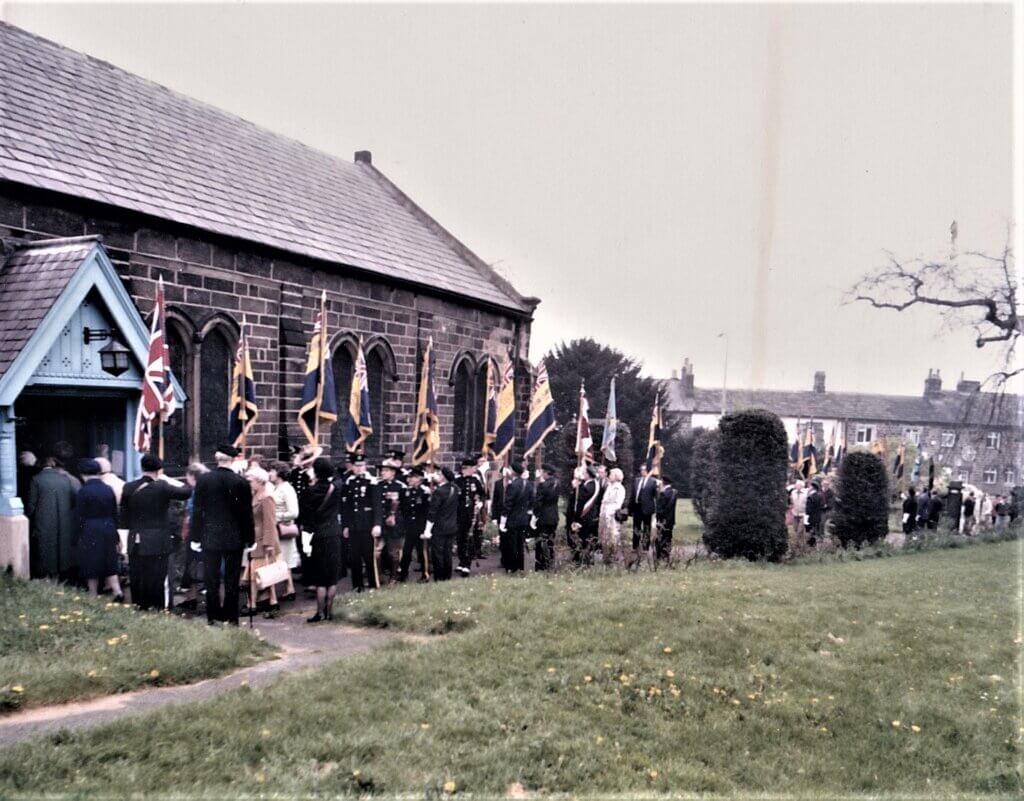
On 10th May 1981 The Royal British Legion, Pool & District Branch, replaced the Old Standard and Dedicated the New Standard. (See “A Village at War”)
During the year 1983 the Sanctuary was re-ordered bringing forward the altar thus allowing the celebrant to face both the congregation and the altar at the same time. Re-decoration of the Church also took place. These were largely funded by an anonymous donation from a “grateful family” after the Falklands War
In 1984 Derek Dalton, headmaster of Pool-in-Wharfedale Church of England School, was made Deacon. At Michaelmas 1985 he was ordained priest and first conducted Holy Communion on 6th Oct. 1985. He later went into full time stipendiary ministry.

On 4th April 1985 Eric Cryer received The Royal Maundy from the Queen in Ripon Cathedral. This was given for services to St Wilfrid’s Church, where he was choir master and organist for over sixty years. A Plaque is in the Church next to the organ

“The distribution of Alms and the washing of the feet on the Thursday of Holy Week are of great antiquity being traced back with certainty to the 12th century. Recipients are now selected because of the Christian service they have rendered to the Church and the community. The red purse contains an allowance for clothing and provisions formerly given in kind, and a payment for the redemption of the royal gown. The white purse contains in Maundy coin silver pennies, twopences, threepences and fourpences as many pence as the Sovereign is years of age. Maundy coins are legal tender and since the change to decimal currency in 1971 the face value of a set of four coins became 10 new pence instead of 10d. in the old £.s.d. system”. Extracts from the Office for the Royal Maundy


St. Wilfrid’s in the 21st Century
In 2002 both St. Wilfrid’s Church and St. Peter’s Church, Arthington were incorporated into a new benefice known as Lower Wharfedale. In 2007 the nominal sale of St. Peter’s Church was made to the Coptic Church of St. Mary and St. Adanoub. As a result the Parish of Pool WITH Arthington is now known as Pool AND Arthington. The Rector of the new benefice resides at Kirby Overblow and the current Pool Vicarage is retained for the services of a House for Duty Priest.

“Many improvements have taken place in the early years of this century. It began in 2002 with the provision of a loop and microphone system as required by law. Pew bibles and new hymn books (Common Praise) were acquired.
There was a substantial amount spent on the organ, the first two stages of a six stage project with a further effort projected in 2008.
The interior of the church has been decorated and rewiring and updating of the lighting system in accordance with European regulations has been dealt with. The interior of the church has been graced by a new altar frontal and pulpit fall in an All Season Portugese Tapestry by Ormesby’s of Scarisbrick. Choir robes have been renewed and simple vestments introduced. The Church has also profited from Weeton Church in the way of a piano and an aisle carpet. The sanctuary has been carpeted in a similar fashion courtesy of congregation giving. There is also a new paschal candle stand in situ by way of a memorial gift, likewise a piano stool and flower pedestal.” In August 2015 the sanctuary lamp was reinstated in the apse. That year the church was redecorated and the “Vicars of Pool” board updated.

Through the generosity of the village, especially the patrons of the Half Moon public house, the church rejoices in being floodlit: porches and gates have been renewed and painted and normal but necessary maintenance effected.
A great deal of voluntary effort has been expended in the Churchyard and a new bench seat in memory of the late Ted Joce provided.
More needs to be done but a good start has been made.” (Rev. J. H. Bassett, Hon.Curate)
Special thanks go to The Rev. John Bassett who kindly checked over this later section making the necessary adjustments and providing the more recent information.

To commemorate the beginning of WW1, on 23rd August 2014 St. Wilfrid’s held one hours’ vigil from 10 pm to 11pm, when all lights except several candles were extinguished.
During WW2 invasion preparations were being made for the digging of slit trenches for bell ringers.
The Church and Chapel were both on standby during WW2 to act as temporary mortuaries if required

This beautiful Christmas card was painted by local artist Griff. “Proceeds from the sale to support the local church.”

The Present Day St. Wilfrid’s Church as seen in 2005 by Peter H. Thornborrow, G.N.S.M.; P.G. Dip. E.L.H.(CNAA), Architectural Historian.
Church of St Wilfrid: was built in 1839 to replace a Chapel of Ease dating from before 1538 that was mentioned in the will of William Vavasour in 1642, and in the Otley Parish Register of 1651. The rebuilt church cost £330 and was designed by the distinguished architect R.D. Chantrell of Leeds at the height of his fame, when his influential design for St Peter’s, Leeds (1837-41) was being built.
On the approach to the church the boundary wall is neatly constructed of large dressed blocks with chamfered-topped copings that ramp to the east entrance gate to the churchyard. This has square gate piers and angled caps originally with a wrought-iron hoop and lamp. This leads down a path lined by four tall clipped yew trees to the south porch of the church that is set in a well kept churchyard that also features an unusual and ancient weeping ash tree.
The church is a pleasant small village church with nave and a later apsidal sanctuary added on to its east end in 1890-1 (by architects T.H. & F. Healey of Bradford). A chamfered plinth runs around the building, the nave with 5 bays articulated by offset buttresses with an open timber porch (an unusual feature) in the 2nd bay, then 3 bays of paired lancets in a simple Early English style with hood moulds with carved leaf stops. The roof has coped gables with kneelers and blue-slate roof embracing a possibly earlier (18th century?) tower of two stages, both built of roughly dressed coursed masonry, the 2nd stage set back from a moulded cornice with, on the three sides (N, S, & W) belfry openings with lancet heads set within a recess cut into the stonework, with scalloped head. A clock face is set in to two faces (N & E) of the square tower that is surmounted by a broached octagonal spire. The narrow west door in the base of the tower enters into the original ringing room, and is embraced on both sides by a choir vestry and the vicar’s vestry (Church Parlour) of 1880 &1937 that has been extended to twice its original length in 1975.
The Interior: The south door leads directly into the body of the church nave that is a single vessel without aisles. Close to the door is a carved wooden board recording the names and dates of the known vicars of Pool, commencing in 1834 with William John Ridsdale Perpetual Curate until 1879. The nave is divided into 4 bays by exposed queen-post roof trusses with brandished decoration. Running around the walls is a simple carved brandished frieze that links with the carving on the truss tie-beams. All but one of the 2-light windows are in-filled with colourful stained-glass windows gifted as memorials to the memory of local residents. Those on the south side are the earliest dating from 1873, 1893 (signed “Kayll & Co Leeds glass maker”) and one dated 1936. Those on the north side are all 20th century being dated 1910 & 1918.
The church is pewed with simple low-backed pitch-pine pews on a raised wooden floor on either side of a lower central path (carpeted), with two tiers of oak choir stalls, and an organ set in the NE corner (a memorial of 1924) forming a pleasant grouping. Instead of a chancel the church has an apsidal curved walled sanctuary, added as a memorial in 1891, its three lancet windows filled with decorative stained-glass. Set behind the altar on a raised dais is an oak reredos carved with Gothic Perpendicular tracery by the famous wood carver Thompson of Kilburn, known as the Mouseman because his signature is a carved mouse usually placed in a hidden position. The furnishings are simple, a low oak pulpit and a circular stone font on a drum column with octagonal base, the font bowl carved with inset roundels with emblems of the four apostles, a gift of the Huddleston family one of whom was a sculptor and may have carved the font.
The church appears to be a pleasant late-Victorian village church, only the small wall monument in the SE corner suggests otherwise. Dated 1743 to Henry Atkinson of Caley Hall, the memorial raised by his wife Francis Fawkes of Farnley Hall. It features a heraldic shield forming a conjoined achievement of arms set within a shaped cartouche with an open-pediment.
At the west end of the nave are the scars of two blocked arch headed windows and another open window set in the apex of the gable. Under this a doorway leads up a short flight of four steps into the base of the tower, where is preserved an important historical painted board recording that “this Church was rebuilt and enlarged in the year 1840, by which means 100 additional Sittings were obtained” in the vicarate of the then minister William John Ridsdale. Set in the sides of the tower are tall narrow lancet doorways one leading to the outside and one to the choir vestry; the vicar’s vestry is a more recent addition on the north side (1880 & 1937). The church silver, the Pool Chalice and Paten, date from 1793 made in Newcastle

The Church Yard: Only the west end of the churchyard is occupied by funerary monuments, in other areas they have been laid flat, some older grave slabs are placed around the boundary. Some notable ones being that to vicar Rev. William John Ridsdale and to John Pilling “late of Pool Corn Mill” (1818), another to the Pilling Millers dated 1807 & 1766 dating from before the building of the present church, and evidence of an older foundation.
The slab to Elizabeth the daughter of William Rawling the Pool blacksmith who died 1795 is a particularly fine example of the stone carver’s art of calligraphy. A slab laid horizontal to members of the Dunwell family including Joseph Rhodes Dunwell, Wesleyan Missionary to Cape Coast Castle, (now Ghana) Africa who died 1835 aged 29 years after only 6 months in Africa.
A box tomb to the Nicholson family, old mill owners and Pool Waterworks owners, faces the entrance to the church.
Running along the south wall of the churchyard is an area kept for wildlife conservation. Extended around 1933 on land given by William L. Whiteley. On 2nd June 1945 the Bishop of Ripon gave permission for the consecration of the addition to the burial ground.
(Reproduction of the above item is given by kind permission of Peter H. Thornborrow, G.N.S.M.;P.G.Dip.E.L.H. (CNNA) commissioned in 2005 by Pool Parish Council in preparation for a Conservation Area for the village, granted in 2009)
THE CHURCH YARD
An extract from the book “Upper Wharfedale” by Harry Speight, published in 1900 describes St. Wilfrid’s and its churchyard.
“Its walls and the surrounding graveyard are a picture of luxuriant rusticity, clothed and covered with trailing ivy and roses, tall, climbing fuchsias, ferns, and a variety of other sweet emblems of mortality. There are also some particularly fine weeping ash-trees in the burial-yard.”
The churchyard contains many headstones, some dating from the days when the old Chapel of Ease stood on this site. Most of these are against the north and west walls. One to be noted near the Church to the north east, is the box tomb for the Milthorp/Nicholson/Snowdon, Pool mill owning family. The family lived from around 1822 until 1960 in a grand Georgian house of Plainville, also named Park House on Pool Bank New Road which was demolished in 2002.
The grave of Joseph Rhodes Dunwell must also be mentioned. In Bains Directory of 1821 James Dunwell was at Pool Farm Cottage around 1830. His eldest son, Joseph Rhodes Dunwell (1807-1835) entered the Methodist missionary in 1833, after being driven from his home as “religious mad”. He was sent to Ghana in 1835 (known as “White Mans grave”) where he died 6 months later of malaria.
To the south of the graveyard are memorials from the early 1800s to Michael Nicholson’s family who were owners of both Pool Fulling and Paper Mills.

The burial ground was extended and consecrated in September 1906. Again in 1933 land measuring 1,200 yards was given by William L. Whiteley, a founder member of B. S. & W. Whiteley Ltd. Pool Paper Mill and who was instrumental in the building of Pool Methodist Church. It is assumed that due to the intervention of WW2 the Consecration did not take place until 2nd June 1945.
Records of burials and baptisms at the Church date back to 1845. On 30th August 1850 a license was issued for the publication of banns and marriages.
Leeds Mercury 14th Sept. 1850
Married. Wednesday. At Pool church (which was licensed for the occasion), by the Rev. W. J. Ridsdale, incumbent, Mr. Michael L. Firth of Boroughbridge to Elizabeth third daughter of the late John Milthorp, Esq. of Plainville: also at the same time and place, Mr. Fryer of Upper Clapton, Middlesex to Caroline Milthorpe, youngest daughter of the above Mr.Milthorpe, and niece of Michael Nicholson, Esq. of Ryddings House.
In 1956 it was decided by the Vicar, The Rev. Southworth, and the Churchwardens that part of the churchyard should be cleared for grass to be laid, so making the area easier to keep tidy. The graves were subsequently removed, most of headstones now surround the west and north walls. The majority of these graves were from the 1800’s although a few were earlier. One such grave is of John Dixon who died in 1749 and may well have been a contributor to Poole Doles. Graves were again moved in the 1970’s.

In 1968 funds were needed to maintain St. Wilfrid’s Church in good repair as it had only just avoided a second annual deficit. Action was taken with a Parish target set of £9,000 to be obtained over the following three years. It was anticipated that this would cover the minimum needs for its’ future, estimated to be in excess of £2,500 per year. The Christian Stewardship Campaign organised the raising of the money.
CHURCH ORGANS. In 2003 fund raising events were organised for the restoration of the 79 year old Abbot & Smith organ when it was estimated £23,000 would be required. In 2011 money to the value of £33,000 was being raised for a complete renovation and conversion from pneumatic to an electronic action. By September 2012 work was completed. The event was celebrated in Oct by a concert in the Church
This was built by Abbot & Smith of Leeds.The original organ was built into St. Wilfrid’s when erected in 1839. The present St. Wilfrids Church organ is an Abbot & Smith organ presented by Mrs. Emily Annie Swallow and daughter, Gertrude Harmer, of Troutbeck in memory of her husband Thomas Swallow and was unveiled in 1924. Fund raising events were organised for its restoration in 2003. In 2011 money to the value of £33,000 was being raised for a complete renovation and conversion from pneumatic to an electronic action. By September 2012 work was completed and a few extra pipes added, celebrated in October by a concert in the Church.
Pool Methodist Church – organ was presented by Mr W L Whiteley in Nov. 1936 as a gift in memory of his wife Jane. This was built by Abbot & Smith of Leeds.

CHURCH ROOMS on Mill Lane built by St. Wilfrid’s church in 1897 to celebrate the year of Queen Victoria’s Diamond Jubilee. The land together with the Half Moon and cottages around, had been purchased by the vicar Rev. A. E. Meredith c.1894. Built “To contain two class rooms available on both Sundays and weekdays for the use of Bible classes, Confirmation classes, mothers’ meetings, Church lectures, Young men’s bible classes, Temperance Society, Band of Hope and other purposes connected to the Church.” It became a doctors’ surgery from 1963 to1980, rent £11 per week. In 2003 it is a private house.
For more information see “Living”, “Events, “Events of the Past” then”Poole Doles & Poole Feast” )
Contrary to many local churches which have recently been “modernised”, the interior of the church remains largely unchanged since being partly rebuilt from the Chapel of Ease in 1839. St. Wilfrid’s church is much admired for this reason.