The main employer until the early 1900’s was Pool Bank quarry. At the same time the paper mill of B.S & W. Whiteley was expanding.
BLACKSMITHS.
1.In part of Hall Farm, (now converted cottages) Robert Hanley had his blacksmith shop before 1900 (SHP) (see extract below also 10.).
2. Thatched cottage on Stocks Hill (stocks were 5 feet high as were at Leathley used as a whipping post.)
3. Joseph Snell blacksmith in 1822 & 1830 (1822 Directory) then son William Snell 1841& 1851 (Census) (wife Elizabeth, son Thomas died 1839 aged 22 months)
4. 1881 David Moon blacksmith at stone quarry
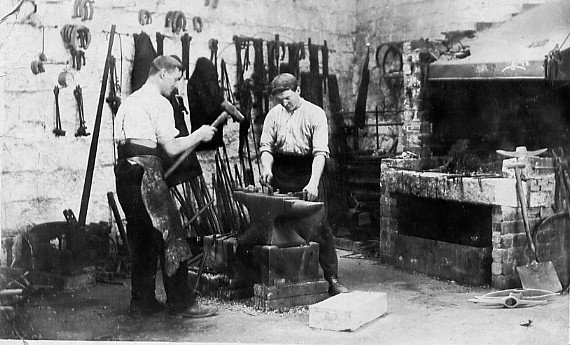
5. Smiths at back of Mill Lane. Eddie Oates worked there from 1910 -c1929. When in WW1 he was a blacksmith. He left in 1929 when Wharfe Cres. was built. He made iron railings to surround the whole of the garden of Pool House, now Church Close. Repairing farm gates and shoeing horses. In this area Joe Whiteley had his butchers shop. The Pool census for 1871 shows Michael Oates born in 1818, was a retired blacksmith living in Pool, born in Morley and another Michael a schoolboy of 8 born in Bowling, as his nephew. (see “A Village at War” & Book “Yorkshire Lads“)
6. Main Street, in area where P.O. now is. (Map of 1888) (Probably John Wood – 1861 P.O. directory)
7 & 8 Walk Mill/High Mill, blacksmith John Pullan (1805-1882) sometime between these dates but was there on census of 1841 & 51, he lived on Chapel Row.
9. Old Mill House, or The Rosary, Otley Road which was situated near High Mill. In 1915 is recorded as consisting of a blacksmith’s shop and blacksmith’s hearth. (see “Pool Mills”)
10. Between Kayes woodyard and The Bar House, Arthington Lane by Robert Hanley c. 1903, he had moved from see No. 1, later c. 1920 owned by Billy Emmitt.
11. There was a blacksmith in 1946 at Pool Bank Quarries – Mr. Gill.
12. ”Cobbler Harrison” had his shop at the back of Wharfe View.
13. More recently in the 1980/90’s there has been “Metal Mickey” who operated from the old Kaye’s woodyard workshop.
14. Geoffrey Wiggins in 2001 operating from Wharfe Crescent. Later moved to Otley as a Blade-smith. The last smith working in the village.
15. A grave in churchyard to William Rawling of Pool, Blacksmith 1782, (daughter Elizabeth died 1793 age 14) William Rawling is also recorded in Otley Parish Registers as a blacksmith in 1732 at the birth of his daughter Mary. Mentioned in Tythe map of 1849
16. Joseph Mason was a blacksmith on census of 1851. William Wood was a blacksmith in 1871 census, possibly at Walk Mill.
Below are two extracts from “Recollections of my Native Village” by Holmes Whiteley born in 1888.
“The blacksmith shop of the village stood near to the Half Moon. Here general smiths work was done including the shoeing of horses, there being a far greater number of these useful animals than there are now. It was here we boys took our iron hoops to repair and how pleased we were when Old Bob (Robert Hanley) allowed us to work the bellows. To see the sparks flying was a real thrill. It was not always we were permitted to blow the fire. Sometimes Bob was as we thought “the wrong way out” and the quicker we cleared off the better for our clothes and exposed places! What joy it was to be allowed to stay with him a while. It was here that I was taught how to divide up a bar of iron without a rule. Bob would lay the bar or rod on the edge of the anvil and at the point of balance, make a mark, this was the centre. It would be about 1900 when Bob built the new forge near to Kaye’s shop “.
Holmes Whiteley
Stephen Kaye’s Joiners and Agricultural Workers later moved from near Hall Farm, now cottages (2008) to Arthington Lane, adjacent to Kayes now demolished where The Beeches housing development is. (See Kaye’s below)
BRICK WORKS A local newspaper advert. in 1866 asks “for tenders to erect at Pool a Hoffman’s Patent Brick Kiln, with Chimney, etc.” During the building of Arthington Viaduct and Bramhope tunnel in 1845 preparation for making bricks at the rate of 50,000 a week during the winter and twice that number in the summer season was planned.

Around 1900 a 22 chamber brick kiln was being operated by Whitakers’ within upper Pool Bank Quarry. To avoid any waste, the bricks were made with the clay and a sandy substance which had previously been removed to get at the quarry stone. In the 1930’s there were about six men actually working in the kiln. (Mrs. Doreen Singleton) The brick works were closed during the late 1930’s. During WW2 broken bricks, which had been left discarded, were taken to form foundations for the Yeadon Avro factory.
Holmes Whiteley recalls “they were not considered a very good brick but had a large sale for underground work and out of sight walls. The price was eighteen shillings per thousand at the quarry, two shillings extra if taken to the railway station.” (See Pool Bank Quarries).

BUTCHERS The majority of Pool’s butchers were close to the Half Moon where at the back, there was a “pining house” and animals were slaughtered. The first mention is a butchers shop in the occupation of Joseph Stead and Co. in 1822 whose relation was farmer and the publican for the Half Moon in 1817. Others 1841 Jabez Batty; Wm.Shires (publican for Fox & Hounds); 1871 Matthew Wood; 1881 Wm. Rhodes; 1891-1911 Thos. W.Horner; later butchers were Billy Tankard c.1920, Joe Whiteley c.1930; Middlemass c.1940; Jepson c.1985
THOMAS DENTON, SHUTTLEMAKER OF POOL Thos. Denton 1820-1896.(Mem.Insc.) Thos. Denton –1861 census Millright. 1871 census – Shuttlemaker age 50. Still a shuttlemaker aged 70 in 1891. Dentons of Guiseley have a letter head “Thomas Denton, Shuttlemaker of Pool.” Dated 1860. The trade was followed on by his sons Albert and Harry Denton. Albert also ran the post office on Wharfe View. Harry was also the postman and mended clocks and watches c. 1900. Around 1890, and no doubt earlier, the workshop was at the back of Chapel Row. The shuttles were made from apple wood for the woollen trade. Ringing machine rollers were made. Harry was known as “Whiteley’s dentist” because he also made and mended the wooden teeth on the cogs of Whiteley’s water wheel, this required a great deal of accuracy. (See Families of the Past”)

Yorkshire Observer 15th July 1930. “ A stout rope swings from the roof. With this you help yourself up the steps leading through a square gap in the floor. Cobwebs drape across your shoulders as, with a final heave, on the rope “banister” you pull yourself through the floor into the workshop of Pool’s shuttlemaker.
Trades not what it used to be … that accounts for the cobwebs which your shoulders caught on the way up and the cobwebs which veil the shafting, the pulleys and the leather driving belts. Yet there are still days when Mr. Harry Denton, the 70 year old village shutttlemaker comes here and plies his old craft when he is not busy being a postman and if trade brightens there will still be days when the throb of the tine engine will tell of more shuttles being fashioned on the lathe or cutter.
Mr. Denton took me into his workshop. It looked just the same he told me, as when his father, Mr. Thomas Denton made shuttles here too, for the Denton family have made shuttles for over one hundred years in Pool.
A Week’s Production. Shuttles lay finished on the bench, stained a golden brown. Shuttles lay completed but unstained, showing the white of the crab-apple wood from which they are made. Thrown under the rough trestle bearing a lathe, were oblong chunks of the same white wood. Some had been hollowed out, others rounded at the ends It is years ago now that drill and gouge worked these iron-hard blocks until when a flaw was revealed in the wood and they were thrown away on this wood heap.
All this tells of the days when this one-man shuttle factory worked hard. “Working full-timeit was possible to turn out 21 shuttles a week” said Mr. Denton, as he fished a huge shuttle, fitted with four wheels, from a joiner’s chest. “They varied in the price they brought, from 1s.3d to 5s.6d. No there’s not many of these now and doesn’t want to be either” he said holding up the shuttle with runners underneath. Mr. Denton turned to his sawdust-coated lathe top – a crude enough machine with a wooden tailpiece and headstock and treadle for power. I remember bringing that into the shop 55 years ago or more. |It did take some getting in and not half”. Remembering those steep steps with their rope, I could quite believe it. Fifty-five years ago! In those days ….at the top of the steps stood in all its newness, the biggest belt leading through the floor to the engine in the basement slapped healthily as it went round the pulleys.”
They were the first to install an internal combustion engine in the village in the late 1800s the noise could be heard in the school Some of the Denton family, Harry and Eva, still live on Castley Lane.(2015) (See “Families”)
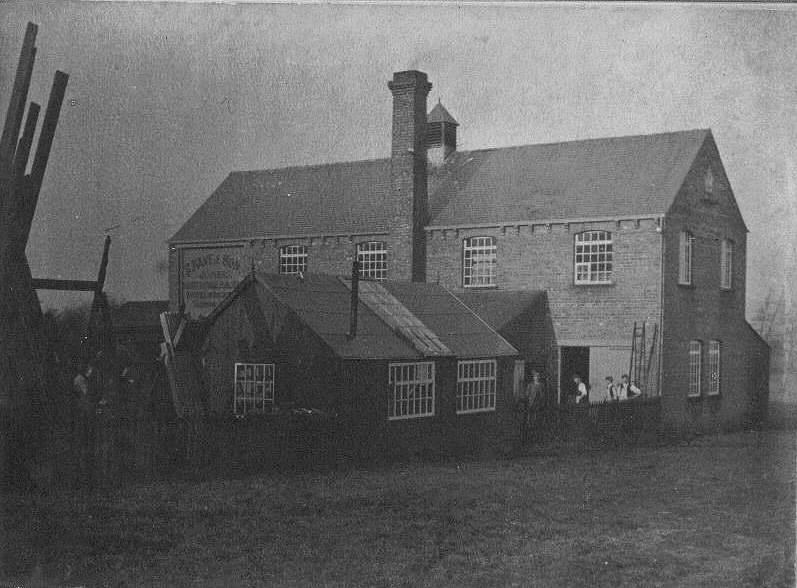
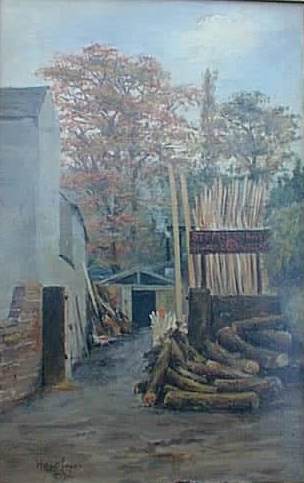
STEPHEN KAYE AND SON LTD estab.1860 on Main St, now has Hall Farm Cottage built on the site. The sign on the property can just be seen on the painting above. They moved to Arthington Lane in 1901
The census of 1871 states that Stephen Kaye is 26 years old and employs l man and 1 boy. Born in Leathley. He had 3 daughters, Elizabeth married James Wade, cornmiller of Arthington
“I can just remember the tree trunks laying about in the yard and seeing various carts and waggons under repair or in the making. For an advertisement, at the entrance was a cart wheel made to revolve by a small wind mill. Then, as it has been during this war time, the timber used was practically all English grown and was to saw up from the trunk. There was a fair amount of iron work about, carts and waggons and gates so it was also necessary to have alongside the joinery part, a forge where the iron work could be made.”
From “Recollections of my Native Village” by Holmes Whiteley, born 1888.
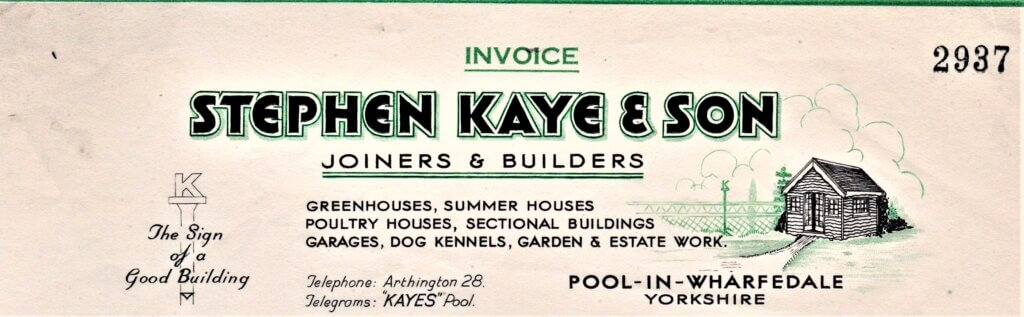
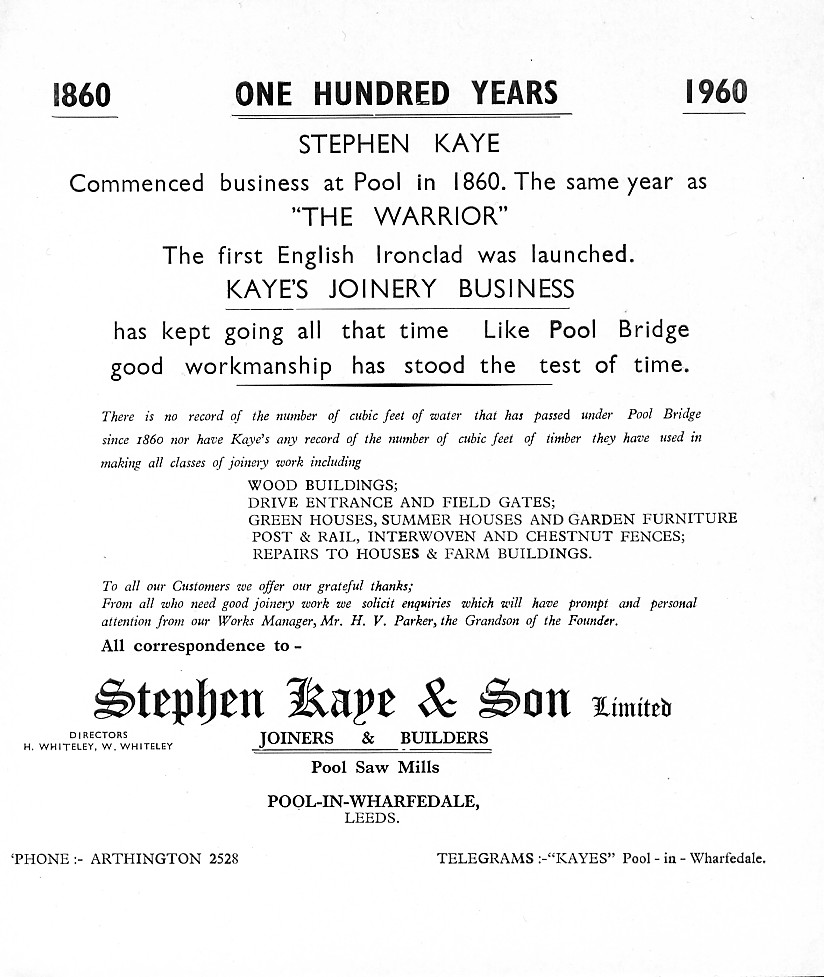

Kaye’s continued trading as joiners and builders in Pool Saw Mills, Arthington Lane from 1901 and traded there until the mid 1980’s.
Arthur Kaye, son of Stephen, continued the business but when his son, Francis Bertram Kaye was killed in World War 2, Arthur lost interest in the business. The Whiteleys’, owners of Pool paper mill, purchased the business and George Parker, son-in-law of Stephen Kaye was made manager. This role was passed to George’s eldest son, Vincent, on his retirement. Vincent, who died in 2002, managed the business for the Whiteleys’ until his retirement circa 1976. George Parker passed away in circa 1953 aged 72. His wife preceded his demise in 1948. (Bryan Perrin)
Francis Bertram Kaye – Stephen Kaye & Son, Arthington Lane, unmarried. Sergeant (Pilot) in R.A.F. Volunteer Reserves 64 Sqdn. Died on 1.11.1941 aged 24. Service No. 1058697. Son of Arthur and Ellen Kaye of Pool. Casualty Type: Commonwealth War Dead. Grave/Memorial Ref. Sec. G. Grave 549. Cemetery: Otley (Newall-with-Clifton and Lindley) Cemetery.
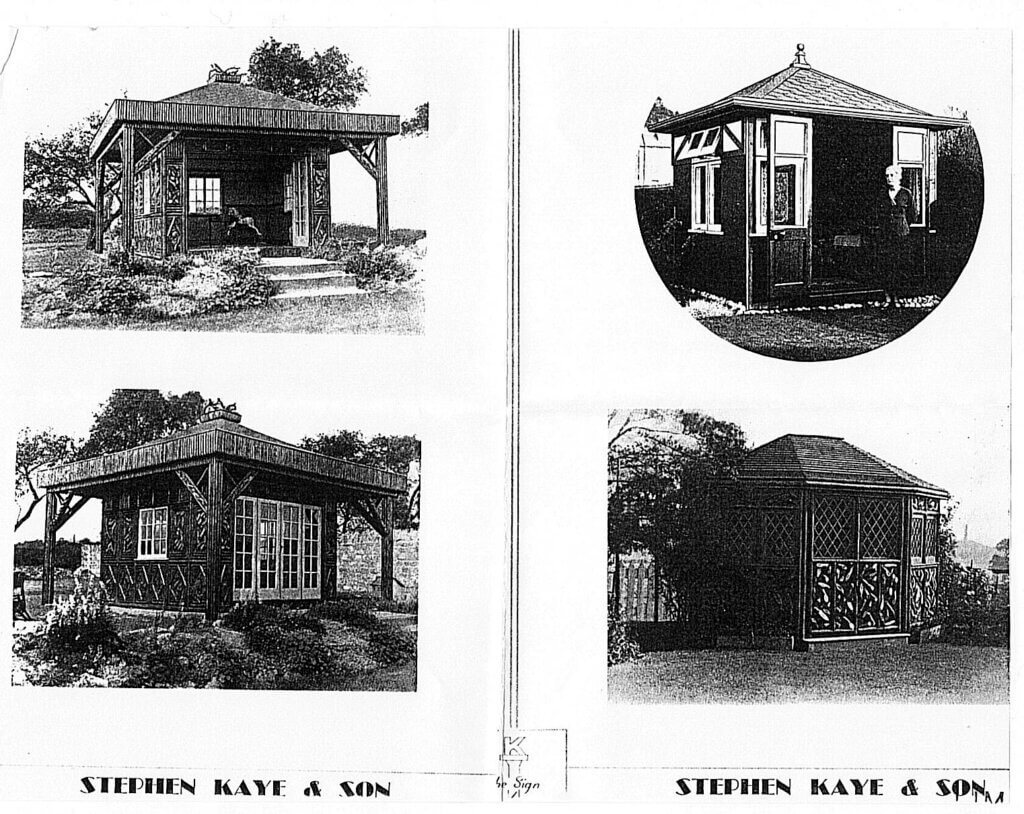
Summer houses taken from sales brochure of 1920
Stephen Kay’s patented some special bee-hives. They made dog carts, dog kennels, hen huts (“en uts”) and snowploughs, (horse drawn), benches, greenhouses, gates, sheds, also summer houses, some of which would swivel to follow or avoid the sun. One major work was the building of the mills as Newton Kyme.
In1901 Pool Choral Union ordered a new box for music from Stephen Kaye’s at 15s. 6d.(Accounts book now in Otley Museum.)
A white building with the date 1901 (now demolished and part of The Beeches) were the offices on Arthington Lane.
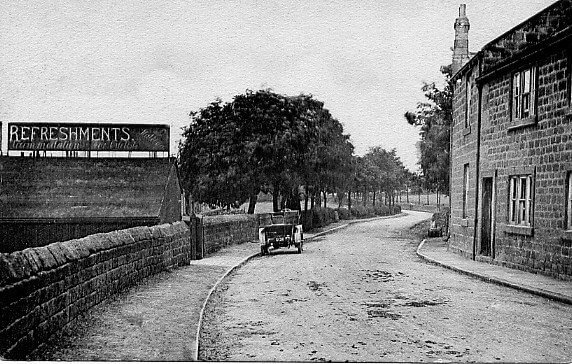
A building on the land leading to Kaye”s was a café run by Joseph Whitley (Not Whiteley) who was also a chauffeur for Mr. Dawson of Asquith. The cafe was very popular with cyclists. They also advertised “stabling”. The building had previously been used by Robert Hanley as a blacksmiths to Kayes. (Robert Hanley is shown as a boarder with Whitley in 1911.) Kayes lived in part of Park Buildings opposite c. 1900. Car registration U 38.
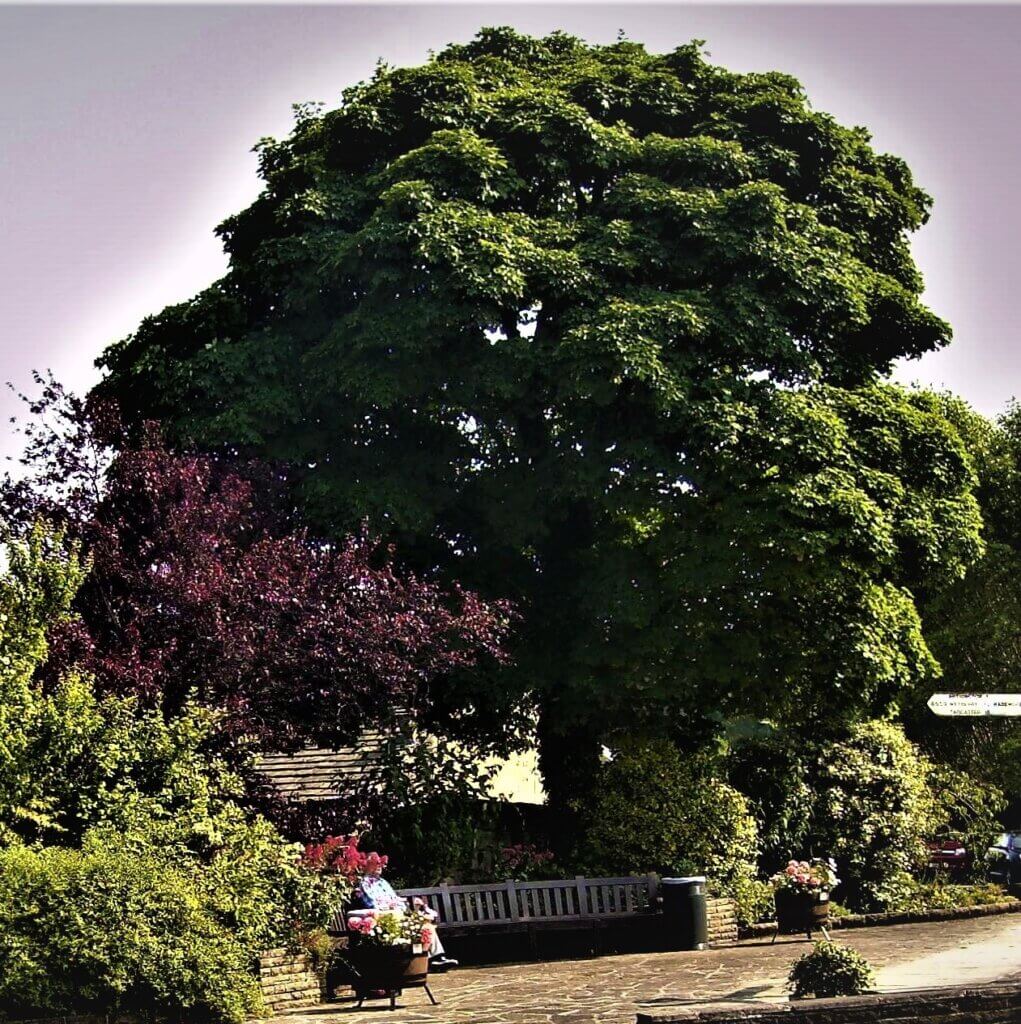
Bench on Stocks Hill
They made the stocks and curved bench for Stocks Hill around 1955, opened a Chapel of Rest on 12.9.1975, dedicated by the Vicar of Pool, Rev. A. Franklin, also making coffins. The property sold c.1985, then part was let to various people including “Metal Mickey” who made wrought iron gates, etc. The main factory burned down on 15.3.1995. The remaining buildings were demolished in 2001 to make way for a small housing estate, the Beeches,
In August 1948 a cricket match was played at Farnley, Farnely Estate vs. Whiteley’s Mill. This was to celebrate the opening of the new cricket pavilion made by Stephen Kaye & Son Ltd and B.S.&W. Whiteley Ltd.
MILLS OF POOL (See separate sections)
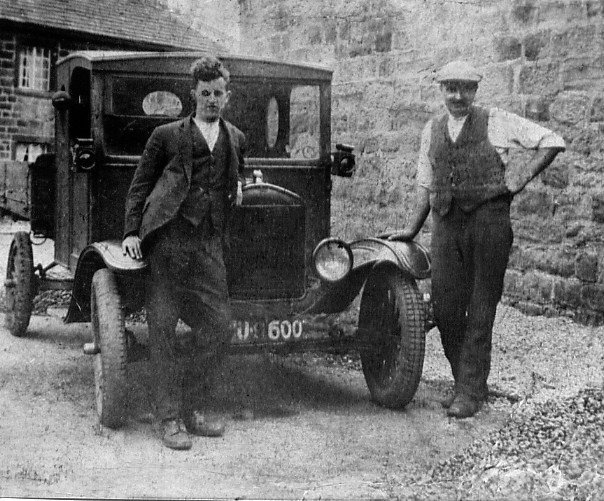

ROBERT MIDGLEY & SON. Robert Midgley, was born in Rufforth. His first job was the doctor’s groom at Ampleforth College. He left there and moved to Pool where he was under gardener at Farnley Hall. (He threw his boss, the head gardener, into a cold frame when accused of being late and left this employment!) He then started up his own coal and haulage business. He started with a horse and cart, increasing to two horse and carts. At the beginning of 1924 a new Model T Ford wagon was acquired to replace these. This was used for transport of goods too and from the station for Whiteley’s Paper mill as well as delivering coal to the village. His coal yard was on Pool railway station yard. He later had 3 lorries. The business carried on through Clifford his son then Peter his grandson, who finally sold to a Knaresborough company in 1998.
Extracts from the Wharfedale Observer.March 19th 1886. “Theft of Coal. Benjamin Greaves, mason of Pool, an aged man, was brought up in custardy charged with stealing coal, value 3d. (1.1/2p .), the property of Mr. Rickards, H. M. Inspector of Factories, of Pool.” (lived in Manor House) . The charge was that he stole the coal from an outhouse. He stated he did not have any coal at home but on inspection he had at least one hundredweight. “Mr. Rickard did not wish to press the case against the person who was an old man but hoped it would be a warning to him.” “The Bench ordered Greaves to be imprisoned until the rising of the Court.”
PETROL STATIONS

1 – A petrol station erected in 1910 stood at the corner of Main St. & Pool Bank New Road until the early 1970’s, selling fist Pratt’s petrol, finally National Benzole. This petrol station was attached to North View Stores (converted to cottages in 2001) which had been in the Denton family since 1849. H. Foster inherited this through marriage. It remained in the family until c.1950. In 1929 their advert said, “ When visiting our village fill up here with petrol of lst grade for your journey. Proprietors H & G. Foster.”

2 – In 1923 S. Foster bought property and land adjoining the Half Moon and built the present post office and Half Moon Garage, known as “Foster’s Half Moon Petrol Filling Station, Free Car Park. Garage and Taxi for Hire”. The Fosters owned the two garages, including No1 above, and post office, when a grocery store, known as “Foster’s Cash Stores”
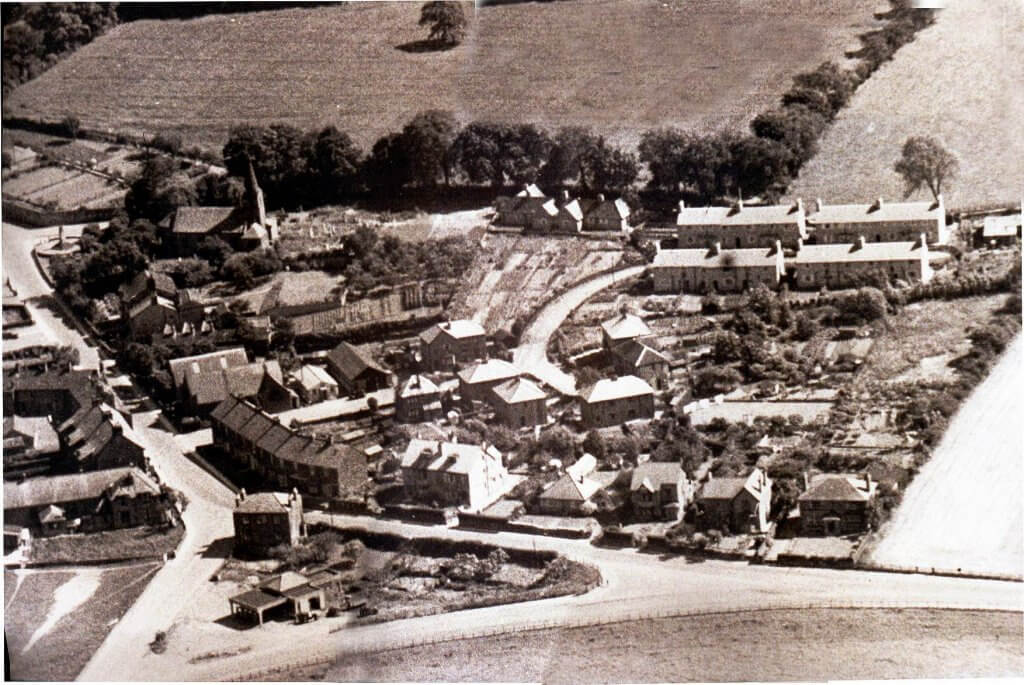
3 – Behind Fir Tree Cottages, (demolished c.1960) was a small garage. During WW 2, after arriving in the village by train, queues of army vehicles could be seen filling up by a hand operated pump,
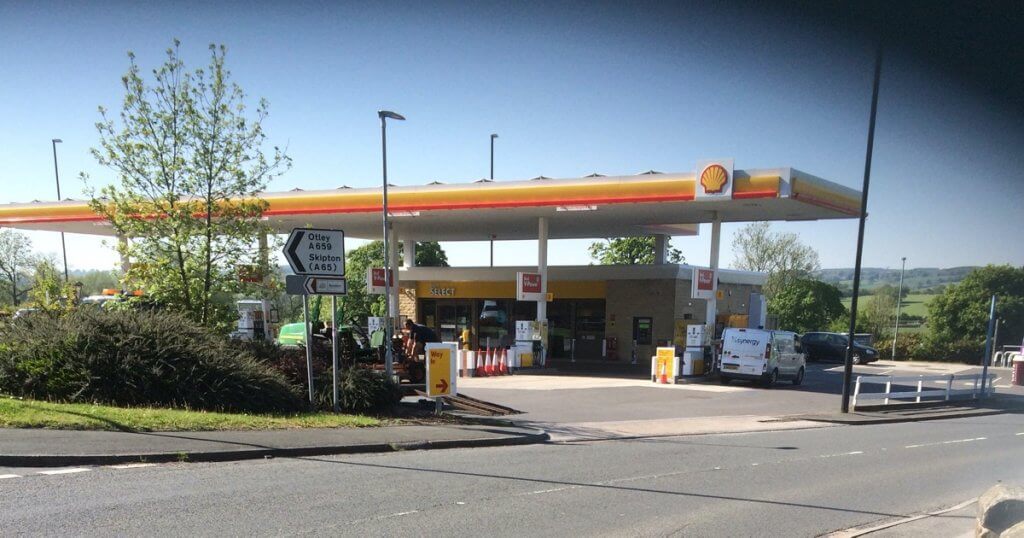
4 – After the demolition of Fir Tree Cottages and petrol station as shown on No.3, when the land came up for sale the White Swan in Otley applied to build an hotel here. This was rejected by P.P.C who said there were already enough licensed premises in the village. In 1960 it was owned by Johnny Tooth, known locally as “Toothy’s Garage”. The story is that he won money on the Irish sweepstake and bought the land to build Pool Bridge Garage, now known as The Shell Garage. It is said to have been the first self service petrol station. Johnny Tooth later became motoring correspondent for BBC Leeds. When it was later sold to Shell, ironically, they were granted an alcohol license in 2012, this against the wishes of PPC, Leeds CC and residents. In 2016 when Shell bored to 3 meters in several areas to check all clear to sink petrol tanks. At the water level, stones were retrieved, some washed smooth by river water, from the alluvial layer. (limestone and sandstone pebbles – 3 in archive). The engineer considered the river had once covered this area and had a bend at this point.
POOL-IN-WHARFEDALE RAILWAY (See separate section)
POOL BANK QUARRIES. (See separate section)
TANKARD

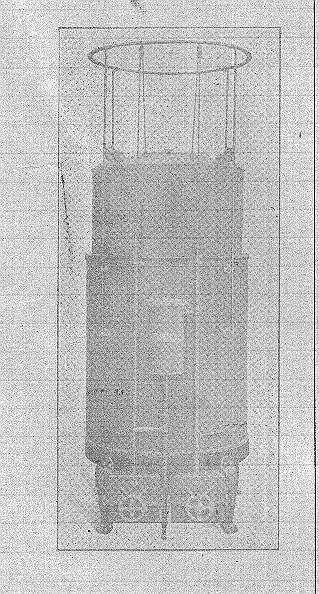

G. A. Tankard made acetylene generators called “Sunlight” c. 1908. This type of lighting was installed in the White Hart in 1908, (see “Inns” White Hart”). It was installed in the Methodist Church and Park House/Plainville, Leeds Library on Commercial St. Leeds, which still can be seen. Allison Tankard, the father of G.A. Tankard, also built his own home Fountain Villa on Arthington Lane in 1901 and Wharfe View in 1907 and the two houses on Mill Lane, Elsinor and Balgowie for his daughters. Allison Tankard was a drawing master at St. Matthew’s Technical School in Leeds. In his youth he had been one of only three prize winners in a designing competition open to the world. Whilst at Leeds he invented a kiln for burning the colours in glass. His son Aldi and grandson Rowland, maintained the privately owned Pool Water Works system from c. 1933 to 1980 when Bernard Bolton took over. (see Families of the Past.)